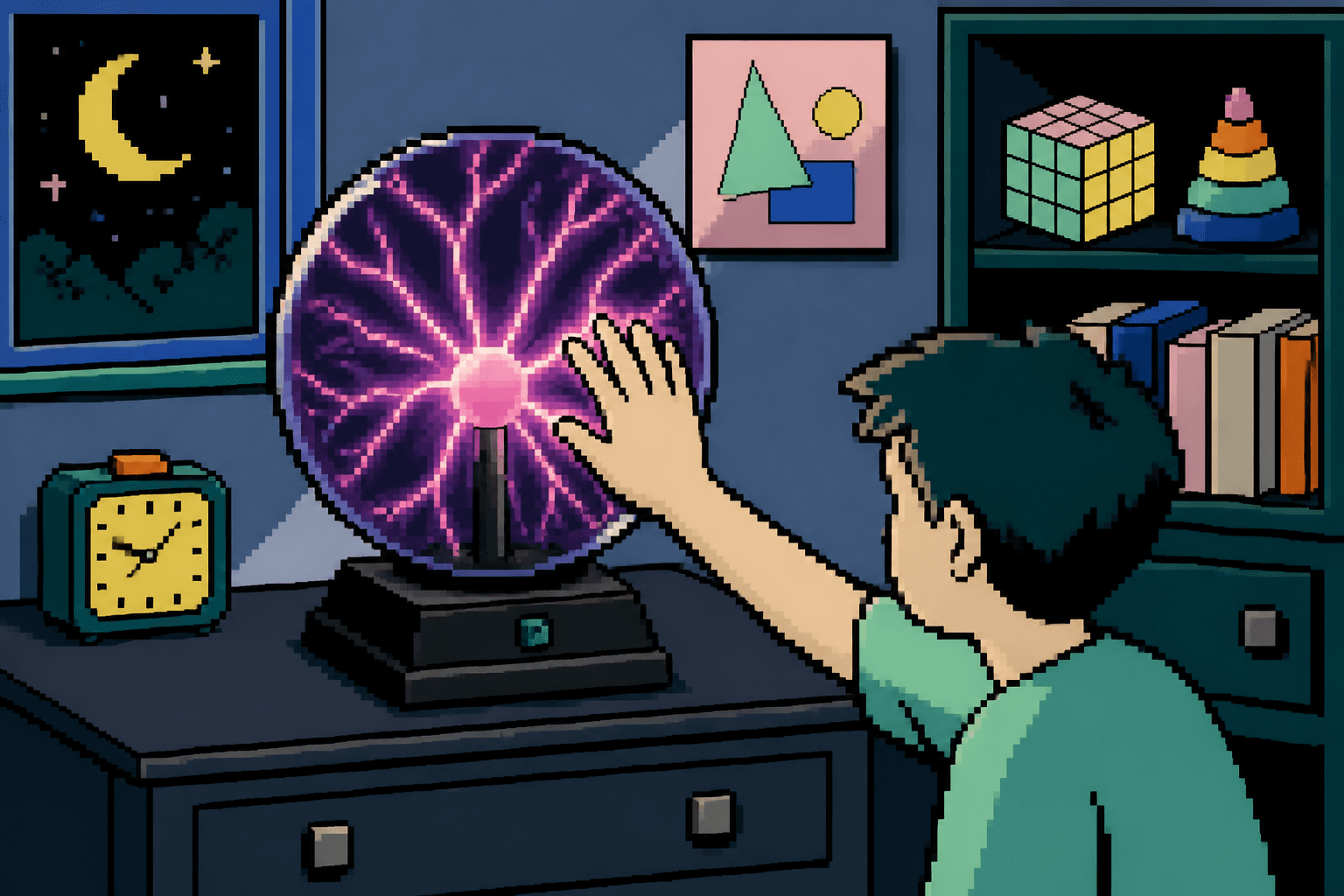
You turned off the overhead light. You sat cross-legged on the carpet. You put one finger on the glass.
The lightning came to meet you.
The plasma ball was the one thing in your bedroom that responded. Not the lava lamp, which did its own thing on its own schedule. Not the Magna Doodle, which was a magnet pretending. The plasma ball was aware. You touched the surface and inside the glass a thin pink-purple vein of electricity bent across half a universe to come find your fingertip. You moved your finger. It followed.
You were pointing at weather.
The Mall Origin Story
Every plasma ball in America came from one of three places. Spencer's Gifts, Natural Wonders, or The Sharper Image. Spencer's sold it next to the lava lamps and the fiber optic flowers, with "EYE OF THE STORM" on the box in a font that was trying hard. Natural Wonders sold it under better lighting, next to the geode slices, with a slightly cleaner box and a slightly higher price. The Sharper Image sold the one your friend's dad had in his home office, an upgraded version that was twice the size and made the room smell faintly like a breaker that was about to pop.
The box always said science. The word "plasma" was there. Sometimes "ionized gas." Sometimes a line about Nikola Tesla. Nobody was fooled. The box was selling a lamp. The parents who bought it for their kid's birthday thought they were giving them a physics kit. The kid got a lamp. Both parties were satisfied.
The box was selling a lamp. The parents thought they were giving a physics kit. Both parties were satisfied.
The small one was forty bucks. The good one was sixty. You wanted the eight-inch, and your parents said the four-inch was fine, and the four-inch was fine, but the eight-inch was better and you knew it.
The One Trick
The plasma ball did exactly one thing, forever.
You touched the glass, and a tendril thickened and bent toward your finger. You moved your hand, and the tendril tracked. You flattened your whole palm against the surface and the inside of the globe became a hand-shaped glow. You dragged your finger across the top, and the lightning dragged with you like the point of a stylus on a slow screen.
That was it. That was the whole thing.
You never got bored of it.
It was the responsiveness that did it. Everything else in the room was passive. The glow stars on the ceiling were just glow stars. The alarm clock told the time whether you looked at it or not. The TV was going to show you Doug no matter what you did. The plasma ball, uniquely, was paying attention. It wanted your hand. You moved; it moved. You were in a conversation with a glass ball full of noble gas and it was the most reciprocal relationship you had going at age eleven.
The Fluorescent Bulb
Here is the thing nobody prepares you for the first time it happens.
Your friend walks into your room. Your friend has brought a loose fluorescent tube, the kind you'd have to steal from a garage or the back of a classroom, and he does not explain. He just holds it next to the plasma ball.
The tube lights up.
It is not plugged into anything. It is a tube in a boy's hand. And it is glowing. Not full brightness - a sort of ghostly, uneven glow that fades toward the ends - but lit. You stare at it. Your friend stares at you staring at it. "Yeah," he says, with the exact tone of someone who has already shown this to three people today. "It's the field."
The field.
You do not know what the field is. You have not taken physics yet. You are in sixth grade and you have just discovered that your bedroom decoration is, apparently, broadcasting electricity through the air into unplugged objects. Nothing about this feels legal.
Your mom calls you for dinner. You go to dinner. You do not mention what just happened. You instinctively understand that if she finds out her son is firing invisible rays into a fluorescent bulb from a sixty-dollar lamp she bought at Spencer's, the lamp will be returned.
- Fluorescent tubes (worked)
- The pink neon bulb from a broken nightlight (worked, faintly)
- A battery (nothing. also: why)
- A butter knife (nothing, but it did give you a small static shock)
- A cat (the cat did not light up. the cat left the room)
- Your friend, through a quarter (nothing, but it tingled)
- A CD (nothing. the CD was unimpressed)
The Hum
If you sat close enough, it hummed.
Not loud. A low, steady electric whine, somewhere between the sound a CRT made when you turned it on and the sound a mosquito made from the other side of the screen door. You only heard it in a quiet room. If the TV was on, no hum. If anyone was talking, no hum. But at night, with the overhead light off and your head about eight inches from the glass, there it was. A noise coming out of a lamp.
A low, steady electric whine. The sound of a lamp that was, for want of a better word, thinking.
Nobody warned you about the hum. The box did not mention a hum. You assumed every plasma ball did it, and that was mostly true, but it was also true that the cheap ones hummed louder, and the one in your cousin's room was so bad you could hear it through the wall, which meant your cousin slept next to a lamp that was technically making noise at him for eight hours a night.
Nobody considered this strange. It was the nineties. Everything hummed. Your refrigerator hummed, your television hummed, your dad's shaver in the bathroom hummed, and now there was a lamp humming in a slightly more sinister key. You adapted.
The Second Layer
Here is what we didn't understand.
The plasma ball was not, actually, lightning. It wasn't magic. It was a glass sphere with a small Tesla coil inside, and the "lightning" was electrified gas - mostly neon and xenon and other things your parents would have called "those weird gases" - being excited into a glow by a high-voltage field. Your fingertip, pressed against the glass, provided a weak ground path. That's a sentence I would not have been able to produce in 1996, and yet it was happening to me daily.
That's what the fluorescent tube trick was. The field was strong enough to excite the gas inside the tube, same as it excited the gas inside the globe, because the tube was also a glass tube full of noble gas waiting to be told to glow. We were doing physics. We did not know we were doing physics. We thought we were doing magic.
This is what the box meant by science.
Why It Mattered
I'm not going to overclaim this, because it was a lamp. But there was something specific about how the plasma ball worked that was, now that I think about it, slightly profound.
Everything else in a nineties bedroom was one-way. The posters were posters. The CD player played CDs. The TV talked and you listened. Even the Magic 8 Ball, which pretended to be interactive, was just a yes-or-no die floating in blue sludge. You asked it something, it told you something, and the loop closed.
The plasma ball was a continuous loop. You moved, it moved, you moved again, and the loop never closed. It would still be doing it after you stopped. The tendrils didn't know you had left. They were just reaching toward the glass, looking for a finger that was no longer there, and if you glanced back at the dresser from across the room you'd see your bedroom's smallest storm still twitching toward where your hand used to be.
I liked that.
I don't think I articulated it at the time. At eleven I would have said I liked it because the lightning was cool. But what I actually liked was that the room had something in it that behaved like it noticed me. Nothing else in my life worked that way. The adults were busy. The TV didn't care. The cat had made its position clear. But here was this purple-glowing responsive thing that waited patiently on my dresser until I came back to touch it, and when I did, it reached up, every time, like a thing glad to see me.
The End of the Plasma Ball
Mine died. Yours probably did too.
The bulb in the base burned out, and the whole thing went dark, and you flipped the switch and there was no hum and no purple and just a glass ball on a plastic base sitting on your dresser. You asked your mom if you could get a new one. She said "we'll see," which was mom code for no. You moved it to the closet. Eventually it broke, because glass does, or it got donated when you moved to college, because things do.
What you do not realize at the time is that you will not get another one. Plasma balls are still made. You can still buy them. But you are not going to, because you are an adult, and the whole deal with adult life is that things that were once magical become line items. The plasma ball is one of those. You cannot buy wonder at Spencer's. You cannot, specifically, buy being eleven in your bedroom with the lights off and your finger on a glass ball that was reaching toward you.
You cannot buy wonder at Spencer's. You cannot buy being eleven in your bedroom with the lights off and your finger on a glass ball that was reaching toward you.
But you had it. For a few years, you had a small purple storm on your dresser, and it knew you were there, and when you touched it, it answered.
That's a lot, for a lamp.