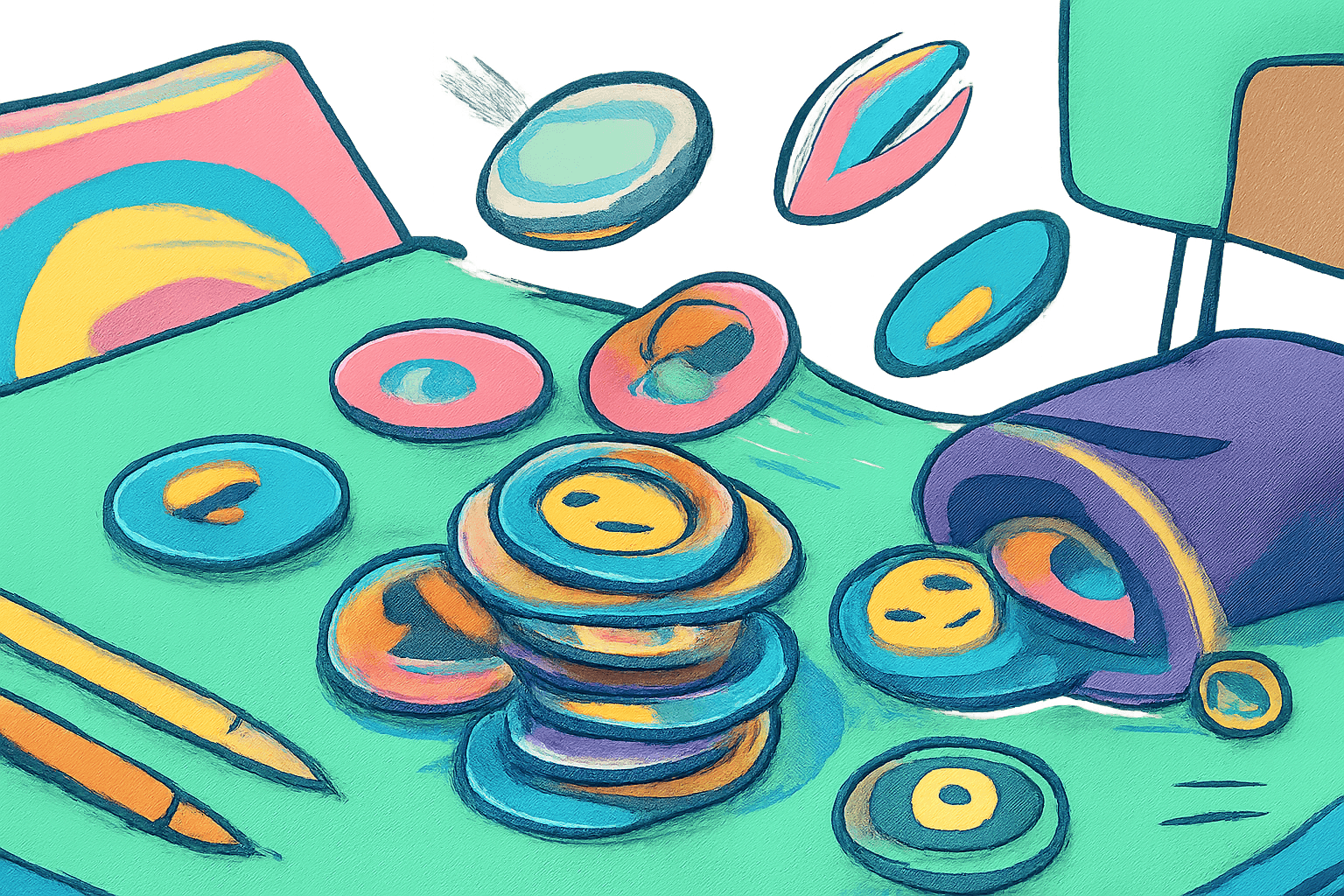
Somebody brought a Crown Royal bag to school.
Not a kid from your class. A sixth grader. He dumped it out on the lunch table and about two hundred cardboard discs clattered out in a slow-motion waterfall, and then a heavier sound - a specific, dense thunk - as the slammer hit the wood. He reached into the pile and picked it up. Brass. Not painted brass. Actual brass. Heavy the way a roll of quarters is heavy. He had wrapped it in a folded paper towel, which he unwrapped slowly, like a magician.
You were nine. You understood, immediately, that this was a person who had access to things you did not.
The Basics, For the Record
Pogs were cardboard discs, about the size of a milk cap, because that is what they originally were. The name was short for Passion fruit, Orange, Guava - a juice bottled in Hawaii, whose cap had been used in a playground game for fifty years before anyone on the mainland heard about it. Then in 1993 a schoolteacher named Blossom Galbiso reintroduced the game to her class, and about eighteen months later every third grader in Ohio had a shoebox full of them.
Here is how the game worked. You stacked a bunch of pogs face down. Your opponent stacked a bunch of theirs on top. You each took turns dropping your slammer - a thicker, heavier disc - onto the stack. Whatever pogs flipped face up, you kept. The rest went back in the stack. You played until the stack was gone.
This was, if you read it closely, gambling. Actual gambling. You were putting an asset you valued into a pile, and based on the physics of a heavy object hitting a lighter object, you were either going to leave with more assets or fewer assets. Nine-year-olds, across the country, in denim overalls, were running informal gaming parlors at their own desks. The principals of America figured this out about fourteen months in. More on that later.
Nine-year-olds, in denim overalls, were running informal gaming parlors at their own desks. The principals of America figured this out about fourteen months in.
The Pogs Themselves Were Not the Point
You had pogs with Tasmanian Devil on them. Pogs with marijuana leaves that were immediately confiscated. Pogs from Sizzler that said 'SIZZLER' across a flaming S. Pogs with holograms that were technically not pogs but let's not litigate that. Pogs from the back of a cereal box. Pogs that came in a little tube with a free Slurpee. Pogs that your dentist gave you along with a toothbrush, as if he had a surplus. Pogs that said 'GOT MILK' and featured a celebrity whose face you did not recognize.
There was no real scarcity system. They were cardboard. They cost nothing. A local print shop could run a sheet of them for a dollar. Which meant the entire currency was fundamentally unstable - every kid had hundreds, they were printed on lunch boxes, they were, in the strict economic sense, fiat nothing.
But you sorted them. You organized them. You kept the cool ones in a separate stack with a rubber band around it. You had a pog of the Power Rangers that you would not play for, under any circumstances, and you would inform your opponent of this fact up front. You were nine and you were already making the distinction between currency and capital.
The Slammer Is Where the Money Was
The slammer did the work. The slammer did the gambling. The slammer was the thing that hit the stack, and its weight, its shape, its metal content - these determined your life.
There were tiers.
The plastic slammer came in the three-for-a-dollar bag at the drugstore. It was the size and density of a hockey puck made of pool-toy material. It floated. Literally. You could drop it in a bathtub and it would bob. When it hit a pog stack, it made a sound like a wet slipper on a tile floor. It flipped nothing. It disturbed the stack's aura and that was it.
The heavy plastic slammer was the real tool of the people. Dense, solid, maybe an ounce and a half, often printed with a dragon or a dolphin or a logo for a mall that had already closed. This was the slammer you actually played with. This was the slammer your mom bought you. This was a slammer that communicated I am serious but my parents are not going to spend sixteen dollars on a child's toy.
The metal slammer was the moment things got real. Usually a steel disc, sometimes a painted alloy, clearly violating every rule the teachers had not yet thought to write. When a metal slammer hit a stack, the stack came apart like a demolished building. Pogs went everywhere. You had to chase them. Kids would gather. It became an event.
And then the brass slammer. The sixth grader's slammer. The one wrapped in a paper towel. The one that weighed more than some fish. When a brass slammer hit a stack, the table shook. Pogs didn't flip, they rose and fell like a cartoon explosion. You could see the wood of the desk depress slightly. You could feel it through your shoes. A brass slammer was either a family heirloom or it had been taken, illegally, from a hardware store.
Nobody admitted where their brass slammer came from. That was part of the brass slammer.
- Plastic (free): Your parents bought one tube of slammers at Rite Aid and thought that was the end of it
- Printed plastic: You had an older sibling explaining the game to you
- Painted metal: You'd been to the mall specifically for this
- Brass: Someone in your life worked with plumbing and didn't ask questions
- A silver dollar wrapped in tape: You played dirty and everyone knew it
- A D battery: You were banned from the lunch table and you knew why
The Bag Was the Statement
Every serious kid had a bag. Not a backpack. A bag. For just the pogs.
The Crown Royal bag - the purple velvet drawstring bag that came with a bottle of Canadian whiskey your dad didn't even drink - was the gold standard. Nobody questioned how a fourth grader had acquired it. Your dad had a bottle once, sometime in 1989, to celebrate a promotion, and then the bag sat in a kitchen drawer for six years, and then one day you noticed it, and your dad said yeah you can have that, and now you were a titan.
The Crown Royal bag was the gold standard. Nobody questioned how a fourth grader had acquired it. The pogs fit perfectly. The drawstring held. The velvet was cool.
The pogs fit perfectly. The drawstring held. The velvet was cool in a way the other bags were not cool. Girls had pink drawstring pouches from Claire's. Some kids had tins that used to hold cookies. One kid kept his in a spare Tamagotchi box, which nobody respected. But the Crown Royal bag - that was a flag. A statement. The boy, my dad has been to the liquor store flag.
The Bans
In 1995, a school district in San Jose banned pogs. Then a district in Chicago. Then about forty more. The reasoning, if you read the actual news articles, was straightforward: children were showing up to class with sixty-dollar metal slammers, losing them to other children during unstructured play, and then crying about it to their parents, who were calling the principal. A game where you won and lost things of real value and your parents had to hear about it was - it turned out - a thing schools were not prepared to mediate.
The ban notices went up. No pogs on school property. Pogs confiscated on sight. Slammers - especially metal slammers - escalated directly to the office. A kid in my grade got a metal slammer taken, and his dad had to come pick it up in person, and his dad was furious at him, and then five minutes later furious at the school, and it was unclear which party was going to win the argument.
We moved the game to the lunch line. Then the bus. Then behind the portable classrooms during recess, where there was a small strip of pavement just out of a teacher's sightline. The game got more intense, the way anything does when you're not supposed to be doing it. A kid lost his entire collection to a sixth grader one day. He cried in the bathroom. It was, by any reasonable standard, a tragedy.
The Disappearance
Here's what I can't explain. Sometime around the end of fourth grade, and for no reason anyone could articulate, we all just stopped.
Nobody decided. Nobody made a speech. One week we were playing every day at lunch. Two weeks later, the Crown Royal bag was in the back of a closet and we were talking about something else. Beanie Babies, maybe. The new Goosebumps. Whatever came next. The pogs sat in the bag. The brass slammer sat in its paper towel. Time moved on and pogs did not come with us.
I've tried, as an adult, to understand how a cultural phenomenon that was that universal, for that short a period, just evaporates. I don't think I have an answer. It was a bubble and it popped. The fundamentals were bad. The cardboard was worthless. The slammer was a rock. The game was luck dressed up as skill, and as soon as one kid realized that, the rest of us realized it within about seventy-two hours.
The Garage
My parents moved a few years ago and my mom gave me a shoebox.
Inside, not labeled, were about two hundred pogs. A plastic slammer with a dolphin on it. A painted metal slammer I had absolutely no memory of acquiring. And the Crown Royal bag, empty, folded flat, the drawstring still intact.
No brass slammer. I don't know what happened to it. It's possible I gave it to someone. It's possible someone took it. It's possible I lost it the same way I lost everything else that mattered for a summer in 1995. A brass slammer is out there, in the world, in someone else's shoebox, in someone else's garage. That's nice to think about, actually. That it's somewhere.
The pogs were not good. The game was not good. The slammer, objectively, was a disc of metal a child should not have been allowed to carry. But for about twenty months, between the end of third grade and the middle of fifth, I walked into school with a velvet bag over my shoulder and a brass disc in my pocket, and I felt like I was carrying something important. And maybe I was. Not the pogs. Not the slammer. The fact that the whole school was in on it. The fact that we had invented, collectively and without adult supervision, an entire economy of nothing. We built it. We ran it. We ran it into the ground. And then we moved on, the way kids do, like it had never been that serious in the first place.