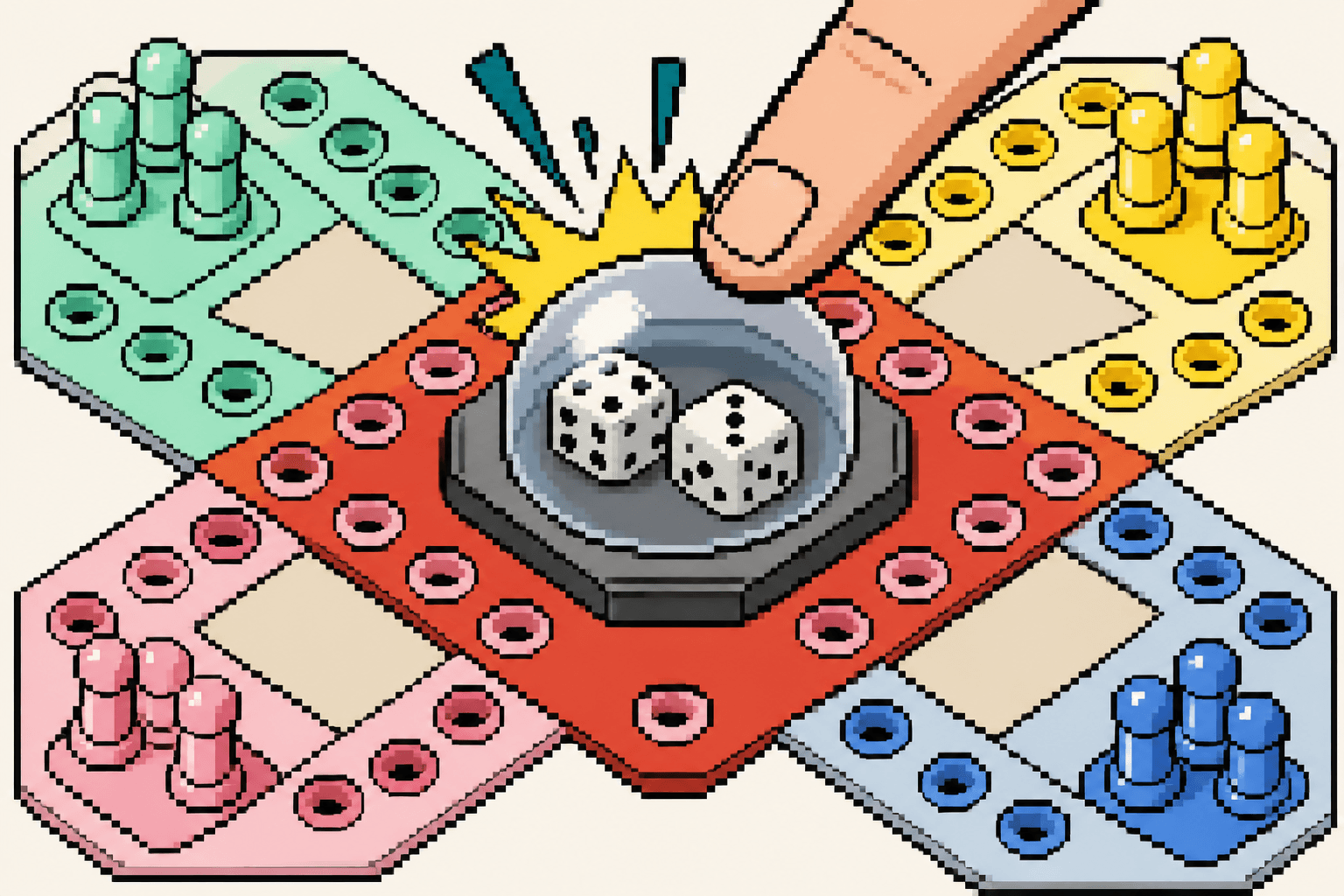
The dice were inside the board.
Not next to the board. Not in a little cup. Not scattered across the kitchen table where you had to reach past your sister's elbow to grab them. They were sealed inside a clear plastic bubble at the center of the board itself, in a small round housing about the size of a hockey puck, and the only way to roll them was to press down on the top of the dome with your palm, and the dome would flex inward, and inside the dome a small spring-loaded platform would kick the dice up against the plastic ceiling, and they would clatter, briefly and satisfyingly, and land.
The bubble was called the Pop-O-Matic. It made a sound. It was named after the sound.
The Object
Trouble was released by Kohner Brothers in 1965 and eventually landed at Milton Bradley, and by the time I was seven, in 1993, it had been on shelves at Toys R Us for basically my parents' entire lives. The game itself was simple. You had four pegs. You raced them around the board. First peg home wins. It was Sorry with fewer feelings and Parcheesi with worse graphic design.
The whole game was engineered around the bubble.
The Pop-O-Matic was, mechanically, one of the more overbuilt objects on a 90s toy shelf. There was the outer plastic dome, clear, dime-store injection-molded. There was an inner platform where the dice sat. There was a spring under the platform. There was a small ring collar around the edge of the dome that clipped it to the board and held the whole assembly together, and if you were the kind of kid who tried to take toys apart to see how they worked, you learned quickly that the Pop-O-Matic was welded shut. It was not designed to be opened. If you got the dice out, you had broken the game.
The Press
You did not roll in Trouble. You popped.
You put your palm flat on top of the dome. Or, if you were showing off, one finger. Or, if you were nine and had a lot of opinions, two fingers pinched together at the top like you were operating a very small elevator button. You pressed down. The plastic flexed a full quarter-inch inward. It resisted. It gave. There was a specific tactile give right before the pop, and if you knew the feel of it you could hover at the threshold and hold the dice in suspense.
Then you released. The spring under the platform snapped up. The dice smacked into the underside of the dome and clattered off each other, sometimes for two seconds, sometimes for four, and there was a small window during which they were bouncing off the walls of the bubble like popcorn kernels, and then they settled, and you had rolled.
There was a specific tactile give right before the pop, and if you knew the feel of it you could hover at the threshold and hold the dice in suspense.
The sound was the whole product. It was crisp. It was contained. It sounded like a small firecracker had gone off inside a Tupperware container. It was, if you were a parent trying to have a Sunday afternoon in the same room as your children, deeply annoying about ten pops in, but a marketing agency somewhere had decided that this was the sound of fun, and they were correct, because I still know exactly what it sounds like thirty years later without playing a track.
The Argument For
The Pop-O-Matic solved a real problem. Dice, in a house with three kids under ten, got lost. Dice rolled under the couch. Dice went in mouths. Dice ended up in the vacuum, in the dog, in a shoe, or in the possession of the sibling who insisted they had already rolled a six even though there was no visible six. The Pop-O-Matic put the dice inside the bubble and welded the bubble to the board, and the dice, for the entire lifespan of the game, could not be lost. Even when the board itself was destroyed by being folded wrong and left in the garage, the Pop-O-Matic was still functional. My mother threw one out in 2004 and swore she heard it pop as it hit the trash.
- Headache (1968). Same company. Same bubble. Barely a different game. The Pop-O-Matic's original spinoff, or perhaps the other way around.
- Perfection. Not a bubble but a timer. Different problem. Same bounded frustration mechanic.
- Sorry Sliders. Late-90s. No bubble. Pucks. Traitorous.
- Trouble: Star Wars Edition. Same bubble. Now it has a Death Star on it.
- Frustration (UK). Literally Trouble with a British name and a slightly domed lid instead of a full bubble. Not the same. Do not @ me.
The bubble also solved fairness. Nobody could shake soft. Nobody could roll off the table. Nobody could claim the die had been tilted. The bubble was a small sealed casino. Whatever came up came up. There was, over the course of a Trouble game, exactly zero disputes about whether the die had come up on a four or a five, and that was, for a house with siblings, worth the whole enterprise.
The Argument Against
The bubble also killed something.
The single best thing about rolling dice, if you are seven, is rolling dice. It is holding two cubes in your fist and shaking them and blowing on them and slamming them onto the table like a hard-boiled craps shooter in a movie you were not old enough to have seen. The bubble replaced all of that with a button press. It was, in the strict mechanical sense, more elegant. It was, in the seven-year-old fun sense, worse. A pop is not a roll. A pop is a machine rolling for you.
A pop is not a roll. A pop is a machine rolling for you.
You never touched the dice. You never held them. If you played Trouble for six years the way I did, you played thousands of rolls and never once made physical contact with a die. The dice inside the bubble had the same relationship to you as the wires inside a light switch. They were the mechanism. You were the user. You pressed the button. The result appeared. The bubble was the first piece of technology I ever used that abstracted away a thing I would later want to have learned how to do.
The Bubble
Press it. Hold it. Wait for the click. The two dice inside are the same two dice as in the boxed game, and they roll the same way, and doubles let you go again. Nobody at your kitchen table is going to congratulate you if you roll a twelve.
The Doubles
Doubles let you pop again. This was the rule. There was no cap. If you were a kid with a favored bubble and a favored spot at the table, you could, on a very good day, roll doubles three or four times in a row, and the resulting sequence of pops was the closest thing to gambling that most of us would experience for another decade. It was, briefly, thrilling.
It also destroyed the pacing of the game. Trouble is not designed for someone to move a peg twenty-four spaces in one turn. But the Pop-O-Matic does not care. The Pop-O-Matic is not a game designer. The Pop-O-Matic is a small machine that produces two numbers between one and six, and if the two numbers happen to be the same, it will happily produce two more, and it will keep doing this for as long as physics allows. Some Trouble games ended in eight minutes. Some Trouble games ended in an hour and forty minutes and a broken piece of the folding board and one crying sibling.
The Failure Modes
The Pop-O-Matic was almost indestructible, but it had exactly two failure modes, and both of them were community knowledge on the playground the way that Konami codes were community knowledge, and the community was correct.
The first was that if you pressed the bubble very slowly, without letting the spring snap, the dice did not move. They stayed exactly where they were. You could re-roll a six-six by not rolling at all. This was cheating, and everyone knew it, and everyone did it once and got called out and never did it again, because your older brother was watching and he was not going to let you get away with it.
The second was that if you pressed the bubble at a specific angle, hard, with one thumb on the north edge, the dice would jam. One would land at an impossible tilt against the wall. The whole board froze. Everybody at the table would lean in. Someone would tap the dome. Someone else would tap it harder. Somebody would eventually rotate the board a full ninety degrees, gently, like defusing a bomb, and the offending die would settle. This was, briefly, more interesting than the game itself.
The Interface
Here is the thing that makes the Pop-O-Matic a real object and not just a novelty. It was, I want to argue, one of the first user interfaces most of us ever operated.
Before you had a mouse, you had a bubble. Before you had a touchscreen, you had a bubble. Before you had a start button on a Sega Genesis, you had, for many years, a small clear dome that you pressed with your palm to make a machine produce a number. The Pop-O-Matic was a button that did a thing, and the thing it did was hidden inside the plastic, and the plastic was the entire experience. There was no debug mode. There was no way to see the mechanism. You pressed. It popped. A number appeared. This was, in retrospect, exactly how every piece of technology after 1995 was going to work.
We just did not know it was training us.
- Press the button. Something will happen. You do not need to know why.
- The result is not up to you. It is fair. Or at least it looks fair.
- If it jams, tap it. If tapping does not work, wait. If waiting does not work, restart.
- Doubles are a bonus. Bonuses are a hook. Hooks make you press the button one more time.
- The machine does not care how much you needed a six.
The Discontinuation That Didn't Happen
The good news, if you are attached to the Pop-O-Matic, is that Trouble is still in production. You can walk into a Target in 2026 and buy a Trouble box with the same bubble on it. The bubble is slightly larger now. The dice are slightly different. The board has been rethemed at least a dozen times, and there is a version tied to whatever movie franchise the license was cheap on that quarter, and none of it matters, because the object at the center of the box is still a clear plastic dome with two dice underneath it and a spring under the platform.
Hasbro figured out, correctly, that the Pop-O-Matic was the game. Trouble is not really about racing pegs around a board. Trouble is about pressing the bubble. You could remove the peg racing entirely and just leave the bubble, and you would still, at the end of an evening, have pressed the bubble two hundred and forty times, and you would have had, more or less, the same experience.
Which is, I think, the honest thing to say about a lot of the toys we remember.
The Empty Bubble
The Trouble box I grew up with was thrown out around 2003 when we moved houses. The board was warped. The peg holes were stripped. Two of the yellow pegs had been chewed by a dog and one by my little sister, and the box lid was held together with masking tape. But the Pop-O-Matic still worked. The last thing my mother did before putting the box in the trash, she told me on the phone recently, was press the bubble one last time.
She said it popped. She said the dice landed on a four and a three, which is not a very memorable roll, but she remembers it. She also remembers, and this is the part that I keep coming back to, that she felt slightly bad putting it in the trash, because the bubble still worked, and things that still work are supposed to be kept.
But there was nowhere to keep a Pop-O-Matic without the rest of the game around it. The bubble by itself is not a toy. It is a component. It is the good part of a larger thing. Take it out of the board and it is just a small piece of plastic that clicks. And so it went in the trash, along with the board and the pegs and the chewed yellow one, and there is no ceremony for that. Nobody writes an obituary for a board game. You just, at some point in your thirties, sit down and write six pages about a plastic dome and pretend you are making an argument.
The argument is this. The bubble was fine. It was a small machine that did one thing, and it did it well, and it taught us a small thing about the shape of the world without us noticing. And then we grew up and started pressing other bubbles, and we forgot.