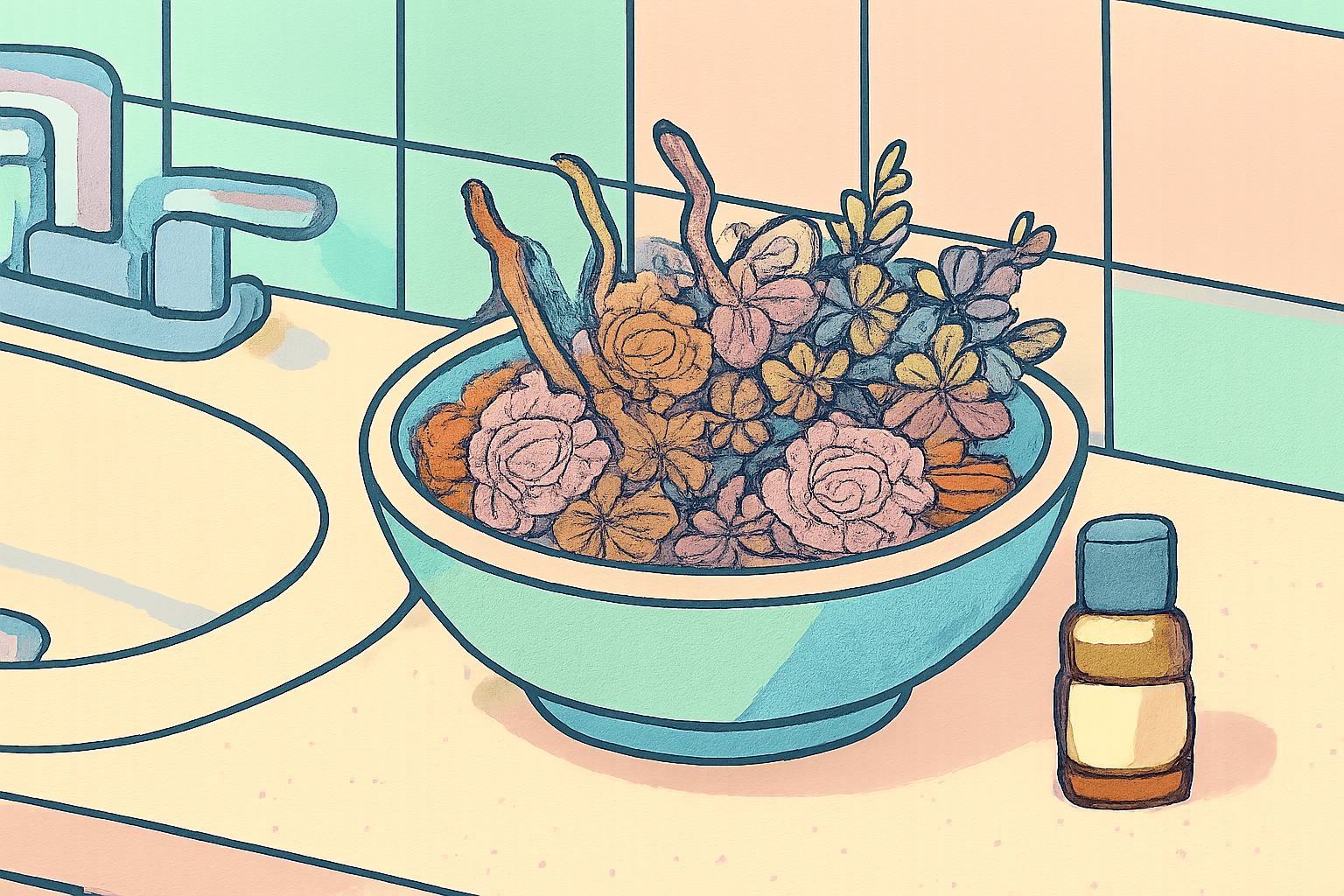
It sat on the back of the toilet. Or the shelf above the towel rack. Or the little table in the hallway that existed only to hold things your mother had placed there with intention. Wherever it was, it had been there since before you could remember, and it would still be there when you left for college, and you never once - not a single time in your entire childhood - saw anyone touch it, move it, refresh it, or acknowledge its existence in any meaningful way.
The potpourri bowl. A small vessel - usually wicker, sometimes ceramic, occasionally a wooden box with a hinged lid and small holes drilled in the top like it was trying to breathe - filled with a collection of dead plant matter that had been marketed as a fragrance solution.
You know exactly what was in it because they all had the same things. Dried rose petals. Tiny pinecones the size of your thumbnail. Some kind of curly twig that looked like it had been through something. A few star anise pods. Wood shavings that might have been cedar. And at the bottom, hidden beneath the decorative decay, a handful of those weird little brown balls that nobody could identify - not seeds, not berries, not anything with a name a child could access. Just spheres. Organic, mysterious, dusty spheres.
For approximately eleven days after purchase, a potpourri bowl smelled like something. After that, it smelled like the room it was in, and the room it was in smelled like nothing, and that was the arrangement for the next decade.
The Purchase
Nobody went shopping for potpourri. It arrived. It showed up the way throw pillows showed up, the way the wreath on the front door changed with the seasons, the way one day there was suddenly a decorative plate propped up on a little stand on the dining room hutch. Your mother went somewhere - a craft fair, a Pier 1 Imports, a friend's Avon party, a HomeGoods that hadn't yet learned to call itself that - and she came back with a bag of dead flowers in a cellophane wrapper and a small glass bottle of essential oil, and by dinner the bathroom smelled like a lavender field that was also somehow a forest.
The oil was key. The oil was the whole promise. You were supposed to put a few drops on the dried flowers every couple of weeks to "refresh the scent," and your mom did this exactly twice. Once when she set it up, with great ceremony, arranging each petal and pinecone with the focus of a florist. And once more, maybe a month later, when she remembered the bottle existed. After that, the oil went under the sink next to the backup hand soap and the cleaning supplies and it stayed there, half-full, for the remaining duration of your childhood.
The Smell Arc
Let's be honest about the timeline.
Days 1-3: Genuinely pleasant. Walking into the bathroom felt like entering a spa, if spas were six feet wide and had a toilet in them. The scent was real, it was present, and it made your mother visibly satisfied. She might mention it. "Doesn't it smell nice in here?" Yes. It did. It actually did.
Days 4-11: Still detectible if you were paying attention. A fading note. Something you could catch if you leaned in close, which nobody ever did, because nobody leans into a bowl of dried flowers on purpose.
Days 12-45: The ghost phase. You'd walk in and think maybe you smelled something, but you might also have been smelling the soap or the towels or the memory of what the room used to smell like. The scent was now more idea than reality.
Day 46 through the end of the Clinton administration: Nothing. The bowl smelled like dust and ambient bathroom. The petals had faded from their original burgundy and lavender to a universal shade of pale brown. The pinecones had become so dry they'd crumble if you squeezed them, which you knew because you'd tried once, and a small pile of pinecone dust sat at the bottom of the bowl like evidence of a crime you committed in 1997.
The potpourri stopped being a scent product and became furniture. It sat there with the same permanence as the towel rack. You would sooner question the toilet than question the bowl.
The Ecosystem
Over time, things happened in the bowl. Small things. Quiet things. Things nobody noticed because nobody was looking.
A spider built a web between two of the curly twigs. It was a tiny web, almost decorative itself, and it lasted for months because nothing disturbed it. Dust settled on the petals in a fine, even layer, giving everything a matte finish that actually made it look more intentional, more artisanal, as if the bowl had been styled by someone who understood that decay was a design choice.
One of the star anise pods split open at some point and released a single seed onto the bathroom counter. Your mother wiped it away without comment. A petal fell out - maybe from the cat brushing against the shelf, maybe from the simple entropy of being a dead flower for six years - and it sat on the tile floor for three days before anyone picked it up.
The bowl had become a small, neglected biome. Not alive, exactly, but not entirely still. It existed in the liminal space between decoration and compost, maintained by nothing, disturbed by no one, persisting through sheer indifference.
The Pier 1 Imports Connection
We need to talk about Pier 1. Because Pier 1 Imports was the Vatican of potpourri. The mothership. You walked in and the smell hit you from the parking lot - not one potpourri but fifty, all competing in a floral cage match, layered and overlapping until the air itself felt thick with botanical aggression.
- Lavender Fields (the default)
- Country Apple (aggressive)
- Ocean Breeze (liar)
- Vanilla Spice (holiday only)
- Rose Garden (your grandmother's pick)
- Something called "Rainforest" that smelled like a candle store, not a rainforest
The potpourri section was usually near the front. Big open bins of it, loose, where you could run your hands through the dried flowers like you were panning for gold. There were little scoops, and bags, and the whole thing operated on an honor system of self-serve aromatherapy. Your mom would hold a handful up to her nose, eyes closed, considering. She was choosing a scent that would define a room for the next decade, even if she didn't know it yet. Every handful smelled almost identical. She'd pick one anyway. She always picked lavender.
Why Nobody Replaced It
This is the part I keep thinking about. The bowl never got replaced. The flowers were dead. The scent was gone. The petals had faded to the color of old newspaper. And still it sat there, year after year, through the late nineties and into the two-thousands, through three presidents and two bathroom repaintings and the full arc of your adolescence.
And the reason is simple and a little sad: it had become invisible. The potpourri bowl had been there so long that it had stopped being a thing anyone saw. It was part of the visual texture of the room, like the grout between the tiles or the light switch plate. Your brain edited it out. You could describe your childhood bathroom in detail - the color of the walls, the pattern on the shower curtain, where your toothbrush lived - and you would forget to mention the potpourri. It was present the way silence is present. You only notice it when it's gone.
The Day It Finally Disappeared
I don't know when my mother got rid of the potpourri bowl. I didn't see it happen. There was no ceremony. No announcement. One visit home it was there - same shelf, same faded petals, same tiny pinecones in their eternal arrangement - and some visit later it wasn't. Replaced by nothing. Just an empty spot on the shelf, or maybe a candle, or maybe the shelf itself was gone because the bathroom had been redone and the new one had a clean, modern look that didn't include a wicker bowl of dried plant matter from the first term of the George W. Bush administration.
I noticed its absence the way you notice a word has been removed from a sentence. Something was off. Something was missing. But it took me a full five minutes of standing in that bathroom to figure out what it was, which tells you everything about how present and how invisible that bowl had been, simultaneously, for my entire life.
The Thing About the Potpourri
Here is what the potpourri bowl actually was. It wasn't about the smell. The smell was a premise, not a purpose. It was about having a room that looked considered. It was about a woman - your mother, your grandmother, your aunt - putting something in a space that said: I have arranged this. I have thought about how this room looks and feels. This isn't just a bathroom. This is a bathroom that someone curates.
The potpourri was proof of care. Dusty, faded, scentless proof - but proof. It said the same thing as the decorative soaps and the folded towels and the little framed print on the wall. It said: someone lives here who notices. Someone lives here who tries.
The bowl was never really about the flowers. It was about the kind of person who puts flowers in a bathroom and calls it done and means it.
I bought a candle for my bathroom last year. A nice one, from a place that takes candles seriously. It smells like fig and cedar and something vaguely Mediterranean, and I light it sometimes when I remember, and it makes the room smell good for an hour or two, and then it goes back to smelling like nothing. It's better than potpourri in every measurable way. But sometimes I think about getting a small bowl - wicker, maybe - and filling it with dried flowers and tiny pinecones and those weird little spheres, and putting it on the shelf, and letting it sit there. Not for the smell. Not even for the look. Just to have something in a room that says: someone here is trying. Someone here noticed this empty shelf and decided it should hold something beautiful, even if the beauty fades, even if nobody sees it, even if it lasts forever only because nobody remembers to throw it away.