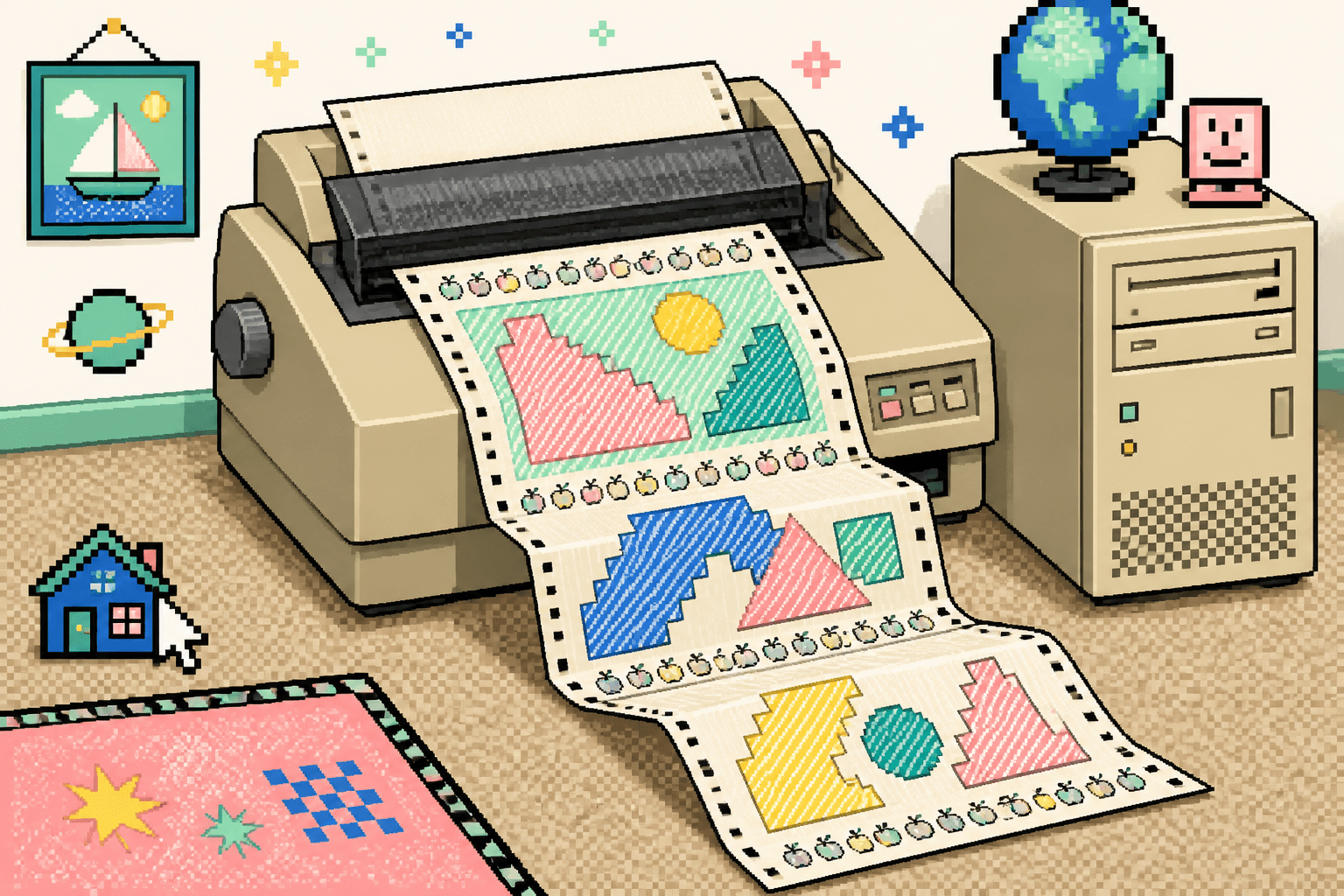
The printer made a sound like a dental drill chasing a sewing machine. It started at 5:47 PM on a Saturday and it stopped at 6:31 PM, when it ran out of perforated paper halfway through the second N in CONGRATULATIONS. Dad had to refill the tractor feed. He lined up the sprocket holes wrong. The printer chewed up half a sheet, then resumed, slightly off-axis, so the bottom border - a band of repeating apples - was now a quarter inch lower than the top border, which was also a band of repeating apples but somehow not the same apples, because you had picked apples once during the wizard and then forgotten which border you'd picked and so you'd picked apples again, but a slightly different shade of apple.
You did not notice this. Nobody noticed this. The banner went up.
The Software
The Print Shop was the program. It came on three floppies, or a CD, or it was already on the Packard Bell when you got it because Dad's coworker had installed it from his own copy. The icon was a tiny printing press. You double-clicked the printing press and a wizard opened, and the wizard asked you what you wanted to make.
There were four products. A Greeting Card. A Sign. A Letterhead. And a Banner. The Banner was the only one that mattered. The Banner was why you turned on the computer.
You clicked Banner. The wizard walked you through five steps with little Next > buttons in the lower-right corner. Step 1 was Choose A Border. Step 2 was Choose A Font. Step 3 was Type Your Message. Step 4 was Add A Graphic. Step 5 was Print. There were thirty options at each step. You took forty-five minutes.
The Borders
The borders were tiny black-and-white drawings, twelve pixels tall, that would repeat themselves across the top and bottom of your banner in an unbroken chain. They were categorized. Birthday. Christmas. Valentine's. Generic. There were apples. There were balloons. There were small running animals you could not identify. There was a border of dancing question marks. There was a border of pencils. There was, for some reason, a border of golf clubs.
You picked the apples because the apples were first. You picked the apples every time. Everyone picked the apples.
The apples were a band of small woodcut-looking apples with a single leaf each, repeating across an unknowable distance, and they were perfect. They were the apples.
The Fonts
The fonts were not fonts. The fonts were banner fonts. This is a distinction. A regular font has a shape. A banner font has a shape and a fill and a border and a 3D effect built into the letter itself, baked in, non-negotiable.
You could pick Block. You could pick Bulletin. You could pick Old English. You could pick Stencil. You could pick the one that looked like it was made of balloons. You could pick the one that looked like it was made of ice cubes.
Block was the default. Block was a thick, condensed sans-serif with a diagonal stripe pattern inside each letter, like the letters had been cut out of fiberglass insulation. Block was the font. Everyone who has ever seen a homemade banner has seen Block.
If you were feeling adventurous you picked Bulletin, which was Block but with a drop shadow.
The Message
You typed your message. The wizard had an input box about three characters wide. You typed HAPPY BIRTHDAY MOM. The box scrolled. You typed it again to make sure the spelling was right. You hit Next.
The wizard told you the message was too long to fit on one page and asked if you wanted to print it across multiple pages. You said yes. The wizard told you the message was going to be five pages. You said okay.
You did not think about what five pages of dot matrix paper meant. Five pages of dot matrix paper meant five feet. You were printing a five-foot banner. You did not understand this yet.
The Graphic
Step Four was optional. Step Four ruined everything.
You added a clipart of a cake. The clipart was nine pixels of recognizable cake on top of seventy pixels of beige rectangle. The wizard told you that adding a graphic would make the banner three sheets longer. You said okay. The banner was now eight pages.
The banner was now eight feet.
The banner was now eight feet. You did not understand what eight feet meant on a printer that printed at the speed of a person dictating the alphabet.
You did not understand what eight feet meant on a printer that printed at the speed of a person dictating the alphabet. You clicked Print.
The Print
The dot matrix printer was a beige rectangle the size of a microwave. It sat on the floor next to the computer desk because it did not fit on the desk. It was connected by a parallel cable as thick as a garden hose. It had a continuous-feed paper tray on the back, holding a folded accordion of pin-fed paper that you'd bought at Office Depot in a brick of two thousand sheets.
You pressed Print. The printer woke up. It made a small clunk. Then the head moved to the left margin and the printing began.
It was loud. Bzzz-shrkkk. Bzzz-shrkkk. Bzzz-shrkkk. The print head was a row of nine pins. Each pin was a tiny solenoid. The head moved across the paper, the pins firing in patterns, the paper advancing one ninth of a line at a time. A single capital H took, depending on the font, four passes of the head. A line of seven letters took, optimistically, eight seconds. A banner of HAPPY BIRTHDAY MOM in giant Block letters with apples and a cake took forty minutes.
You sat next to the printer. You watched. There was nothing else to do. You could have done your homework. You did not do your homework. You watched the banner emerge, one ninth of a line at a time, like an extremely slow image download on an extremely literal computer.
The Tear
When the printer finally stopped and the head returned to home and the room went quiet - the way a kitchen goes quiet when the dishwasher ends - you picked up the front of the banner. You pulled it gently across your bedroom, careful not to tear the perforations, which were the lines where you were supposed to be able to fold the pages, but were also the lines where the paper would rip if you were too rough.
You ripped off the side strips. The tractor-feed edges, the columns of holes, one quarter inch wide on each side, came off cleanly, in long ribbons, if you were lucky. If you were unlucky, they came off in fragments and took a little bite of your banner with them, removing one of the apples from the border. You found one of those apples on the carpet a year later, under the desk, still attached to a curl of perforated paper.
You held the banner up. It was eight feet long. It was a paper accordion with HAPPY BIRTHDAY MOM in giant blocky letters and a row of apples on top and a row of apples on the bottom and a 70-pixel cake in the middle. It looked exactly like a banner.
You taped it to the dining room wall with masking tape. The corners curled up. Mom said it was perfect.
The Math
You had spent forty-five minutes setting it up and forty minutes printing it. You had used about a tenth of a fresh ink ribbon, which would need to be replaced in four months for $14.99 from Office Depot. You had used eight sheets of pin-fed paper out of two thousand. You had monopolized the family computer for an hour and twenty-five minutes, during which your brother could not play Carmen Sandiego, which you knew because he stood in the doorway and said so three times.
You could have written HAPPY BIRTHDAY MOM in marker on a piece of poster board in three minutes.
You did not do this. You did not think of this. You did not want to do this. The hand-lettered banner was not a banner. The hand-lettered banner was a sign. The Print Shop banner was a banner. The banner had borders, and a font, and a print queue, and a perforated edge that you had personally torn off. The banner had taken effort in a very specific way. The banner was unambiguously a product of the family computer, which was the proof that you were a family that had a computer.
The hand-lettered banner was not a banner. The hand-lettered banner was a sign. The Print Shop banner was a banner.
The Cake
The cake graphic, the one Step Four had asked about, almost always ended up wedged into the middle of the banner, between the words. The wizard placed it for you. If you typed HAPPY BIRTHDAY and added a cake, the banner came out as HAPPY [cake] BIRTHDAY [cake]. If you added two graphics, the wizard distributed them. The wizard was, in this sense, a designer. The wizard had opinions about graphic placement and you, an eleven-year-old, did not overrule the wizard.
You let the wizard cook.
The cake itself was, objectively, terrible. It was a low-resolution silhouette of a tiered cake with three candles and a single horizontal stripe that might have been frosting or might have been a printing artifact. It looked nothing like a real cake. It looked nothing like the cake you were, in two hours, actually going to eat.
It was instantly recognizable as a cake anyway, because of the candles, and because the brain is generous, and because the wizard had labeled it CAKE in the menu and you trusted the wizard.
This was, in some sense, the whole 90s computing aesthetic. The graphic was bad. The fill was correct. You knew what it was supposed to be, so you saw what it was supposed to be. Computers ran on context, like everything else.
The Aftermath
The Print Shop is still around, in a way. It got bought, then resold, then bundled with a lawn-care suite, then released as an app that nobody uses. The current version is called Print Shop Pro or Print Master Platinum or something with a number after it. The banners still print. You can still pick Block. You can still pick the apples.
You don't, though. You don't have a dot matrix printer. You don't have pin-fed paper. You don't have eight feet of dining room wall to tape it to. And if you did, you'd order a custom vinyl banner online for twenty-two dollars with two-day shipping and the colors would be correct and the resolution would be high and the cake would look like a cake.
It would arrive folded in a flat envelope.
You would tape it up.
It would say Happy Birthday Mom in a clean modern sans serif with a small gold flourish at the bottom.
You would look at it.
You would think huh.
I made a Print Shop banner last week. There's a web app that does it. I typed HAPPY BIRTHDAY DAD. I picked Block. I picked the apples. The web app rendered it instantly, as one continuous SVG, in about three hundred milliseconds. There was no chugging. There was no head moving back and forth. There was no ribbon. There were no perforations. I clicked Download and got a PDF. I sent it to a local print shop and they laser-printed it on a single sheet of glossy banner paper, in full color, perfectly aligned, in about twelve seconds.
It looked great.
It wasn't a banner.
The banner was the forty minutes.