I was forty hours into Final Fantasy VII when my younger brother saved over my file. Forty hours. I had just gotten to the Gold Saucer. I had spent an entire weekend grinding in the Mythril Mines because a kid at school told me there was a secret materia you could only get if your party was level 40. There wasn't. But I was level 40, and I had the save file to prove it. And then I didn't.
He didn't even do it on purpose. He started a new game, hit the save point in the first reactor, and picked Slot 1 because he was seven and Slot 1 is what you pick when you're seven. No confirmation screen. No "are you sure?" No undo. Just gone. Forty hours of my life, overwritten by a kid who hadn't even named Cloud yet.
The Gray Rectangle
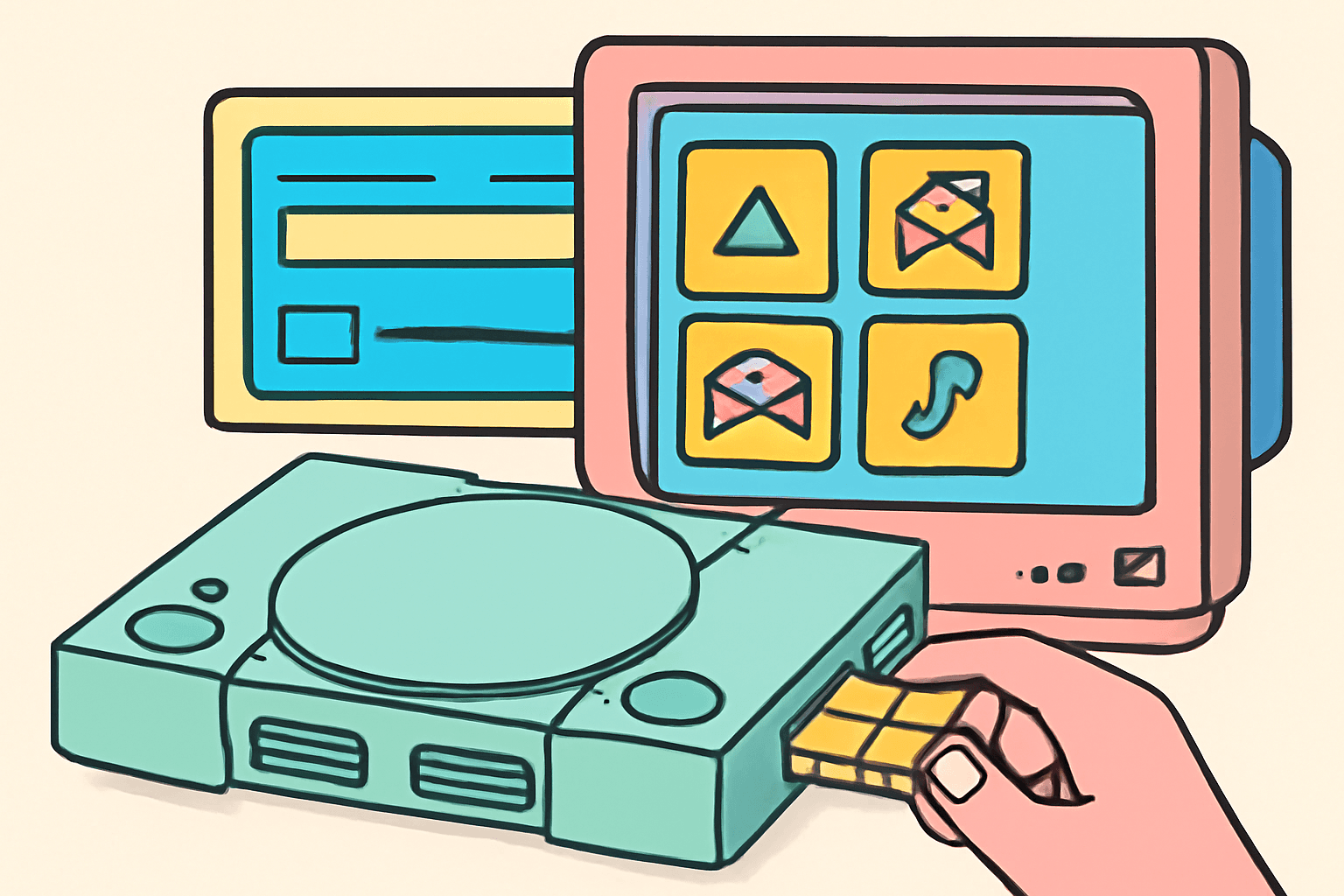
The PlayStation memory card was the size of a matchbook and held 1MB of data. One megabyte. Fifteen save slots. That was it. That was all the space you got to store every meaningful thing you'd ever done in a video game. Your 100% completion in Crash Bandicoot 2. Your Resident Evil save where you'd finally made it to the lab with enough ammo to actually survive. Your Tony Hawk's Pro Skater career where you'd unlocked every single tape.
Fifteen slots sounds like a lot until you realize that some games used three. Final Fantasy VII took a slot per save, and if you were smart - and paranoid - you kept at least two saves going in case one got corrupted. Suddenly fifteen slots is seven and a half games. You had a library of twenty PlayStation titles and storage for seven of them.
Fifteen save slots. That was all the space you got to store every meaningful thing you'd ever done in a video game.
So you made choices. Terrible, Sophie's Choice-level decisions about which saves to delete. You'd stare at the memory card manager on the PlayStation home screen, scrolling through those little icons - the chocobo for Final Fantasy, the spinning globe for Resident Evil - and try to figure out which save you loved the least. It was like being asked which of your children you'd send to boarding school.
I deleted my Crash Bandicoot save once to make room for Spyro the Dragon. I still think about it. I had every gem. Every clear gem, every colored gem. I'd done the secret warp rooms. And I killed it so a purple dragon could exist on my memory card. I regretted it within a week, but by then it was too late. The slot had been used, reused, and the Crash save was as gone as anything has ever been gone.
The Economy of Saving
You learned to be strategic. You kept one memory card for RPGs and one for everything else, if you were lucky enough to have two. You brought your memory card to Electronics Boutique when you went to the mall, just in case they had a demo kiosk and you wanted to, I don't know, save your demo progress. You couldn't. But you brought it anyway. Like a security blanket made of gray plastic.
- Final Fantasy VII (1 slot per save, needed multiple)
- Final Fantasy VIII (same deal)
- Resident Evil (1-2 slots)
- Gran Turismo 2 (2 slots minimum)
- Tony Hawk's Pro Skater (1 slot, but you needed it)
- Crash Bandicoot (1 slot, but that completion percentage was sacred)
- Castlevania: Symphony of the Night (1 slot per save)
Taking your memory card to a friend's house was a whole ritual. You'd pop it out of your PlayStation, hold it carefully like it was a relic, and put it in your pocket. Then you'd worry the entire bike ride over that it was going to fall out, or that sitting on it wrong would crack it, or that pocket lint would get in the connector. You'd show up at your friend's house, plug it into Slot 2 of his PlayStation, and load up your Tony Hawk save to prove that yes, you had unlocked Officer Dick, and no, you didn't use a cheat code.
That was the thing. The memory card was proof. It was your resume. Your save files were evidence that you had done the work, put in the hours, beaten the hard parts. Losing them wasn't just losing progress. It was losing the receipt.
The MadCatz Betrayal
At some point, you ran out of room and your parents weren't going to spend $24.99 on an official Sony memory card from Funcoland. Not when the MadCatz one was twelve bucks and held eight times the data. Eight pages of memory! One hundred and twenty slots! It was a miracle of third-party engineering.
It was also a trap.
The third-party memory cards - MadCatz, InterAct, Pelican, whatever off-brand thing they were selling at the register at Electronics Boutique - were disasters waiting to happen. They worked fine for a week, maybe two. Then one day you'd boot up your PlayStation and the card would just... not be there. The system couldn't read it. Or it could read it, but every icon was corrupted - little broken squares where your save data used to be. Or, my personal favorite, it would work perfectly except for one specific game, which it would corrupt every single time you tried to save.
I lost a Resident Evil 2 save on a third-party card. Both scenarios, Claire A and Leon B, gone overnight. The card just decided it didn't want to hold that data anymore. Like it had an opinion.
The third-party memory cards were disasters waiting to happen. They worked fine for a week, maybe two. Then one day your PlayStation couldn't even see the card.
You'd go back to GameStop or Funcoland or wherever, and the guy behind the counter would give you that look. The look that said I told you not to buy the off-brand one even though he absolutely did not tell you that; he was the one who upsold you on it in the first place. And then you'd buy the official Sony card because you had learned the lesson that every PlayStation owner eventually learned: Sony's monopoly pricing existed for a reason, and that reason was that your save data was worth twenty-five dollars.
The N64 Had It Worse (Somehow)
Here's the thing about the PlayStation memory card - at least it was external. At least it was portable. At least it existed as a default. The Nintendo 64 Controller Pak was all of those things except necessary. Half the N64 library saved directly to the cartridge. The other half required this little gray brick that you jammed into the back of the controller, where it added weight and wobbled slightly and held maybe 123 pages of data that you could never quite figure out how to manage.
The Controller Pak menu was worse than the PlayStation's. Way worse. You had to use the actual game to manage saves, or use that bare-bones built-in manager that showed you file sizes in "pages" like anyone had any idea what a page was. And if the battery in the Pak died? Everything was gone. No warning. No recovery. Just a dead battery and the ghost of your GoldenEye times.
What We Were Really Losing
I think about this sometimes - how the first generation of console gamers learned about data loss before we even knew what data was. We didn't have the vocabulary for it. We didn't say "my save data was corrupted." We said "my game got erased." Like it was an act of nature. Like the PlayStation had made a decision.
And it hurt. Not in a dramatic way. In a quiet, sinking way. You'd turn on the console, navigate to the memory card, and the slot where your save used to be would just be empty. Or worse, it would be someone else's save. Your brother's. Your friend's. A stranger's, if you bought a used card at Funcoland. Some kid named DAVE had a Crash Bandicoot save with 67% completion, and it was sitting where your 100% used to be.
We have cloud saves now. Auto-save. Multiple redundant backups happening invisibly in the background. You could throw your PlayStation 5 into the ocean and your save data would be fine, floating somewhere on a server in Virginia, perfectly intact.
But there was something about that memory card. That tiny plastic rectangle in your pocket on the way to a friend's house. How it held everything you'd worked for, and how easily all of it could disappear. You carried your progress with you, literally, and it could be destroyed by a sibling, a cheap knockoff, a magnet, or just bad luck.
Fifteen slots. That was all you got. And somehow it was enough to make you feel like you had something worth losing.