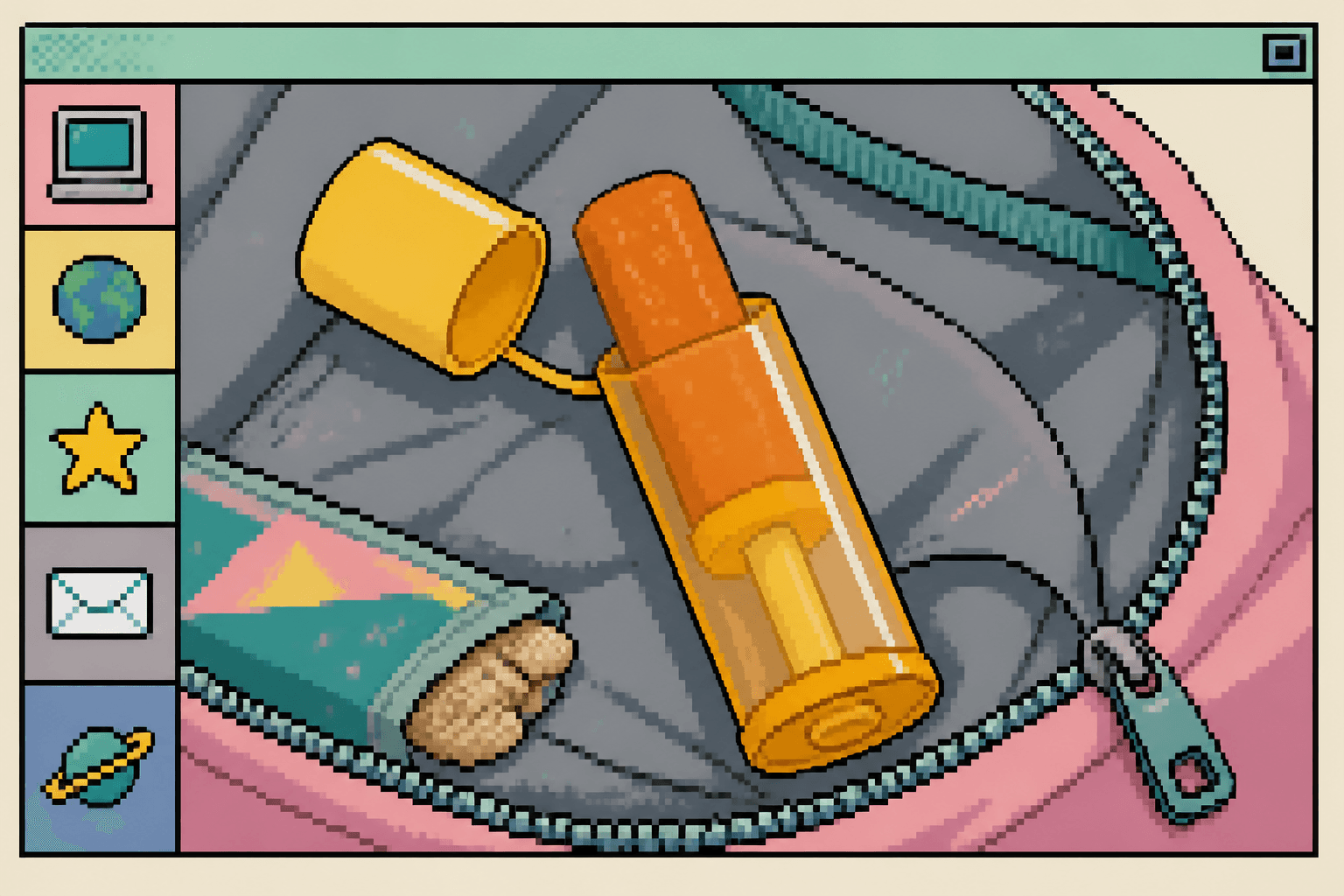
The cap was orange. Or green. Or blue. Whichever it was, it did not fit.
Not at the store. At the store the cap was fine, because at the store the candy inside the tube had never moved, and the plunger at the bottom was seated all the way down where it had left the Topps factory in some dignified corner of Scranton. You bought the Push Pop from a plastic bin at the checkout of the pool concession stand, or the CVS, or the front counter of a Cumberland Farms on the New Jersey Turnpike, and you paid seventy-five cents for it, and you put it in the pocket of your bathing suit while it was still cold. Twenty minutes later you took it out again, and by then, everything about the cap was different.
You had pushed it once. That was the mistake.
The Object
The Push Pop was a plastic tube. This is the honest description of it. Everything else was applied.
The tube was three or four inches tall, clear or lightly tinted, and had inside it a small cylinder of hard candy. Not lollipop-hard. A softer, slightly-waxy, slightly-tacky hard candy with rounded edges, colored in one of the four available flavors of American children's sugar in 1993: watermelon (pink), grape (purple), blue raspberry (blue), and, for the kids whose parents were being punished by a specific God, cherry (red). At the bottom of the tube was a plunger. At the top was a cap. The plunger had a wheel or a slot you could push up with your thumb. The cap had a color-coordinated dome you could pop off with any finger that had ever met plastic.
That was the whole thing. That was the whole product. A candy on a plunger in a tube with a cap.
The Push Pop was a plastic tube. This is the honest description of it. Everything else was applied.
Topps sold this for seventy-five cents, then a dollar, then a dollar-nineteen, and every kid I knew bought one every time we were at a place where you could buy one. There were, if you counted carefully, about six flavors and about one shape, and the packaging had, on the front, a picture of the pop mid-lick, cap dangling from a plastic tether that was optional and often absent. The tether was supposed to keep the cap attached to the base by a thin plastic ligament so that you couldn't lose it. On the ones I owned, the ligament had already snapped by the second push. That was fine. The tether was a rumor. The tether was for kids in commercials.
The Push
The push was the whole product experience and the entire marketing angle. It was in the name. It was on the wrapper. It was, in some sense, the idea.
You held the tube in your left fist and used your right thumb to advance the plunger, which was mounted on a screw or a slotted track depending on the year and the manufacturing run and possibly the phase of the moon at the factory. On the twist-up models, you rotated the base and the candy rose in tiny discrete jumps, click by click, and every click sent a small tremor up the tube because that was the sound of a plastic ratchet catching a plastic tooth. On the push-up models, you just shoved the plunger up with your thumb, which was faster and less satisfying and involved slightly more risk that you would push too hard and pop the whole candy right out the top and onto the swimming pool deck, where it would collect one leaf and two ants inside three seconds.
Either way, up came the candy. Above the rim of the tube. Now edible. Now, in the language of the marketing, pushable.
You licked it.
You licked it the way you licked any hard candy, which is to say slowly and thoughtfully at first and then, because this was a Push Pop and not a lollipop, in a specific pattern that involved rotating the tube in your fist so that you didn't leave the whole top of the candy asymmetrically dissolved on one side. This never worked. By minute four you had a candy that looked like a wet plastic thimble that had been chewed by a raccoon, and the tip of it was pointy, and the tip of it was aimed at you, and one edge of it was sharp because sugar is a mineral and minerals form edges. You did not care. You kept licking.
The Cap
The cap was where the whole product theory began to unravel.
Here is what the Push Pop cap was for, in the manufacturer's mind, as best I have been able to reconstruct it from the wrapper text and the television commercials that ran during Nickelodeon programming blocks in 1994. The cap was so that you could stop eating the Push Pop, pop the cap back on the top, put the pop in your pocket, and save the rest for later.
I want to say this plainly. This was a lie.
Not a mean lie. Not a corporate cynicism. A soft, marketing-strategy-adjacent, mostly-well-intentioned lie about a physical object that could not, by the laws of physics that governed a hard candy that had been in your mouth for four minutes in July, do the thing the cap was claimed to do.
The cap was so that you could stop eating the Push Pop, pop the cap back on, put the pop in your pocket, and save the rest for later. I want to say this plainly. This was a lie.
The candy that had come out of the tube did not, mechanically, want to go back into the tube. The candy had, in the four minutes since it had first met air, developed a soft glossy skin of dissolved-and-re-crystallized sugar that had grown, minutely, larger than the tube's internal diameter. The plunger inside the tube, which you had happily advanced, did not, mechanically, want to be advanced backwards. The cap, which had been molded to snap around a factory-fresh candy dome, did not, mechanically, want to snap around a chewed-and-slobbered-on candy nub of unpredictable shape. All three of these physical facts converged, at the cap, into a single dispiriting truth. You could push the cap on. It would go on. It would even feel on for a second, and you would think, hey, I did it, I saved it.
Then you would take one step, and the cap would fall off.
You would find it, later, in the bottom of your pocket, alongside a receipt and a piece of another candy and a small brown mystery that your mother would eventually ask about. The candy itself would still be in the tube. The tube would be in your pocket. The candy would have picked up two pieces of pocket lint, one of which would be recognizable as coming from a shirt you no longer owned, and you would look at it, and you would push it back up out of the tube with your thumb, and you would eat the lint.
You would eat the lint.
Do not lie about this. You would eat the lint. Every single one of you.
The Twist-Up
There was a nuance to the twist-up model that deserves its own paragraph.
The twist-up base had a small serrated wheel that you rotated with your thumb, and this rotation drove a plastic screw that advanced the plunger in tiny increments, and the sensation of that click-click-click was, if I am being completely honest, half the reason to buy the pop. It was tactile in a way that the push-up variant simply wasn't. You could sit on the school bus with a capped Push Pop in your hand and, without pushing the candy up at all, just rotate the base back and forth against the internal detent so that it made a small satisfying series of noises against your thumb, and this was, briefly, a fidget spinner in 1994, before that was a thing anyone had thought to name.
The problem, again, was that the twist-up only went up. You could not twist the plunger back down. Or you could, but the mechanism resisted, and the wheel felt wrong going backwards, and you got the distinct impression that you were breaking the toy, which you were, so you stopped. Which meant that once you had twisted the candy up, it was up. The cap was, in this case, sitting on top of a candy that had been mechanically committed to the world. The cap did not know this. The cap kept trying.
- Push Pop (original). The one everybody meant. Four flavors. Plastic tube. Plunger. Cap. Ligament optional.
- Ring Pop (the sister product, technically Topps). Not a push pop but often shelved next to it. A sugar diamond on a plastic ring. Marriage proposals as jokes. Stained your finger.
- Baby Bottle Pop (later, cousin product). A stick that came out of a base with dip powder. Marketed via a jingle that lived rent-free in your head. Not really a Push Pop, not really a lollipop, not really anything.
- Push Pop Jumbo. Same design, roughly double the sugar, at gas stations that also sold beef jerky by the pound. The ratchet on these felt heavier. The cap fit even worse.
- Push Pop with a whistle in the cap. I have been assured this existed. I have never held one.
The Flavors, Ranked, With No Argument
Watermelon was the correct answer. This is not up for debate. Watermelon was the correct answer because watermelon Push Pop tasted like Push Pop watermelon, which was a specific 1993 flavor that had exactly nothing in common with an actual watermelon and did not need to, because it wasn't trying to be one. It was trying to be a Push Pop. It succeeded.
Grape was the second-best. Blue raspberry was the flavor you got when the store was out of the other two. Cherry was for kids whose parents made them go to the CVS specifically for a Push Pop and this was the only one left, and it wasn't good, but it was still a Push Pop, and by the time you were three licks in the fact of it being a Push Pop had absorbed the fact of it being cherry, and you were fine.
The strawberry-that-was-really-mostly-just-pink flavor came later. Some kind of green apple thing came later still. The tropical assortment came out and no one I knew ever bought a pop from it. The point of a Push Pop was that it was watermelon, or, in a pinch, grape, and everything else was Topps trying to justify a new SKU to a buyer at Walgreens.
The Kids Who Knew
There was a kind of kid who could actually do the save-for-later thing. I will describe this kid to you.
This was a kid whose backpack was organized. This was a kid whose Trapper Keeper had all the dividers in the correct order. This was a kid who kept the wrapper - the wrapper - to their Push Pop, folded it flat around the top of the candy, capped the cap over the wrapper, and slid the whole assembly into a small side pouch of a lunchbox where nothing else could touch it. And then, an hour later, they took it back out, and the candy was fine, and they finished it.
The rest of us hated that kid.
Not for the organizational skills. For the moral clarity. That kid had accepted the terms the manufacturer had proposed. That kid had made the wrapper into a shim, engineered a functional seal out of a paper the rest of us had already thrown away, and unlocked the actual, advertised, promised feature of the product. And we could see them do it. And we still, every single time, threw our own wrappers away. And then we tried, empty-handed, to cap our candy, and the cap fell off, and we ate the lint.
That kid had accepted the terms the manufacturer had proposed. That kid had made the wrapper into a shim, engineered a functional seal out of a paper the rest of us had already thrown away. And we could see them do it. And we still threw our wrappers away.
There is a lesson in this that I am not going to write down.
The Half-Life
If you didn't finish the Push Pop and you didn't have the wrapper trick, and you put the tube in your pocket anyway, here was the timeline.
Minute five. Cap comes off in the pocket. You don't notice.
Minute ten. Candy has softened at the tip. Pocket has warmed to skin temperature. Candy is now slightly tacky. It touches the fabric.
Minute twenty. Candy is now bonded, at the microscopic level, to whatever you are wearing. Small pool of dissolved sugar has formed on the inside of the pocket. Candy has taken on the color of the pocket lining, which is beige. Candy is now a beige nub with pink undertones.
Minute forty-five. Somebody's mom does the laundry.
The next morning. The tube is in the tumbler in the dryer, empty, plunger fully advanced, cap missing. The candy has become, at some earlier point in the wash cycle, a wet pink dissolved shape spread across the interior of a pair of denim shorts, and it has now, in the dryer, re-crystallized into a bright pink permanent stain on the pocket. You get in trouble.
You do not learn from this.
You buy another Push Pop the next weekend.
The Modern Push Pop
They still make them. I checked.
I was at a CVS about three months ago, buying, I believe, a phone charger and a bag of the peanut M&M's that always seem to be a dollar cheaper here than they are at any grocery store in America, and there in the checkout island was a plastic bin of Push Pops. The wrapper design has changed. The tube is exactly the same. The cap looks, from the outside, exactly the same. I bought a watermelon one for a dollar-forty-nine.
I opened it in the car. I pushed the plunger up. The candy came up. I licked it, because I was forty and the concept of anyone judging me for licking a Push Pop was, for the first time in my life, structurally impossible, and I found this genuinely liberating.
The candy still tasted like Push Pop watermelon. Whatever they use to make that flavor - some ratio of maltitol and artificial pink number seven and the vibes of a fruit that has never met a chemist - has been held constant across three decades in the exact way the recipe for a Twinkie has, because the demographic that would care about this being changed is now buying it for their own kids at a checkout at CVS while sighing about the fact that a Push Pop costs a dollar-forty-nine.
I pushed it about a third of the way through. Then I did the thing.
I did the thing without meaning to. I put the cap back on. I put the pop in my center console. I drove home.
Thirty minutes later I opened the console. The cap was in the console. The tube was in the console. The candy was still in the tube. The pink was, faintly, on the inside of the plastic console tray. Nothing had changed. The cap had been a lie in 1994 and the cap had been a lie in 2026. The candy in between had gotten pinker, and the sugar had softened, and the whole thing had picked up one long dark blue thread of pocket lint from god knows where, and I looked at it, and I looked at it, and I looked at it.
Reader, I ate the lint.