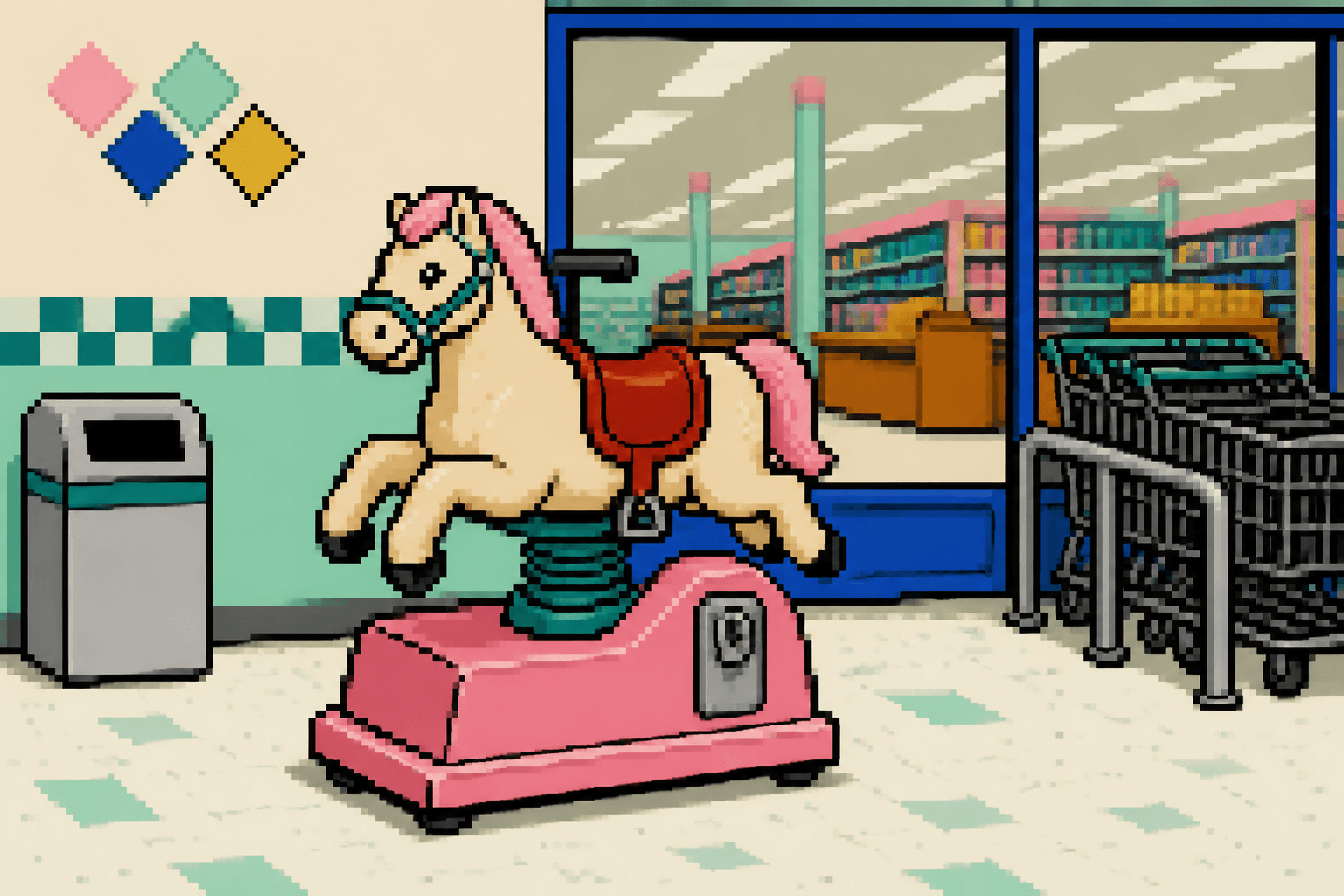
The pony lived in the vestibule between the two sets of sliding doors at the Foodmart. Not inside the store. Not outside the store. In the airlock, where the shopping carts also lived, where it was always slightly colder than inside and slightly warmer than outside, where the automatic doors wheezed open and shut all afternoon over a specific stretch of ribbed black floor mat that trapped grit from a thousand sneakers.
The pony was pink, or it had been pink. Now it was the color pink becomes after seven years of fluorescent light and sweaty hands and one time a kid threw up on the saddle. It had a red plastic saddle with a little horn molded onto the front. The eyes were two black dots. The nostrils were two smaller black dots. The whole animal weighed maybe eighty pounds and was bolted into a blue metal plinth that was bolted into the floor.
There was a slot in the plinth that said 25c. There was no sign that said what the slot did. The slot was the entire user interface.
The Economy
The deal was: one quarter, sixty seconds. The economy was non-negotiable. You could not buy thirty seconds for a dime. You could not buy two minutes for two quarters, back-to-back, because the pony stopped between quarters and made you re-insert, which meant the gear or the solenoid or whatever lived inside the pony had an interval it insisted on, and that interval was fully off, then fully on again.
A quarter in 1994 was real. It was a phone call. It was a gumball from the machine by the exit. It was the price of a plastic football helmet from the vending machine your orthodontist had next to the toy chest. A quarter was a decision.
Your parent had, in their pocket, between zero and three quarters at any given time, and those quarters had jobs. One was for the parking meter. One was for the newspaper box. One was supposed to be for the pony. The pony's quarter was the first one your parent would deny you, because the pony's quarter was the one with the least obvious adult utility. A parking ticket was a hundred dollars. A pony ride was a pony ride.
The sign said twenty-five cents. The ride was sixty seconds. Those two numbers, together, were the first ratio my brain ever did math on, and the answer was always not enough.
The Movement
I want to be specific about how little the pony moved.
The pony rocked. It did not gallop. It did not canter. It did not simulate a gallop or a canter. It rocked, forward and backward, through an arc of maybe four degrees in each direction, at a frequency of roughly one rock per second. If you drew the motion on a piece of graph paper, you could not see it. If you took a photograph of the pony mid-ride with a 1994 point-and-shoot camera and the pony mid-ride with no quarter in it, you could not tell the two photographs apart.
The pony also made a sound. The sound came from a small speaker buried somewhere inside the pony's chest cavity, and the sound was a MIDI loop of about eight bars of a song that was almost, but not exactly, "Yankee Doodle." It looped twice. On the second loop it was faster, which was the engineering concession to the idea of excitement.
The lights, if the pony had lights, were two red LEDs behind the eyes, which did not blink. They came on when the quarter dropped and went off when the ride ended. In between, they were just on. They did not pulse. They did not do anything.
That was the ride.
The Pretending
What you did, when the pony started, was pretend.
You pretended the pony was going faster than it was going. You pretended the four-degree rock was a canyon-leaping gallop. You pretended the MIDI "Yankee Doodle" was theme music from a Western, which required ignoring that the song was about macaroni. You leaned forward into the rock. You leaned backward out of it. You yelled, if you were four and your mom was in the dairy section and no one was watching. You held the saddle horn with both hands in a death grip, as if the pony were trying to throw you.
The pony was not trying to throw you. The pony was not trying to do anything. The pony was a plastic cylinder on a slow pivot, powered by a quarter, and it was you who was supplying the ride.
- Pink Horse: baseline. In every grocery store in America. Also at the entrance of every K-Mart.
- Fire Engine: slightly cooler. The siren was fake but it was there.
- Spaceship: aspirational. Had a plastic steering wheel that did nothing.
- Race Car: hard to find. Had a plastic gear shift that also did nothing.
- Thomas the Tank Engine: licensed. The face moved. Minimally.
- Big Bird: beloved by three-year-olds. Bewildering to seven-year-olds.
- Carousel Horse: fancy. Lived in malls, not grocery stores. Rotated instead of rocked, which was arguably worse.
The siblings who were there with you had a system. If one of you got the quarter, the other one stood next to the pony with a hand on the saddle, running alongside, which meant they got to pretend they were in the ride without being charged for it. By the second lap of the MIDI loop they had wandered off, because standing next to a pony that was not moving while your brother sat on top of it looking slightly beatified was not a long-term entertainment plan.
The adults walking past did not look. Not because they were being polite. Because the pony was infrastructure. The pony had been in that vestibule for ten years. It was going to be in that vestibule for ten more. Adults do not look at infrastructure. Only kids look at infrastructure.
The Quarter You Didn't Have
The real experience, more often than not, was the pony with no quarter in it.
You walked into the vestibule. Your mom was already past, into the store, pushing the cart with the broken wheel that pulled to the left. You stopped at the pony. You climbed on. You put your hands on the saddle horn. You rocked yourself forward and backward using your own body weight, which was the only way to generate motion in an un-quartered pony, and you held this position for a while. Maybe thirty seconds. Maybe a minute.
You were not a dumb kid. You knew the pony was off. You knew the lights were not on and the MIDI was not playing and the small internal motor was not engaged. You were doing something more interesting than riding the pony, which was pretending to ride a pony that you knew was not riding you, and this was its own activity. It was the first time, maybe, that you did a thing fully knowing the thing was make-believe, and you did it anyway, because the point was not the pony. The point was the climbing on and the holding the horn and the sixty seconds of someone else being on the other end of the store.
Half of childhood was riding a pony with no quarter in it. The other half was describing the ride, later, as if the quarter had been in it.
Then your mom came back with the cart and said let's go, and you dismounted the stationary pony, and you went home with two bags of groceries and a box of Entenmann's chocolate donuts, which was also something you had asked for and been denied, and which also you would not get, and which the pony and the donuts together represented, briefly, the whole shape of being seven.
The Argument, Briefly
The pony was engineering.
Not the pony itself. The placement of the pony. Somebody, in a corporate office somewhere in the Midwest, had decided that if you put a coin-operated kiddie ride in the vestibule between the two sets of automatic doors, you captured the child's attention at the exact moment the parent was most willing to pay a quarter to end the conversation about the pony. Not before the shopping. The parent would say no before the shopping. After the shopping, when the groceries were in the cart and the parent was already two hundred dollars deep and had successfully gotten the kid out of the toy aisle, that was when the pony got funded. The pony was positioned to collect the quarter that the parent would not have spent inside the store.
The pony earned, I have read somewhere I will not vouch for, roughly two to five dollars a day in a decent location. That is eight to twenty quarters. That is eight to twenty children who, over the course of one grocery day, had done the specific thing I just described, which is climbed on, held the horn, got sixty seconds. The pony was a volume business.
The grocery store did not own the pony. A company owned the pony and leased it to the store, or paid the store a cut, and sent a guy in a van around once a week to empty the quarter chamber into a canvas bag. The guy had a key. The key was a long tubular key, like the kind that opened arcade cabinets. He did not look up when he worked. He opened the pony's lower belly with the key, swapped a canister, locked it, and left. We saw him once. We did not talk to him. He was the pony's cardiologist. We were just the patients.
The Other Side
But.
The pony was also, I want to say, one of about four things in your childhood that was yours alone.
Your parent did not ride the pony. Your parent was not on the pony. Your parent could not advise you about the pony, because they had no information you did not have. The pony was a thing you did in a vestibule, alone, for sixty seconds, while a stranger walked past and did not look at you, and that was the ride.
Agency, at seven, is a short list. You could pick a cereal. You could pick a shirt sometimes. You could pick the color of your toothbrush. You could pick a prize from the dentist's bin. And you could get on the pink pony in the vestibule and hold the horn and rock. The list is finite. Nobody is adding items to it. You lose items off it as you age, and you do not get replacements.
The pony did not care if you were having a good day. The pony did not grade you. The pony did not know if you had done your spelling homework. The pony offered a flat, administrative experience, available to any kid of any temperament with any quarter, and the pony delivered that experience, flatly, administratively, every time, for sixty seconds, before shutting off mid-rock.
That is a surprisingly rare contract, when I think about it now.
The Last Ride
I remember the last pony ride specifically because I remember being too big for it.
I was nine. I was with my mom at a different grocery store, a chain called Giant, in a different town, and the pony in the vestibule there was a race car, not a horse, and I did not care about race cars but my mom offered me a quarter without being asked, which was unusual, and I took it, and I got on the race car, and my knees came up to roughly my own chin.
I put the quarter in. The race car did its tiny rocking. The MIDI played, and it was not "Yankee Doodle" this time, it was something that sounded like a worse version of the Indy 500 theme. The lights behind the headlights came on. I sat there with my knees against my chin and tried to pretend.
I could not pretend. The pretending had stopped working. The quarter was in the slot and the car was rocking and the lights were on, and I was fully aware that I was a nine-year-old sitting on a plastic cylinder in the vestibule between two sets of automatic doors, being watched, briefly, by a woman carrying a case of Diet Coke to her car.
The ride ended. The MIDI cut off mid-note. The lights went off. I got off.
My mom was standing by the newspaper box, waiting, and she said was it fun, and I said yeah, which was a lie and also not a lie. The ride had been exactly what it always was. I had changed, and now the exact thing I always was did not land the way it used to land. The pony had not gotten worse. The quarter had not gotten more valuable. I had just grown out of the specific trick that made twenty-five cents into sixty seconds of being somewhere else.
The pony stayed in the vestibule. I know because I drove past that grocery store, twenty years later, and the pony was still there, and the vestibule was still that specific temperature, and a kid I did not know was climbing on. He put his hands on the saddle horn. His mom was already inside, past the second set of doors, out of sight. The pony was not moving. He rocked it forward and backward with his own body weight. He was pretending.
I watched him for about thirty seconds through the glass. He was riding the pony with no quarter in it. He was good at it.
Then I went inside to buy milk.