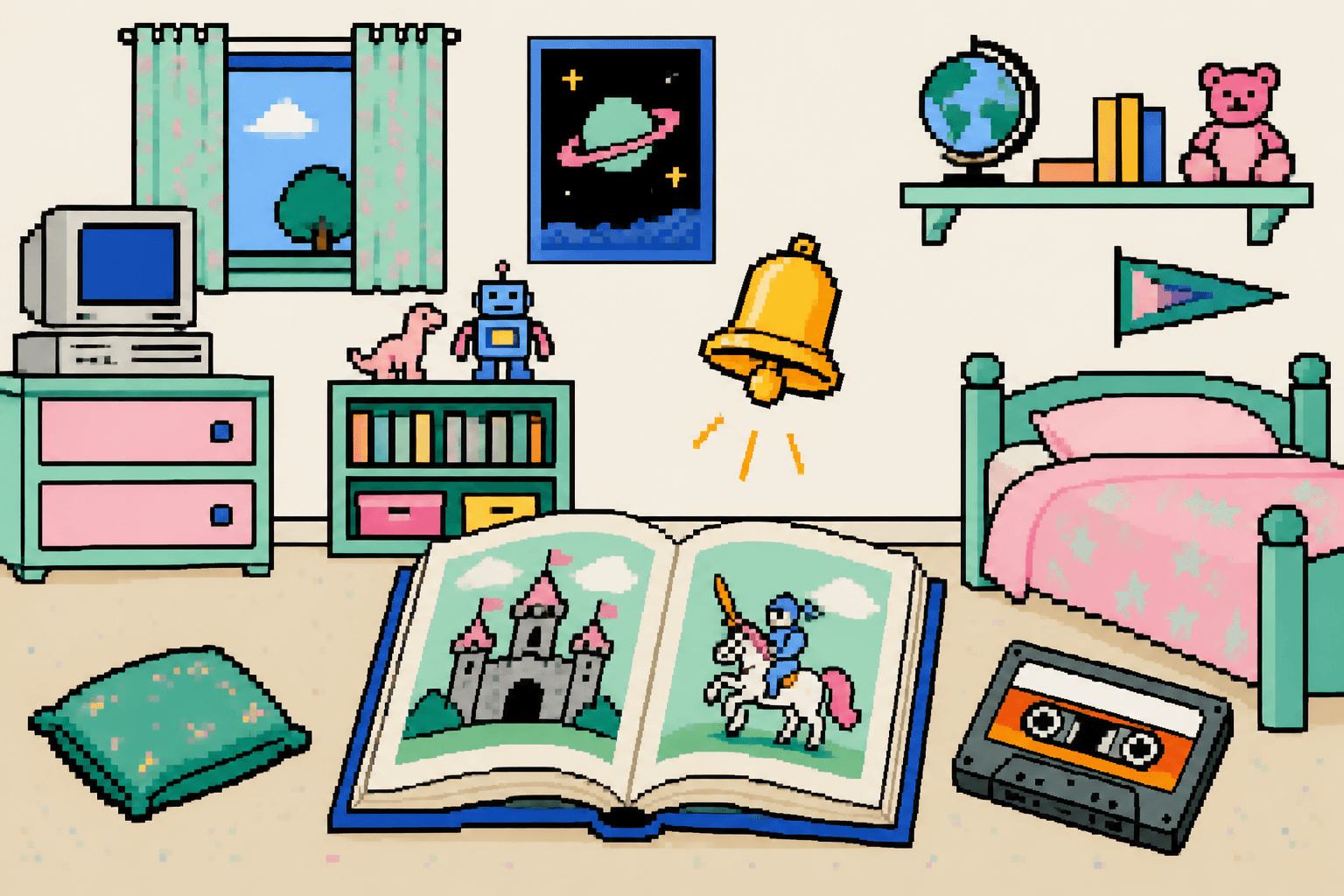
The book came in a plastic sleeve, with the cassette sealed in a little blister on the back. You bought them at a Disney Store, or at the book fair, or you got them at the library, where they lived in a cardboard pocket that held the book against the tape so neither could escape without the other. You took the whole thing home. You did not separate them. They did not work apart.
You opened the book. You put the cassette in the player. You pressed PLAY with your whole hand because the buttons on a Fisher-Price tape deck were stiff in a way that respected you. The tape hissed. A man cleared his throat. And then, before any actual story happened, he gave you the rules.
The Rules
"You can read along with me in your book. You'll know it's time to turn the page when you hear the chimes ring like this."
Then a chime rang. A high, bright little ding, layered, almost like a triangle and a bell having a small disagreement. You learned the chime in three seconds. Forever.
Sometimes it was a chime. Sometimes it was Tinker Bell, who got her own brand because she was small and shimmery and the noise she made when she landed sounded like exactly the right number of bells. Sometimes it was a wooden whistle or a kazoo or a single piano key being tapped by an adult who wanted to go home. The instrument varied. The contract did not.
You will read along. You will not turn the page early. When the bell rings, you turn.
You learned the chime in three seconds. Forever.
The Narrator
The narrator was always a man. He had a voice like a kind dentist. He was not your father and not your grandfather but he occupied a frequency between them, in the part of the audio spectrum reserved for explaining things to children and for promoting whole grains.
He read at exactly the wrong speed. Slower than your eyes wanted to go. Faster than your finger could keep up. You'd be halfway down the page, and his voice would still be at the top, and you'd have to stop reading and wait for him, because the bell was tied to his timing, not yours. You'd glance at the next page. You'd look back. The narrator was on the sentence about the goat. He was still on the goat. He would be on the goat for a while.
You'd stare at the spine of the book and listen to him finish the goat sentence with the patience of a man who got paid by the hour.
The Production
Behind the narrator was a soundscape that I cannot fully account for.
There were sound effects. A door opening when the door opened. A whoosh when a character ran. A rain noise that was clearly a guy with a coffee can full of dried peas. There was music sometimes - a string section underneath the more emotional passages, which were always about a character missing their mother or finding a coin.
There were also other voices. The narrator did the boy. A woman did the mother. A second man did the villain, usually with a slight regional accent you couldn't place because nobody told you where the story was set. A small choir of children did the crowd scenes, which was wild, because nobody in the story was ever in a crowd. They were always alone in a forest, or in a kitchen, or under a bed.
- Track 1: The narrator explaining the chime
- Track 2: The story
- Track 3: The same story again, but without the chime, "for when you can read the story yourself"
- Track 4: A song based on the story, often inexplicably in a calypso style
- Track 5: Tape hiss for thirty seconds, then sudden silence
- Track 6 (Side B): Nothing, or a different story your mom didn't realize she'd bought
The choir would come in for one line - "Pip! Pip! You found the songs!" - and then vanish back into whatever recording studio in Burbank had assembled them on a Tuesday morning. You imagined them as adult choir members in cardigans, looking down at a sheet of paper that just said cheer for Pip. You imagined them being paid in donuts.
The Cassette
The cassette had a label on it. The label said the title and the publisher and PLAYS BOTH SIDES in tiny print, which was almost always a lie, because Side B was usually blank or contained nine minutes of nothing.
It also said narrator: [name]. You didn't recognize the name. The narrator was famous somewhere - in a soap opera, on a regional commercial, in the original off-Broadway run of something - but to you he was just the man who knew the chime. He existed only inside the tape.
If you played the cassette without the book, you got the same story with no pictures. If you opened the book without the cassette, you got the same story with no chime, which meant you had to decide for yourself when to turn the page, and that turned out to be a different kind of book. A worse book. A book where you had to make every decision alone.
The book and the cassette were not two products. They were one product, sold to you as a system, with each half useless without the other. This was a business model. This was also, accidentally, a piece of media theory.
The book and the cassette were one product. Each half was useless without the other.
The Toy
Anyway. Here. The book is open. The tape is loaded. Press PLAY and wait for the bell.
I will tell you what the real read-along did that this one cannot, which is to take exactly as long as the narrator decided. The tape was the clock. You could not skim, you could not skip ahead, you could not even slow down. You sat there and the narrator dragged his goat sentence across the floor and you stared at the page and you waited.
That was the discipline. That was, in retrospect, half the point.
The Library Version
The public library had a whole shelf of them.
They were in plastic bags with a yellow Dymo-tape label that said BOOK + TAPE, and they were checked out by parents in a hurry who did not look at what was inside. You got home, opened the bag, and discovered that the bag did not contain the book and the tape from the same story. It contained The Berenstain Bears Go to Camp and a cassette of The Velveteen Rabbit. This was somebody else's fault but the fault could not be assigned.
You played the tape anyway. You read the book anyway. You turned the page when the bell rang, even though the bell was telling you to turn from a scene about Brother Bear forgetting his sleeping bag to a scene about a small fox in a forest. Your brain did the cross-referencing. You did not complain. You were six.
This is probably how I learned to read. I cannot prove it. I am not ruling it out.
The Argument
I want to say something kind about the read-along cassette, because it taught me to follow text with my finger, and it gave me a sense that books had rhythm, that there was a right pace to a sentence, that the goat sentence required a certain weight.
I also want to say something less kind, which is that the read-along cassette taught me a habit I am still trying to break. The habit is: wait for the bell. Don't skip ahead. Don't decide on your own when you're done. There is a chime out there somewhere that will tell you when to move on. Listen for it. Do not turn the page until it rings.
That is not how reading works as an adult. As an adult, you make the chime yourself. You decide when the page is done. You decide when the chapter is done. You decide whether to put the whole book down forever or to read it three times in a row because something in it is still loose in your chest.
But for a long time, after the read-along, I would finish a paragraph and look up, slightly, as if waiting to be told it was time. The chime did not come. I had to learn to turn the page anyway.
There is no chime, in adult life. You decide when the page is done.
The End
I found one of mine last year. The Little Mermaid: Read-Along. The book had no scratches on it - I had handled it carefully, the way you did with anything that came with audio, because somehow we knew the tape was the more delicate component. The cassette had a sticker on it that said PROPERTY OF ALEX which is not my name and never has been. I have no idea how this cassette became mine.
I held the book. I did not have a tape deck. I did not have anywhere to play the tape. The narrator was in there, sealed in magnetic oxide, waiting to give me the rules.
I opened to the first page. I read it to myself, in my head, at my own speed, with no bell. I turned the page when I was ready. The fish were swimming. The crab was singing. The story moved forward because I moved it forward. Nobody told me when.
The read-along cassette was a teaching tool. It was also, structurally, a small bureaucracy. It said: here is the story, here is the timing, here is the moment you may proceed. It was patient. It was firm. It rang its bell at the same place every time.
I have heard people say they miss it. That what they want, in their loud lives, is a small voice telling them when to turn the page. A chime, somewhere in the apartment, that goes off and says: that's enough now. Move on. The next part is ready.
I understand the impulse. I also know what it cost.
The chime rang. You turned the page. The chime rang again. You turned again. By the end of the cassette, you had read a whole book, which was a small triumph, but you had also gotten a little better at waiting to be told it was time, which is a skill the world has plenty of uses for, and not all of them are kind.
Press PLAY. Wait for the bell. Turn when it rings. That's how it worked. That's how it always worked.
Ding.