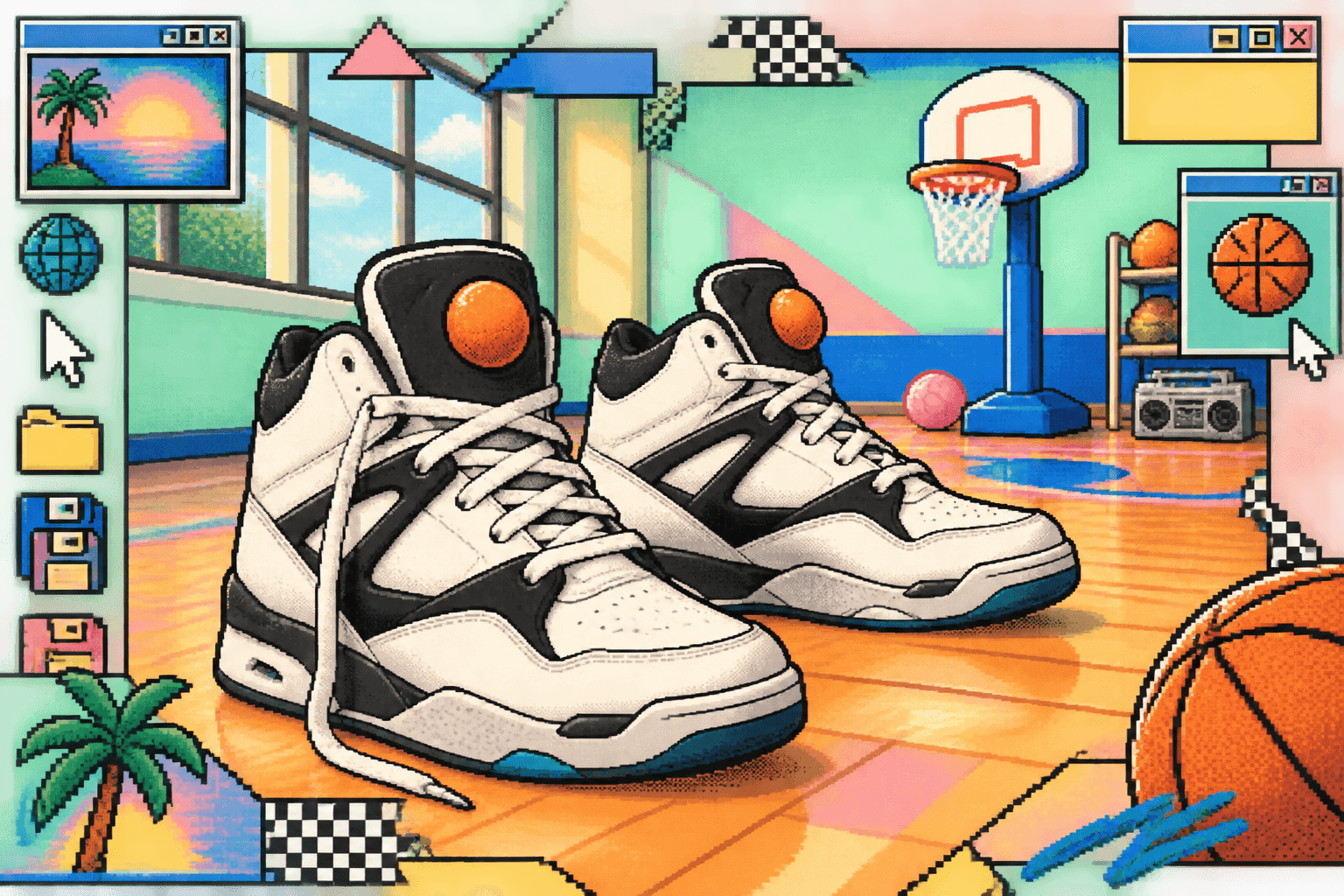
The commercial had Dee Brown do a no-look dunk in the Slam Dunk Contest. He bent down, hit the little orange basketball on the tongue of his shoe, stood up, ran at the rim, covered his eyes with his forearm, and threw it down. That was 1991. That was the entire ad campaign. That was, functionally, the entire pitch for a sneaker that cost $170 in 1991 dollars.
Which is $400 now. For a shoe.
You wanted them anyway.
The Pump
The pump was a small orange ball on the tongue of the shoe. You hit it with your palm and you heard a little hiss and something inside the shoe got tighter around your ankle. Not a lot. A little. Enough that you could feel it. Enough that if you closed your eyes and hit the button four or five times, you were pretty sure something was happening in there.
There was also a release valve. It was a tiny gray button on the back of the heel that you had to press with a pen or a fingernail. Nobody in gym class knew where the release valve was. You pumped the shoe in the morning and you wore the shoe tight all day and by fifth period your foot was slightly numb and you were pretending it wasn't.
The pump was a small orange ball on the tongue of the shoe. You hit it with your palm and you heard a little hiss and something inside the shoe got tighter around your ankle.
The thing about the pump was that it worked. That's what made it different from other 90s marketing lies. It wasn't a hologram sticker. It wasn't a special substance. There were actual air bladders inside the collar of the shoe, and when you hit the button, they actually inflated. You could see the tongue puff up. Reebok had engineered a whole pneumatic system into a sneaker and sold it to eleven-year-olds who had never once needed a custom-fit ankle.
The Ad
The Dee Brown ad worked because nobody watching it thought about it for two seconds. He hit the pump. He dunked. The implication was that the shoe made the dunk possible. Not the years of playing basketball. Not the fact that he was a professional athlete. The shoe.
If you actually thought about it, the ad was arguing that a slightly tighter ankle collar was the difference between a normal human and a person who could jump forty inches in the air. If you had thought about it in those terms, in 1991, at age eleven, you would have laughed. You did not think about it in those terms.
I bring this up because you know what didn't happen when you got Pumps? You did not start jumping higher. You did not develop hops. Your friend Jason still beat you at PIG. Your vertical, as measured by how high you could get above the concrete of your driveway, remained approximately the height of a footlong sub. The shoe hugged you. That's what it did. It was a shoe that gave you a hug.
The Rich Kid
There was always one kid who had them. In my school it was a kid named Ryan whose dad worked in insurance and whose family had a boat that they kept in a garage that was bigger than my house. Ryan had the Pumps in the black and white colorway. Ryan had the pumps in the D3 colorway, which came out later. Ryan had a sequence of Pumps, upgraded seasonally, like an operating system.
Ryan did not play basketball. Ryan was fine at basketball. Ryan was slower than half the kids in gym class and had asthma and wore the Pumps at recess and hit the little orange ball on the tongue five or six times every time he sat down on the low brick wall by the four-square courts. He hit it because it was there. He hit it because it hissed. He hit it because the whole point of owning the Pumps was to hit the pump, and if you didn't hit the pump, then what did you even have?
You had a $170 shoe.
The whole point of owning the Pumps was to hit the pump, and if you didn't hit the pump, then what did you even have? You had a $170 shoe.
The Placebo
Here's what the pump was, and what Reebok correctly and beautifully identified: a placebo delivery mechanism you controlled with your own hand. It was a fidget toy that closed on your foot. It was a ritual. Before the game, you hit the pump. Before the free throw, you hit the pump. Before the dunk you were not going to complete, you hit the pump. It gave you something to do with your body before doing the thing you were about to do. And doing something with your body before doing the thing calms you down. Which, arguably, does help you play basketball, or at least stop panicking about it.
So maybe the pump did work. Not the way Reebok said. Not the way the ad implied. Not the way you told your mom when you asked for them in the JCPenney parking lot. But it worked in the way that every ritual works, which is that when you do the ritual, you feel like you did the ritual, and that changes something small in your head. Which is not nothing. It is also not $170.
The Ankle Support Argument
Your dad said the shoe was a scam. Your mom, who paid for them, said they were "supportive," a word she'd gotten from the salesperson at Foot Locker, and which she repeated to relatives who asked why she'd paid that much for a sneaker for a fifth grader. "They're very supportive." This is how all high-top basketball shoes were justified in the 90s. Not for performance. For support. As if we were all one crossover away from rolling an ankle and needing to be carried off the driveway.
Nobody in my family ever rolled an ankle. We were not playing basketball at that intensity. We were shooting on a Nerf hoop nailed to a bedroom door frame. But if we ever had rolled an ankle, the Pumps would have been ready. Waiting. Slightly inflated. Very supportive.
The Second Ankle
There is a specific 90s ritual I want to name here, which is that once you had the Pumps, every time you sat down on a couch or a curb or a bleacher, you hit the pump on both shoes an equal number of times. This was not a decision. This was a compulsion. You had to make them match. If you hit the left pump three times, you had to hit the right pump three times. Otherwise your legs would be uneven and something bad would happen. This was the actual logic of a fifth grader with $170 sneakers.
I saw kids at church do this. I saw kids at the movies do this. I did it myself, sitting on the school bus, hitting each pump quietly against my knee under my backpack, keeping count. Everybody counted. Nobody talked about it.
The Pumps are back now. Or they've been back for a while. Reebok reissues them every few years, in the original colorway, targeted at grown-ups who were eleven in 1991 and now have jobs and can afford a $200 sneaker without asking anyone. They still have the pump. It still hisses. It still doesn't do anything.
I saw a pair last year at a shoe store in a mall. I picked one up off the shelf. I hit the orange ball on the tongue and I heard the little pssht sound and I felt the collar tighten inside the empty shoe and I put it back down and I walked out.
I did not need to buy them. I had already gotten the thing they were selling, thirty years ago, in a JCPenney parking lot, from a mom who had used the word supportive because she didn't have any other word for what a hundred and seventy dollars was buying.
She was right, actually. Not about the ankle. About the shoe.
They were supportive.
Of what, exactly - the pump never said.