You were lying flat. The halogen lamp was aimed at the back of your throat. There was a plastic retractor stretching your lips to a shape your own mother wouldn't recognize, a saliva ejector hissing in one corner of your mouth, and a gloved hand holding something metal somewhere near your left molar. You had been in the chair for forty-five minutes. You could taste the glue. Your jaw had started making a sound. Somewhere above you, the hygienist and the orthodontist were having a conversation about a kitchen renovation that did not involve you.
Then the orthodontist pulled the retractor out. Your lips snapped back. Your tongue returned to its usual size, which was now - because of the braces - slightly too big. The hygienist stood up, swiveled on her stool, and came back with a small plastic tray.
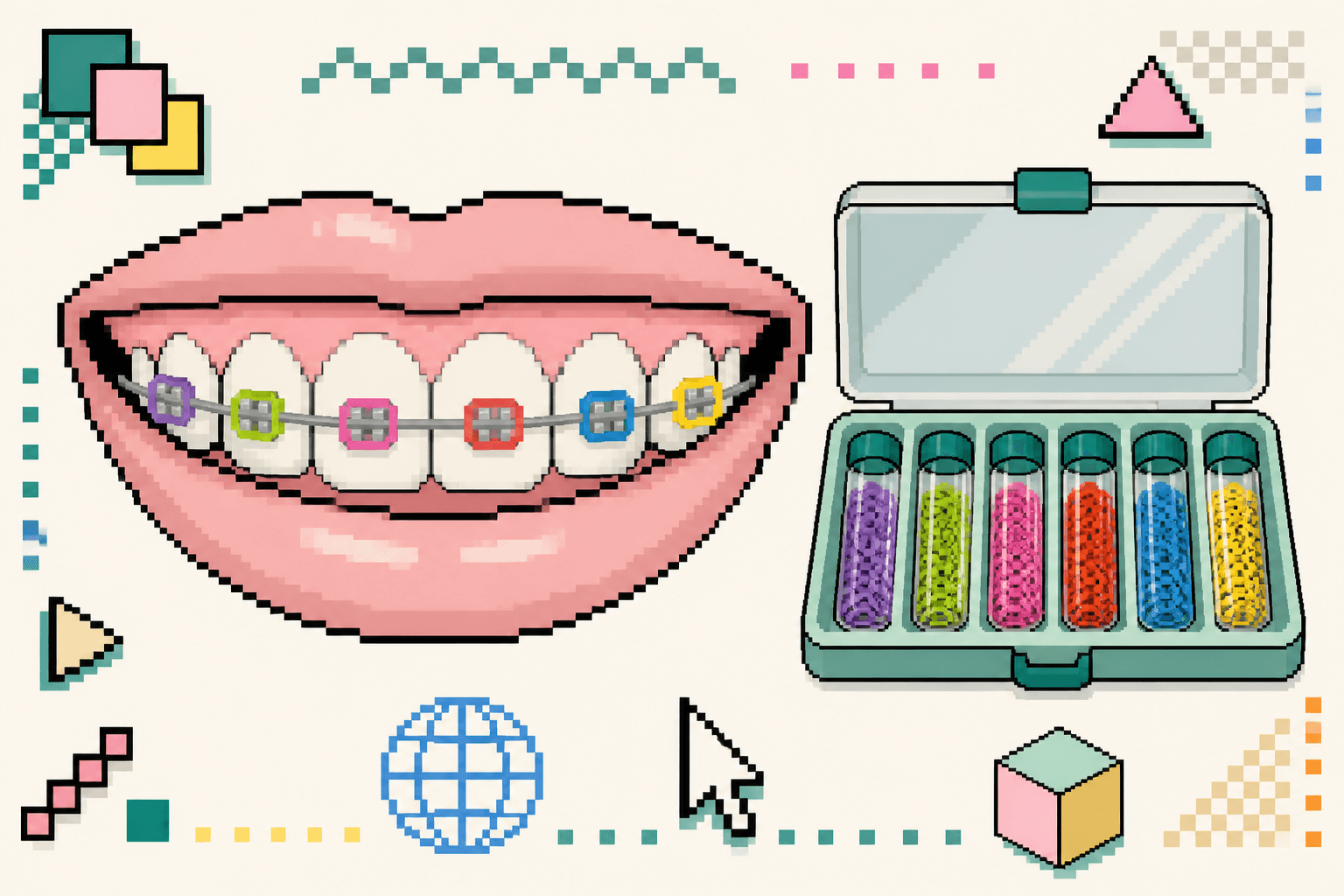
The tray had a velvet-looking liner, a thin pink felt, and twenty-five tiny clear test tubes slotted into it in a row. Each tube held a different color of tiny rubber bands. Red. Orange. Yellow. Green. Blue. Purple. Pink. White. Black. Clear. Silver. Also brown, for some reason.
"Okay," she said. "What colors do you want today?"
It Was the Only Thing That Was Yours
Nothing about braces was consensual. Your parents paid for them. Your dentist recommended them. The orthodontist decided how, and when, and for how long. You showed up every four weeks because that's when the appointment was. You lay in the chair because that's what you did at the chair. You opened your mouth because keeping it closed was not an option that had been offered to you.
And then, at the very end of the appointment, after the wire had been tightened and your teeth had been nudged half a millimeter closer to the position some computer in Minnesota had calculated, you got the tray.
The tray was a bribe. Everyone knew it was a bribe. The orthodontist didn't need to let you pick colors. They could have put clear bands on every bracket in the whole office and called it a day. Clear was adult. Clear was invisible. Clear was what adults with jobs chose, if adults with jobs had braces, which they sometimes did and nobody ever talked about.
But the tray was there, and you were twelve, and you got to pick.
Nobody picked brown. Brown was in the tray and I never - in six years of appointments - saw anyone pick brown. It was there as a courtesy. It was there because the manufacturer sold a brown. Brown existed as a possibility, which is not the same thing as a choice.
The Strategies
The safe play was school colors. You picked your school's two colors in whatever ratio felt right. Purple and gold. Red and white. Blue and silver. You alternated them, bracket by bracket, like a tiny flag you were wearing in your mouth for the next four weeks. It was the vanilla ice cream of orthodontic decisions. Nobody would judge you. You would also not be remembered.
The slightly bolder play was alternating two colors that were not school colors but had some logic to them. Pink and purple, if you were a certain kind of girl. Black and red, if you were trying to be a certain kind of boy. Green and yellow, if you were really committed to Sprite as a personal brand.
The seasonal play was high-risk and I don't recommend it. Red and green at Christmas was the obvious one, and it was fine for the first two weeks, but then it was January, and then February, and now you were a human Christmas tree in a classroom studying the War of 1812. Orange and black for Halloween was worse, because Halloween is one day. You wore those bands until Thanksgiving.
The flex was all one color, a bold one, repeated twenty times. All pink. All green. All blue. It took confidence. It said: I am sure about this. It also meant that if the color was a mistake, there was no visual relief anywhere in your mouth. You were committed to the mistake for a month.
The adult choice was clear. The adult-adjacent choice was silver, which was like clear but somehow sadder, like you had given up but you still wanted credit for trying. White was supposed to look like your teeth, which it did briefly, until the first time you ate anything, after which it looked like plaque. Yellow also looked like plaque. Yellow was a trap.
The Colors You Could Not Have
There were colors in the tray that nobody picked, and you noticed them.
Brown. Nobody. Not once.
Black was picked rarely, by one specific kid in your grade who was already wearing a Marilyn Manson shirt and whose mother was going to make him change before second period. Black was a statement. Black also made it look like your bracket wasn't there, which was either good (bracket disappears) or bad (now there's a little gap of darkness in your mouth where a tooth should be). Nobody could agree.
White was picked by kids whose parents picked it for them. White said: the goal is for these to be invisible, and when they are not invisible, the goal is for them to be nice. These were kids who were going to wear retainers correctly.
- Bold: pink, hot green, red, all-one-color
- Safe: blue, purple, school colors, two-tone
- Mysterious: black, dark green, dark blue, silver
- Regrettable: yellow, white, clear-after-spaghetti, brown
Four Weeks With Your Decision
Here is the thing nobody warns you about. The colors did not stay the colors.
A green band after one lunch of spaghetti became a brown band. A white band after a single orange juice became a tan band. A clear band after two days became a sort of greasy, translucent yellow that made it look like the band had been there since 1987 and nobody had cleaned it since. Red bands held up pretty well. Blue bands got weird. Pink bands turned brown.
By week two, no matter what colors you had picked, your mouth looked like a tiny abandoned Christmas tree in late February. The vote you had cast with such confidence - the purple and silver, two-tone, going for pretty vote - had been overridden by whatever you had for dinner on Tuesday.
By week three you were counting down to the next appointment. Not because you wanted the wire tightened, which you did not, but because you wanted the tray back. You wanted to go again. You wanted to overwrite the current colors with new, cleaner ones, and this time, you had a plan.
By week four, you were back in the chair. The orthodontist peeled off the old bands with a little hook. They came off in a dry, slightly stretched state, and they went in a little tray that got dumped at the end of the day. Your month's worth of self-expression ended in a small plastic cup.
Then the hygienist swiveled over with the tray. Again.
"What colors do you want today?"
The Argument, Briefly
I want to steelman the cynic here, because the cynic is not entirely wrong.
Letting a twelve-year-old pick a color at the end of a thousand-dollar procedure is a textbook psychological trick. It's a tiny, meaningless choice offered at the very end of a long, humiliating experience in which the child had no agency. The color doesn't affect the medical outcome. The color is a sticker. It's the lollipop at the end of a shot. Everyone in orthodontics knows this. The manufacturers know it. The orthodontists know it. The reason the tray has twelve colors instead of two is not because the medical science required twelve colors.
The tray was engagement design, applied to pediatric dentistry, twenty years before anyone used the phrase.
The Other Side
But.
I keep thinking about this. You get older and you learn that most of the things you thought were choices were not choices. Your college was mostly where you got in. Your job was mostly what paid. Your city was mostly where the people you loved happened to be. You are, more often than you'd like to admit, picking from a tray somebody else wheeled over.
And the thing is, picking still matters. The tray was limited. The outcome was mostly set. The whole experience was non-consensual in every meaningful sense. But at the end of it, somebody said you pick, and you picked, and for four weeks the picking was yours. The green was yours. The pink was yours. The purple-and-gold-for-the-eighth-grade-dance was yours. You walked out of that office with a mouth full of a decision you had made, with a cheek that hurt in a specific way because of the tightening, and you had chosen the color of the thing in your mouth.
That is not nothing. That is, in fact, roughly the shape of most of my adult decisions, now that I think about it.
The Yearbook
My eighth grade yearbook picture has braces in it. I know the picture was taken on a Thursday because that's when picture day was. I know I had just gotten my bands changed on the Monday before, because I remember thinking about it when I combed my hair in the hallway mirror. I had picked blue and silver, which were my school colors, because I had told myself I wanted to look school-spirited.
In the picture, you cannot see the bands. The photographer's flash was too bright, and my mouth was mostly closed in that practiced non-smile a kid gives when they're told to smile but they're wearing braces. The braces are there, slightly, as a glint of metal. The bands are not visible.
I had planned for the picture. The picture did not record the plan.
The picture recorded, instead, a kid in a collared shirt his mom bought that morning, trying not to smile too wide, aware for the first time that choices he was proud of weren't necessarily things anyone else would see.
I think about this every time I pick anything, now. Every paint color. Every job offer. Every outfit for a thing. The tray goes by, I pick what I pick, I commit for four weeks, and by the time anyone sees the result, the colors have already shifted into something else because of what I had for dinner on Tuesday.
The tray was good practice.
The tray was maybe the only practice.