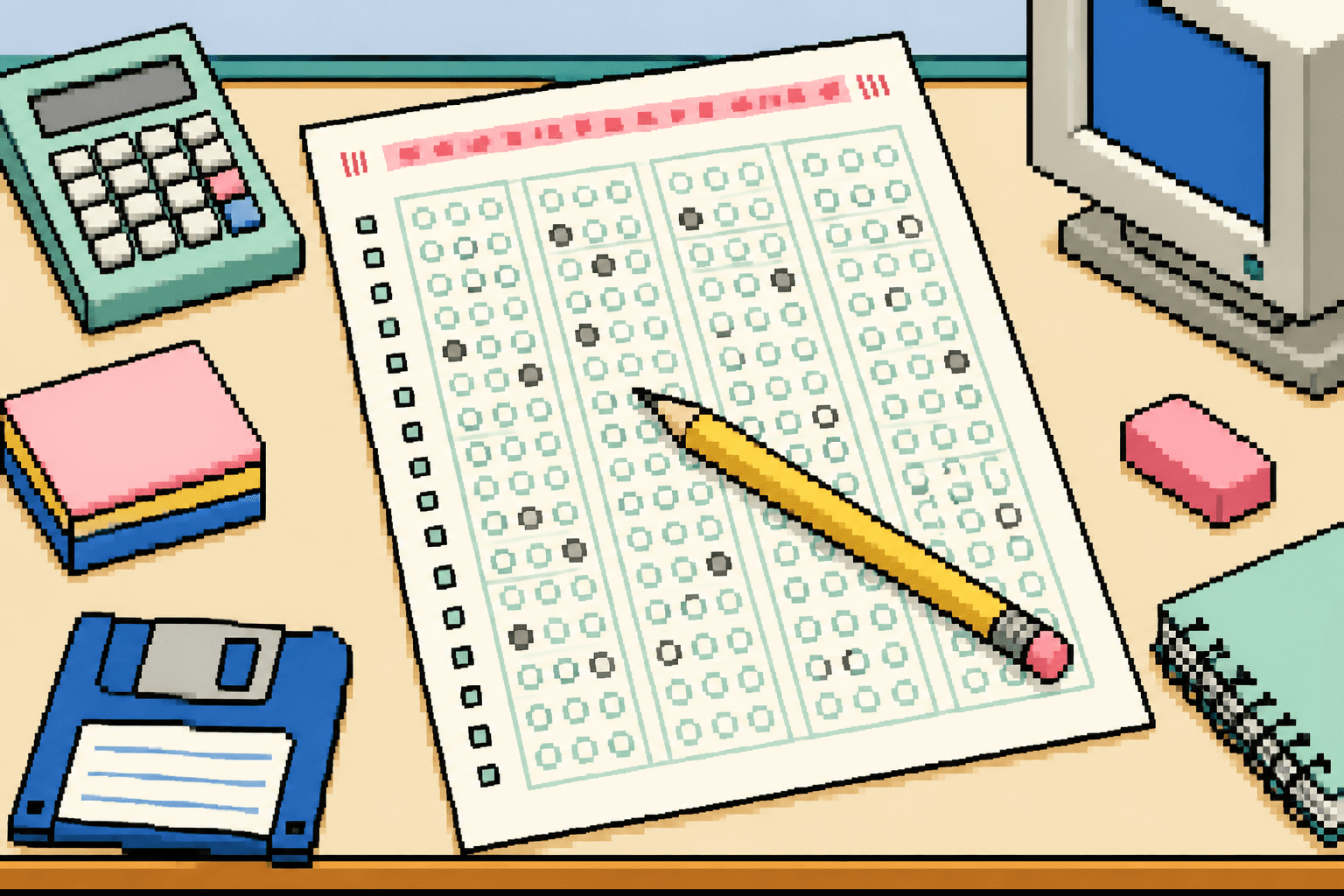
The teacher put the sheet on your desk face down.
It was long and cream and slightly thicker than regular paper, with a red stripe across the top and a serial number in the corner that was not for you. It said OpScan. It said Form 882-E. It said, in a small line of print that you were not supposed to notice, do not fold, spindle, or mutilate, which was the kind of thing a machine said in a sentence a kid did not understand, and which was, in retrospect, the entire mood.
The teacher said: Number two pencil only. Shade completely. If you change your answer, erase completely. Do not make stray marks on this sheet. You have one hour.
You turned the sheet over.
The Sheet
The Scantron sheet was not a Scantron. The Scantron was the machine in the office that read the sheet. The sheet was an OpScan form, or a National Computer Systems form, or an NCS form, depending on which company had won the district's contract that year. Nobody at my school called it any of those things. Everybody called it a Scantron, after the machine, because that was the part of the system that had opinions about you.
The sheet was cream white with a slight blue tint, the way a legal pad is yellow and nothing else is. The columns of bubbles were sixty rows deep and four wide, labeled A, B, C, D, going down the page in two columns. There were little black squares in the left margin, one per row, and they were there for the machine, not for you. The red stripe on top said DO NOT WRITE ABOVE THIS LINE. The red stripe on the bottom said the same thing. You wrote your name in the one small box provided, in pencil, in the specific handwriting of a kid who had been told, three separate times, your name must be in pencil.
The whole sheet looked more like an invoice than a test. It did not want anything from you except compliance. It had been designed in a factory in Minnesota for the eyes of a scanner in a basement, and you were in between, briefly, with a pencil.
It had been designed in a factory in Minnesota for the eyes of a scanner in a basement, and you were in between, briefly, with a pencil.
The Pencil
The pencil had to be a number two.
Nobody could explain, in grade school, what number two meant. The pencils in the supply closet all said No. 2 on the side, in gold stamped lettering, and you did not question them. The number was not optional. The teacher said number two only. The box of pencils said No. 2. The sheet said use #2 pencil only. The machine, somewhere in the office, agreed. You could use a different pencil. Nothing was stopping you. But the sheet would come back ungraded, and the teacher would hand it back to you with no comment, and you would understand.
The reason, which nobody told you, was that the Scantron scanner read the sheet by shining a light at the page and measuring reflectance. A number two pencil used graphite that reflected a specific wavelength that was within the scanner's tolerances. A number three pencil was too hard, left too thin a line, did not reflect enough. A number one was too soft, smudged. A pen was ink, which was a chemical the scanner could not distinguish from the paper substrate. A highlighter was transparent to the scanner. A crayon reflected too much, which somehow was also wrong.
The number two pencil was the only tool, in the entire known universe, that the machine would see.
This was the first time, for most of us, that a tool was mandatory. You could draw a stick figure with a crayon. You could write a note in a gel pen. You could do math in a mechanical pencil. But the Scantron sheet needed a number two, specifically, and if you did not have one, you borrowed one from Chelsea, who had three, because Chelsea's mother had packed Chelsea's backpack the night before, and Chelsea's mother did not play about Scantrons.
The Shading
The bubble had to be filled in completely.
Not mostly. Not shaded. Not a line through the middle. The entire inside of the circle had to be dark and uniform, from edge to edge, with no gaps, with no white dots in the middle, with no slant that showed the direction of your pencil stroke. The teacher said shade completely at the beginning of the test and nobody asked why, because by eighth grade you had figured out why, which was that if you did not shade completely, the machine would not count your bubble, and the machine would mark the question as blank, and the blank would count against you, and the whole hour you had just spent would be partially wasted because of the specific laziness of your thumb.
Shading a bubble took about four seconds. You pressed the pencil down. You moved the tip in a small, tight circle. You lifted and pressed again, overlapping, until the bubble was as uniformly dark as the dark bubble on the sample row at the top of the sheet, which the sheet had helpfully included as a reference. Correct, the sample said, next to a bubble that was so black it looked like a hole. Incorrect, the sample said, next to a bubble that had a check mark through it, or an X, or a dot in the middle, or a partial shade, or any of the other eight ways a kid could mess up a bubble.
The sample bubbles were the Scantron's way of saying: here is the one acceptable gesture, and here are the many, many unacceptable ones. We all got the message.
Here is the one acceptable gesture, and here are the many, many unacceptable ones.
Try It
Shade one bubble per question. Then feed the sheet into the machine. The machine will tell you what it could and could not read, which is not the same as what you knew.
The Erasing
You changed your mind on question seventeen.
You had bubbled in B, confidently, four minutes ago, and now the context of question nineteen had made you realize that the answer to seventeen was actually C, and you were going to have to erase B, and the eraser on the end of the pencil was pink, and the eraser on the end of the pencil was a liar.
The pencil eraser did not erase. The pencil eraser smeared. It took the top layer of graphite off the surface of the paper and pressed the lower layer into the fibers of the paper, and left behind a gray smudge in the exact shape of the bubble you had been trying to remove. The smudge was lighter than the shade, but it was not lighter than nothing, and the scanner, which read reflectance, could not necessarily tell the difference between a lightly erased bubble and a lightly shaded one. If the smudge was too dark, the machine would read question seventeen as both B and C, and would mark it a multiple response, and would give you zero points on a question you had, in fact, answered correctly as C.
The solution was a Pink Pearl eraser, which lived in your pencil case for exactly this purpose, and which erased better than the eraser on the pencil, and which still did not erase cleanly, because nothing erases pencil cleanly, because pencil is a layer of carbon pressed into paper fiber, and paper fiber is porous, and the carbon just goes deeper.
The Pink Pearl had its own problem, which was that it crumbled. The crumb from the eraser landed on the sheet, in a small ring around the bubble you had just erased, and if you did not sweep it off, the crumb would slide across the sheet when you tilted it, and the crumb would eventually settle on another bubble, and that other bubble, which was blank, would now have a brown-pink crumb on it, which the machine would read as a mark, and would score accordingly. You spent half the test blowing crumbs off your sheet. You spent the other half worrying about the ones you could not see.
- Shaded too light: the pencil tip was too hard, or you were in a hurry, or the pencil had gotten dull. Scanner read it as blank.
- Multiple responses: you shaded B, changed to C, didn't erase B completely. Scanner read both. Scored as zero.
- Smudge from eraser: see above. The ghost of B voted against you.
- Crumb from eraser: the crumb slid onto bubble D during the fourth-period transition. You answered question twelve with D, even though you had no idea question twelve existed.
- Pen on the sheet: you borrowed a pen because your pencil broke. You bubbled in questions nineteen and twenty with the pen. The machine read nothing. You lost twelve points.
- Folded corner: your sheet got bent in your backpack. The scanner jammed. The teacher had to retype the sheet by hand. You got a lecture.
- Name not in the box: the sheet got scored but had no name. It became orphaned. It haunted the office for weeks.
The Machine
The machine lived in the office, and we never saw it.
The machine was a Scantron 888P, probably, or an NCS Sentry 3000, probably, or one of about four other models that showed up at American schools between 1988 and 2003. It was the size of a large laser printer. It had a tray on top where the stack of sheets went in, and a tray on the bottom where the scored sheets came out, and a feeder in the middle that pulled a single sheet through at a time, and a lamp inside that shone a specific wavelength of red light at the page, and a sensor that measured how much of that light bounced back from each bubble position. The whole thing hummed. The whole thing was warm. The whole thing produced a printed strip of paper, one strip per sheet, that said Student: your name. Score: a number. Items missed: a list of question numbers.
The list of question numbers did not tell you what the right answers were.
This was, in some way, the entire pedagogical statement of the Scantron. The machine knew. The machine would not say. The machine would tell you that you got number seventeen wrong, and it would tell you that you got number four wrong, and it would print the list of numbers in a clean typewriter font, and the list was the whole feedback loop. If you wanted to know what the right answer was, you had to ask the teacher, and the teacher usually did not go over the test, because the teacher had a hundred and sixty of them to grade and had already handed them back.
So you learned, over time, to study for the test in a way that was specific to the Scantron. You learned to shade the bubble fully. You learned to erase cleanly. You learned to never, under any circumstances, make a stray mark in the margin. You learned that your performance would be reduced to a number of correct responses and a list of incorrect question numbers, and you learned that this was not an insult but a format, and the format did not care that you had, in fact, understood question seventeen but had second-guessed yourself and switched from the correct answer to the wrong one at four minutes past three in the afternoon.
The machine knew. The machine would not say.
The Argument
Here is the part I don't quite know what to do with.
The Scantron was a bad teacher. It gave feedback in a format that had been optimized for the office, not for the student. It told you a score. It told you a list of wrong numbers. It gave you no insight into why you had gotten them wrong, no indication of which concepts you had misunderstood, no suggestion for what to do differently next time. It graded you against a key that it did not share. It was, by any serious measure of pedagogy, worse than a human reading your paper and writing this is a comma splice in the margin.
And yet. The Scantron taught something else, which was not pedagogy but was still a lesson.
The lesson was: the machine is going to read what you give it, not what you meant. Your intent does not survive the scanner. The scanner does not know you second-guessed yourself. The scanner does not know you were tired. The scanner does not know you had a bad week. The scanner reads the bubble, and the bubble is a yes or a no, and the sheet is a stack of yeses and nos, and the stack is what you get credit for.
This was true in the Scantron and it was also true in roughly everything else that happens after high school. The form you submit is the form. The email you send is the email. The code you push is the code. Nobody is going to open your head and read your intent out of it. Everyone is going to read the bubble. The bubble is either shaded or it is not.
I did not know this at the time. I thought the Scantron was being mean. I thought the eraser was being mean. I thought the Pink Pearl was being especially mean, because the Pink Pearl had promised, in its very name, to be nicer than the eraser on the pencil, and the Pink Pearl had delivered a smudge. But what the Scantron was doing, in the pedagogical margins of the lesson, was teaching me that the gap between what I meant and what came out was a gap I was going to have to close with my own thumb.
Which is a thing you learn, in a way, by shading bubble C on question seventeen until the inside of the circle is as dark as midnight.
The Thumb
The pencil was a pencil, but the thumb was a thumb.
Your thumb became, over the course of a four-page test, slightly gray at the tip. The gray came from the pencil, which was shedding microscopic flakes of graphite onto the sheet, into the air, onto your hand. By the time you finished question forty, your thumb and the pad of your middle finger were the color of a storm cloud. The desk had a dusting of graphite on it. The sheet, if you held it up to the light, had a faint matte sheen in the shaded bubbles, like the gloss of a very small lake.
You wiped the graphite off your thumb onto the leg of your jeans. The jeans got a small gray streak, which came out in the wash, or did not. The thumb went back to the sheet. Question forty-one. Shade B. Shade C. Change your mind. Erase B. Blow the crumb off. Shade C again, this time all the way.
The desk had a dusting of graphite on it when the hour was up, and the sheet had a serial number in the corner, and the serial number went into the machine, and the machine printed a strip of paper, and the strip of paper was handed back to you two days later with a number on it, and the number was the number, and that was the test.
- Two number two pencils. One sharpened, one as backup. Your mother insisted. Your mother was right.
- A Pink Pearl eraser. Loose in the pencil case. Half gone by October.
- A small plastic ruler. For nothing, exactly, but you brought it.
- A tissue. For blowing the eraser crumbs off the sheet. For your nose, if it came to it.
- A sweater you did not need. Because the test room was cold or warm, depending.
- Your name, pre-written on a Post-it. So you did not misspell it in a panic. Shelby did this. Shelby was ahead of her time.
- A watch. Nobody said the clock in the classroom worked.
The End
The machine, in the office, is gone.
Not every machine. There are still Scantrons. The company still exists. They still make the sheets. The sheets still have a red stripe at the top. The college I eventually went to had a Scantron in the testing center as late as 2008, and the LSAT, as of a few years ago, still used some kind of bubble sheet, and the SAT and ACT both took a long time to let go of them, and the premise is still alive in the way the premise of a landline is still alive, which is to say present but largely retired.
Most tests have moved to the computer. The computer gives you the test on a screen, and you click the answer, and the computer scores you in real time, and the computer tells you, immediately, that you got question seventeen wrong, and the computer sometimes tells you the correct answer, and the computer has eliminated the Pink Pearl and the smudge and the crumb and the specific terror of a sheet that will not grade cleanly, and the computer is, by every measure that matters, a better feedback mechanism than a scanner that measures reflectance.
I think about this a lot, and I think, actually, that we lost something.
The Scantron was slow. The Scantron was unforgiving. The Scantron gave you a number and a list of wrong items and refused to show its work. But the Scantron also made you do a physical act at the moment of the answer. You had to shade. You had to shade completely. You had to make a mark that was, in some real sense, a commitment. The computer click is weightless. The bubble was not. The bubble was a thing you did with your thumb, in graphite, on paper, for four seconds, forty times, in a room where the only sound was pencils and the HVAC and someone, two desks over, sighing.
I don't think the Scantron was a good teacher. I don't think the four seconds of shading taught me anything the computer click doesn't teach a current eighth-grader. But I remember the four seconds. I remember my thumb being gray. I remember the Pink Pearl crumbs and the way the sheet felt when I handed it to the teacher, slightly warm, slightly bent, slightly mine.
I do not remember a single question on a single Scantron I ever took. The test is gone. The commitment is still here.
The sheets are in a landfill now. The sheet I filled out on April 12, 1996, in a social studies class in a middle school in central Illinois, is in a landfill in a different state, and the machine that scored it is scrap, and the number it gave me is in a filing cabinet in a storage unit for a school district that no longer uses the number for anything. The gray on my thumb has washed off. The Pink Pearl is in a drawer somewhere, half gone. The number two pencil is still in production, in a factory in Tennessee, which has not stopped making them, because people still occasionally need to shade a bubble, and the bubble, when you shade it, is still either shaded or not, and the machine, when there is one, still measures reflectance, and the kid, when there is one, still blows the crumb off the sheet.