Your teacher said it was a reading event.
Your teacher was wrong.
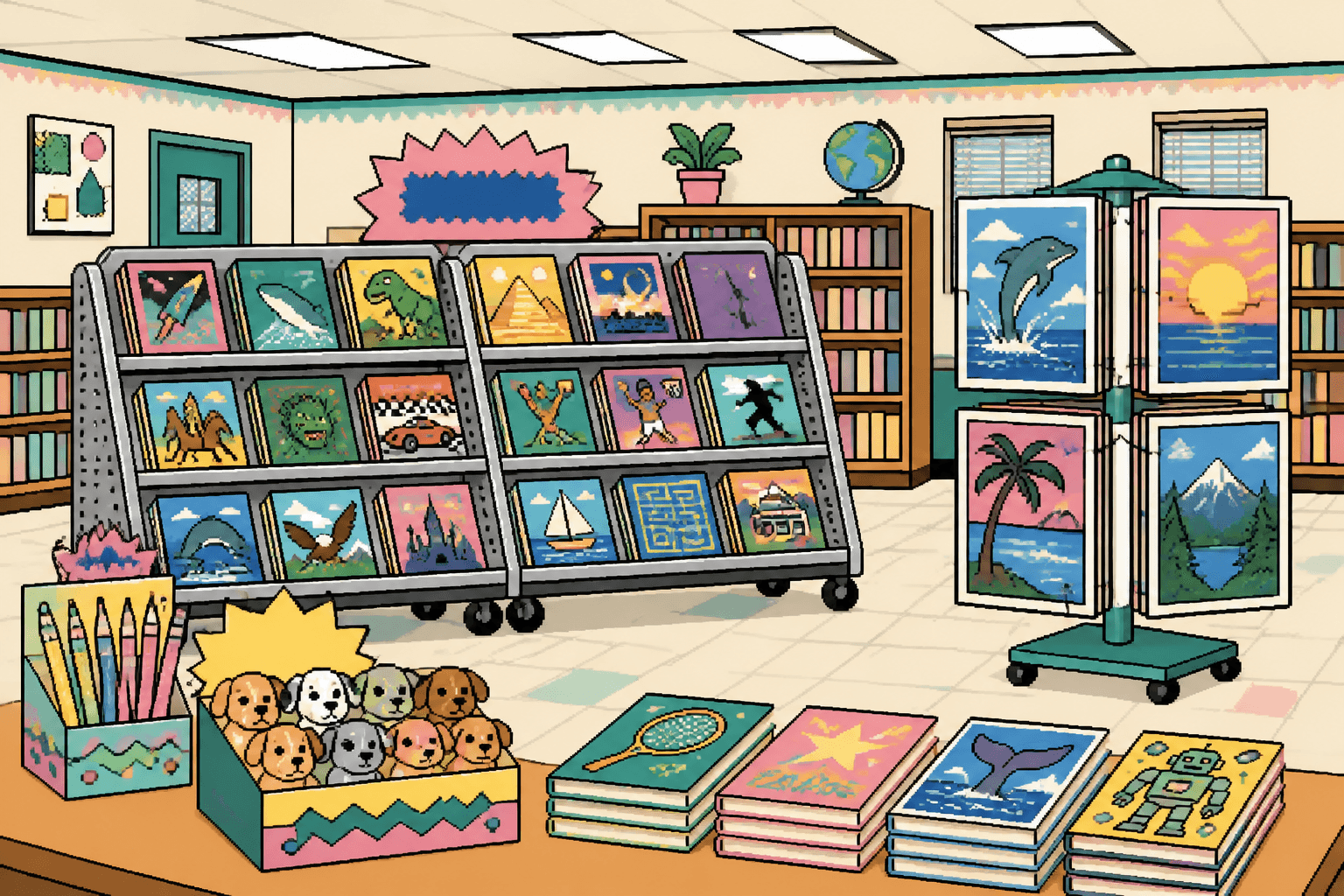
You walked into the library and the library was gone. The library had been replaced by a store. There were four metal cases on wheels that had unfolded themselves into shelves, there was a cardboard poster rack spinning slowly in the corner, there was a long folding table covered in paperback books arranged face up in rows, and there was a woman you had never seen before sitting at the front of the room behind a small plastic calculator and a shoebox of cash.
The library had become capitalism.
The Setup
Here is the exact configuration of a Scholastic Book Fair, which was identical in every school in America.
Three rolling cases, sometimes four, folded open to reveal shelves of paperbacks. These cases had wheels on the bottom and they looked like something you would ship a body in. They arrived on a weekday morning on a truck. The librarian helped unlock them. Each case had a small Scholastic logo printed on the side and a pop-up cardboard header on top that said something like READ. YOU WILL LOVE IT.
A spinning rack of posters, laminated, four to six feet tall, full of the exact categories that mattered. Dolphins. Puppies. A sunset with a quote on it in a serif font. A single poster of Michael Jordan, mid-air, with his tongue out. The dolphin poster was the leader. Everyone wanted the dolphin poster. Nobody bought the dolphin poster because the dolphin poster was four dollars and ninety-five cents and you needed that four ninety-five for a book, which was the whole structural problem of the book fair.
The library had become capitalism.
A folding table of paperbacks with the covers up. R.L. Stine, Ann M. Martin, Beverly Cleary, Louis Sachar, Roald Dahl. A single hardcover copy of Chicken Soup for the Kid's Soul that cost $12.95 and was apparently for a different kind of family than yours.
And then, crucially, the side table. The side table was where they got you. The side table had nothing to do with books. The side table had erasers shaped like animals, pencils with plumes of neon feathers on top, scented pencils that smelled like banana or grape or watermelon, bookmarks shaped like hands, bookmarks with dolphins, a tiny spiral notebook that had three pages in it, and a kit of six pencil toppers shaped like different troll heads. The side table existed to break your five-dollar budget.
The Five Dollars
You had five dollars.
Your mom had given you five dollars. Your mom had said, specifically, this is for a book. Your mom had then added, because she knew you, just a book.
You had agreed to this. You had taken the folded five from the kitchen counter. You had put it in the small pocket of your backpack with the zipper. You had walked to school with the five in the pocket and you had thought about the five all morning, through math, through science, through the phonics drill that was clearly below your reading level. When fourth period finally came and Mrs. Castille said okay class, we are going to the library, you stood up with the five already in your fist.
You walked in and the five was no longer enough.
The books were $4.99. Most of the books. The good ones, the Goosebumps, the Boxcar Children, the one with the dragon on the cover, were $4.99 plus tax, and your state had sales tax, and nobody had explained tax to you yet, so you were operating on five dollars with no float. The hardcover was out. The two-book set was out. The book-with-bookmark bundle was out. You had one book of budget. Maybe.
Unless.
You looked at the side table.
The dog eraser was seventy-five cents. The pencil topper was a dollar fifty. The scented pencil pack was two ninety-five. You could buy two things. You could buy a Goosebumps and a dog eraser and have twenty-six cents left over for the pencil case at home. You could buy three erasers and no book at all. You could buy a pencil with a neon feather on it and still have three dollars and ten cents for a cheaper book and oh my god oh my god.
You were seven years old and you were performing Pareto optimization in a school library.
The whole thing collapsed into a math problem and you were seven.
Try It
You have five dollars. Tap items to drop them in the bag. Watch the total. Try to leave with a book.
The Preview Day
There was always, always a preview day.
The day before the actual book fair, your librarian walked your class through the library and let you look but not buy. This was theoretically so you could plan what you wanted. Functionally, it was the Scholastic company's wishlist mechanism, implemented in 1994 without any technology whatsoever. The librarian handed you a half-sheet of paper with a Scholastic logo on it and said circle what you want and show your parents tonight.
You circled everything.
You brought it home. Your mom looked at it. Your mom said pick one book. You said just one. Your mom said yes, one. You said can it be the one with the dragon. Your mom said we'll see, which was a no delivered on a time-release schedule to minimize the emotional shock.
The next morning your mom gave you five dollars.
Mrs. Gordon
Mrs. Gordon ran the book fair. I do not know Mrs. Gordon personally. I know that every school had a Mrs. Gordon. She was a PTA mom who had taken this on as her annual project, she wore a Scholastic volunteer T-shirt that had been washed one too many times, she sat at the front with a calculator and a receipt pad and a coffee, and she was tracking two numbers in her head at all times: the running total of your purchase, and whether she'd met the volume bonus that gave the school a free box of library books.
Mrs. Gordon was a professional.
- Add seven items with tax in her head
- Spot a kid palming a dog eraser from twelve feet away
- Make change for a twenty without blinking
- Ask a kid very gently if his mom knew he had a twenty
- Add a sticky note to the register with the name of every kid who had already been through twice
- Recognize a Trapper Keeper full of unpurchased pencils and go say something to the teacher
Mrs. Gordon was the whole reason the system worked. She remembered faces. She knew whose brother had come through earlier. She knew who had been told no on the hardcover and who was now trying to buy it anyway with a crumpled ten they had found in a coat pocket. She was not warm, and she was not cold, and she treated every seven-year-old like a customer, which was, to a seven-year-old, the most respectful thing an adult had ever done.
The Bag
The purchase went in a clear plastic bag.
This was on purpose. You could see everything. The whole classroom could see everything. The kid who got a book, the kid who got three books, the kid who had somehow left with the dolphin poster and the scented pencils and still had money for a bookmark, the kid who had gotten nothing because his mom had not known the book fair was today, the kid who had a single eraser rolling around in the bottom of a bag too big for it.
Clear plastic was a status display. You walked back to class with the bag held low or held high depending on what was in it. A full bag was cool. A half-full bag was fine. An empty bag was humiliating, but an empty bag was also, importantly, not possible, because the whole point of the five dollars was that something had to come back.
Clear plastic was a status display. You walked back to class with the bag held low or held high depending on what was in it.
The kid with the hardcover had a parent who did not know what things cost. The kid with the dolphin poster had negotiated something at home we did not understand. The kid with two books had the moral authority of the whole room for the rest of the afternoon.
The Night Read
You went home. You did homework. You ate dinner.
Then you went to your room and you opened the book.
The paperback was fresh in a way you did not have words for. The spine had not been cracked. The cover was glossy in the specific way only a new paperback is glossy, which is to say too glossy, so that your fingerprint showed on it under the lamp. The pages smelled like a smell that does not exist in your life anymore, which was new mass-market paperback, a mix of warm ink and wood pulp and the glue they used to bind the spine, and if you held the book open and put your face into the gutter you could smell it the strongest.
You read the first chapter.
You did not finish the book. Statistically, you did not finish any of them. The point of the book was not finishing it. The point of the book was the having of the book, the acquiring of the book, the little moment on the floor of your room when you were alone with the thing you had chosen out of five hundred things at the book fair. The reading was optional. The reading was, honestly, for school. The possession was for you.
What It Was Actually Teaching Us
I want to take a second and say what the book fair was actually doing.
Scholastic is a company. The book fair is a revenue channel. The fair moved into your library for three days, extracted twenty to forty dollars from each household in the school, left a small cut for the PTA, and rolled out again. The books were marked up. The erasers were marked up. The whole operation was, by any adult accounting, a direct-to-child marketing event that used your public elementary school as free retail floor space and your teachers as free staff. You can look at it that way. It is a defensible reading.
But here is the other thing. The book fair was the first time most of us had five dollars and a decision. We had never shopped alone before. We had gone to stores with our parents, we had asked for things, we had been told no or yes. The book fair was the first environment where there was no parent and there was a wall of options and we had to pick. The side table existed to teach us that there was always a cheaper thing. The books existed to teach us that there was always a better thing we could not afford. The dolphin poster existed to teach us that there was always a want that was not a need.
We were learning how to spend money we did not have on a scale we did not understand, while pretending to be interested in books.
The book fair was a first rehearsal of adult financial life. The hardcover you could not afford was a house. The pencil topper was the three-dollar coffee. The dolphin poster was the trip you did not take because you were saving. The crumpled five in your fist was a paycheck. We were learning how to spend money we did not have on a scale we did not understand, while pretending to be interested in books.
Our parents sent us in with five dollars because our parents were, I now suspect, outsourcing a hard conversation. They could have given us the book. They could have bought it off Amazon instead. They did not do that. They sent us into a gymnasium with a folded bill and let us figure out, alone, that things cost what they cost, and that if you want all of them you have to pick one of them, and that the one you pick is not the one you most wanted but the one that fit inside the number.
That is an entire adult skill. We learned it at a folding table next to a spinner of dolphin posters.
The Catalog That Came Home
A week after the fair, you took home a catalog.
It was a flyer printed in color on cheap paper and it had everything you had seen at the fair, plus some things you had not seen. The flyer was so you could order a book, through your teacher, and have it delivered a week later. The flyer existed because Scholastic understood that the kids who had not spent all their five dollars might have some left, and the kids who had spent all of it might have another five coming on allowance day, and the kids who had bought a book might be ready to buy a second one.
This was its own ritual, but the Arrow catalog ritual is a different post. For now I just want to note that the book fair had a tail. It did not end when the cases rolled out. It ended when the catalog ran out, and even then, it did not really end, because another one was coming in the fall.
What You Still Have
I am going to be honest. I don't remember most of the books I bought at the book fair.
I remember the dog eraser. I remember the scented pencils, which lost their scent in about a week and then just smelled like pencil. I remember the hand-shaped bookmark, which I used exactly zero times because it was the wrong size for a real book. I remember the clear plastic bag. I remember the walk back to class.
I remember one specific book. It had a dragon on the cover. I was in fourth grade. I had taken the five dollars and I had not bought an eraser and I had not bought the pencil and I had, with an amount of restraint I could not now summon as an adult, walked past the whole side table with a stiff back and bought the book. I still have the book. It is on a shelf in my office. The spine has a crease in it from where I once sat on it.
I did not finish it.
I did not finish it. That was never the point.
That was never the point. The point was the gymnasium, the clear bag, the five-dollar decision, the woman with the calculator who treated me like a customer. The point was that at the age of nine I had been handed a budget and told to do something with it, and I had done something, and the thing I had done was choose.
The book fair is still running. Scholastic still rolls those cases into a library somewhere today. There is a kid right now, in a gym, holding a folded five, looking at a dolphin poster and a Goosebumps book, and running a small spreadsheet in his head.
I hope he picks the book. I know he won't finish it. It does not matter.
He will remember that he picked it.