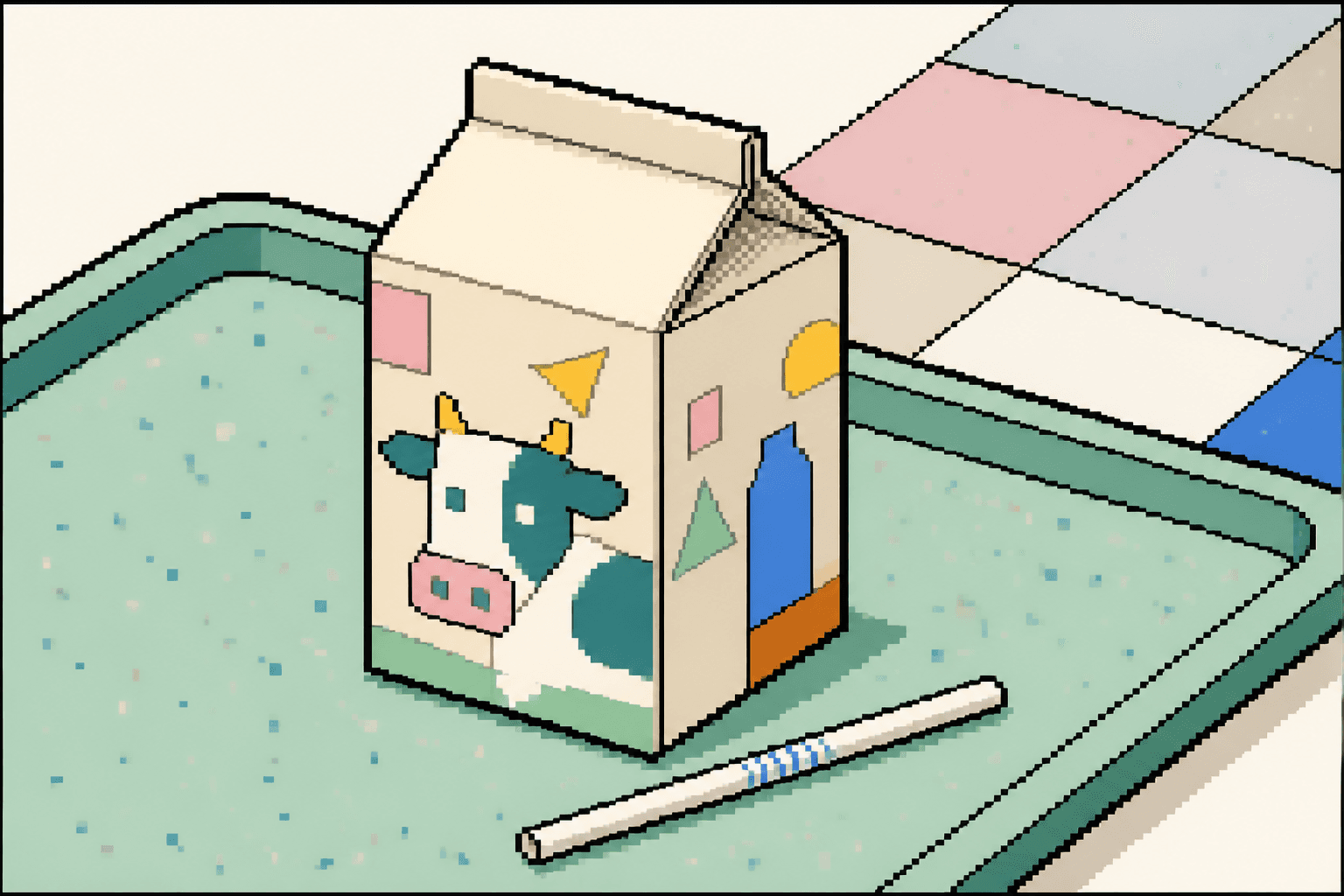
The crate came in on a cart with one wheel that didn't turn right.
It was the aluminum crate, the kind with little square dividers inside, and in each square sat a half-pint milk carton standing straight up like a soldier. The cart rolled into the cafeteria at 11:42 and the lunch lady - her name was Linda or Patty or something ending in a Y - lifted the crate and slid it into a slot at the end of the serving line. The cartons were cold to the touch, but not as cold as they should have been. A few on the bottom row had been there since breakfast. You never knew which ones.
You grabbed one. You slid your tray along the metal rails. You sat down.
Now the real test began.
The Gable Top
The half-pint milk carton is a piece of industrial design that has not meaningfully changed since 1936. It's called a gable top. Two folded triangular flaps meeting at a center ridge, like a tiny house roof made of waxed paper. The idea was: you pinch the ridge, you pull the two flaps apart, and the top unfolds into a diamond-shaped pour spout. Elegant. A packaging engineer won an award for it. Probably two awards.
The problem was that it only worked from one side.
Two folded flaps. One opens into a pour spout. One tears into a wet paper wound. The box does not tell you which is which until after you've chosen.
The flap you could pull cleanly - the one that unfolded into the little peaked spout - was glued, at the factory, with slightly less adhesive than the one on the other side. The other side was a trap. It was sealed harder. It wasn't supposed to open. If you pulled on it, the paper stretched, resisted, and then split - not along the fold, but at some random point, tearing a jagged wet gash across the top of your carton. The flap would come off in your hand, soft and limp, with flecks of wax stuck to your fingertips.
You could not tell, from the outside, which side was which.
The Fifty-Fifty
You had a fifty-fifty shot.
Not even really fifty-fifty, because you'd convinced yourself, by the fourth grade, that you could read the carton. There was a trick. There had to be. You looked for a subtle difference in how the two flaps sat. One looked slightly more pinched, maybe. Or slightly less. You squinted at the ridge. You rotated the carton. You consulted an inner oracle that had been failing you for years and would keep failing you.
Then you pinched. You pulled.
And one of two things happened.
- Clean open (best case): The flap unfolds into a diamond spout. You feel like an engineer. You pour. You replace the flap most of the way. You drink.
- The resistant flap (mid case): It won't budge. You know, immediately, you picked the wrong side. You turn the carton around and open the other side, pretending nobody saw.
- The torn flap (worst case): You pulled too hard. The paper tore at the fold. You now have a jagged wet mouth on top of your carton, and the only way to drink is to tip it so a stream of milk comes out of a slot that is, structurally, a wound.
- The crumple (special loss): You somehow crushed the whole gable top. The ridge collapsed. You cannot find the fold. The carton is now a small white box with a damp crater where a pour spout should be. You use a straw.
The cruelest part was the text. On the side you had just ruined - on the inside of the torn flap you were now looking at - there were three small words, printed in a plain sans-serif font, in red:
OPEN OTHER SIDE.
You had, on average, half the time, chosen the exact side the carton had labeled, in advance, as not that one. You just couldn't see it until you'd already done it. It was an insult printed in milk ink that only revealed itself after you'd lost the bet.
OPEN OTHER SIDE. Three words, in red, on the inside of the flap you had just destroyed.
The Straw
The straw was there to help you, in theory. There was a little basket on the lunch line full of thin, striped, bendy plastic straws, and you were allowed to take one. The straw was for punching through the top of the carton, right in the center of the ridge, when you had torn both sides open and were about to cry.
You stabbed. The straw bent. You stabbed again. The straw bent further, in a different direction, until it looked like a small plastic avalanche. You switched to the blunter end. You pushed. The carton resisted. Then, suddenly, it gave, and the straw punched through, and milk came up the straw and splashed onto the tray and you pretended that was fine.
The straw was a confession. If you were using a straw, everyone at the table knew what had happened. The straw was for kids who could not open the carton. The straw was shame in a long thin plastic form. The kids who could open the carton cleanly - and there were a few, always, every grade, the carton savants - did not use straws. They had the diamond spout. They tipped the carton like adults. They were the aristocracy of a cafeteria economy you were still trying to figure out.
The Flavors
There were three.
White was the default. 2% white milk, the kind that tasted of the crate it had been in. It was fine. It was fuel. Nobody chose white if they had a choice.
Chocolate was the one you wanted. Chocolate was negotiated for, traded for, saved up for in a sense that had nothing to do with money. Chocolate milk came in a brown-red carton with a cartoon cow who was, implausibly, winking. The chocolate milk itself was thicker than regular milk and left a film on the inside of the carton that you could not rinse out and that would, if you forgot about the carton on your desk, begin to smell by Thursday.
Strawberry appeared on Fridays and only on Fridays. Pink milk. A controversial flavor. Half the kids loved it and half the kids thought pink milk was an abomination. The pink was aggressive. It was the pink of a highlighter, not of an actual strawberry. Nobody has ever eaten a strawberry that pink.
- Chocolate. Always. Non-negotiable. If chocolate was in the crate, chocolate was in your tray.
- Strawberry, but only on Fridays. Any other day, strawberry would have been unsettling.
- White 1%. Marginally better than 2%. Nobody could articulate why.
- White 2%. Fine. Acceptable. The tofu of milks.
- White whole. Too rich. Felt like drinking a cow directly.
- The last chocolate in the crate. Warm. Cursed. Still better than any white.
The Carton Was Also a Billboard
Somebody, somewhere, had decided that a flat panel of a milk carton was the right surface on which to publish a missing-child advertisement.
I don't know who that was. I don't know when it started or when it stopped. But in my memory, every half-pint in the cafeteria had, on at least one side, a photo of a child who had disappeared. HAVE YOU SEEN ME, it said, in friendly serif. Below the photo was an age that had been printed as if the kid were still that age. Below that was a date they had last been seen that was, often, before you had been born.
You read it. You were eight years old, sitting on a plastic chair, holding a carton of 2%, and you read about a missing kid. And then you ate your tater tots.
Nobody explained what you were supposed to do with that information. The photo was not accompanied by a plan. You were not expected to call anyone. The adults around you were also not calling anyone. The photo was just there, published on the side of a dairy product, in rotation with ads for the state fair and friendly reminders about washing your hands, and we all went about our day.
We read about missing kids on our milk cartons at lunch. And then we ate our tater tots. Nobody thought this was strange.
I'm not going to make too much of this, because I don't know what I think about it. I know that it felt normal at the time. I know that it does not feel normal now. I know that the kids on those cartons are, if they are alive, adults my age, and that some of them are probably still missing, and that the odds of the carton having helped find any particular one of them were vanishingly small. The milk carton was participating in a civic duty nobody had asked it to perform, and it was doing it half-heartedly, between the nutrition facts and the picture of the barn.
Try It
Pick a side. You get one shot. If you lose, the carton will tell you, in red, which side you should have picked, right there on the inside of the one you just destroyed. The straw is available if you want to admit defeat.
The Tray
The tray.
Here is what you don't remember, because it was too ordinary to remember: the tray was divided into compartments. A big one for the entree, two small ones for the sides, and a small round well for a cup. The milk carton did not fit in the well. The well was for a cup. The milk carton sat beside the tray, or on the tray balanced precariously on the edge of a compartment, or in the empty space between the entree and the corn.
Which meant the carton tipped. A lot. The carton tipped and milk came out of the torn flap or the straw hole and pooled on the tray or on the table, and the lunch monitor made you wipe it up with a rough brown paper towel from the dispenser by the trash, and the paper towel got progressively wetter until it was translucent and useless, and you threw it away and got another one, and this was, somehow, the normal operating condition of a cafeteria.
The whole lunchroom smelled faintly of spilled milk at all times. Not in a dramatic way. Just a background note, under the tomato sauce and the industrial soap, of dairy that had hit a surface it wasn't supposed to.
What the Carton Was Really For
Here is my theory. Nobody asked for it.
The gable-top half-pint milk carton existed, in the late twentieth century American school cafeteria, as one of the only objects a child was handed that was harder to use than it looked. Everything else at school came with instructions. The scantron sheet had a little arrow showing which end was up. The textbook had a title. The lunch tray had a slot for a cup. The pencil had an eraser on one end and a point on the other and nobody had to tell you which was which.
The milk carton did not.
The milk carton was given to you, already sealed, and you were expected to figure it out. There was no demonstration. The lunch lady did not come over and show you. The teacher at the end of the table was eating a sandwich and had problems of her own. You had, functionally, a box of liquid, and you had to get the liquid out of the box, and you had about twenty-five minutes, and if you tore it wrong, you had to drink it the hard way.
This was, I think now, a kind of test. It was not a hard test, and it was not an important test, but it was a test. Every lunch period in every school in America, children were handed a small container that required them to think about an object, develop a hypothesis, commit to a motion, and absorb the consequences. The carton did not explain itself. It assumed you'd figure it out. And if you didn't - if you tore the wrong side - the carton told you, kindly but firmly, in three red words, that you had been wrong.
The milk carton assumed you'd figure it out. If you didn't, it told you, kindly but firmly, that you had been wrong. Then it gave you another one tomorrow.
I'm not going to overclaim this. It was a carton. Most of the time I tore it wrong and drank from a jagged hole and did not feel particularly educated by the experience. But something about the ritual of it - the pinch, the pull, the fifty-fifty bet, the small quiet moment of victory when it unfolded clean - that was a real thing. That happened to me every day at lunch for about a decade. It was practice at a kind of patience and a kind of observation that I would not have known to call either of those things.
Where They Went
They still make them. You can still get a half-pint in a gable-top carton, somewhere, if you know where to look. But most schools have moved to plastic cups with foil lids, or those little screw-top bottles, or juice-box-shaped Tetra Paks with a punch-through straw.
Which is fine. Those are all better engineering. The plastic cup lets you see how much milk is left. The bottle reseals. The Tetra Pak comes with its own straw, already sized to the carton, already pointed at the exact spot you're supposed to stab. These are improvements, measured on any axis you'd care to measure.
But none of them tell you, in red, that you've been wrong.
I don't think the kids in those schools are missing anything in particular. They are not going to grow up and write an essay about a juice box. The juice box is not memorable. The juice box works. That's why it doesn't matter.
What mattered about the milk carton was that it didn't work. Or, more precisely, that it worked only if you paid attention. For a generation of kids, before lunch every day, there was a tiny moment of truth - pinch, pull, hope - that nobody noticed because it was too small to notice. We opened a billion cartons. We poured a billion diamond spouts and tore a billion jagged wounds. We drank the milk, warm or cold, from the right side or the wrong side, from the clean spout or the jagged slot or the bent straw.
I don't miss the taste. The milk was fine. The milk was always just fine.
I miss the ridge in the middle, and the fold on either side, and the three red words on the flap that said, as gently as a carton can say anything:
Not that one. Try again tomorrow.