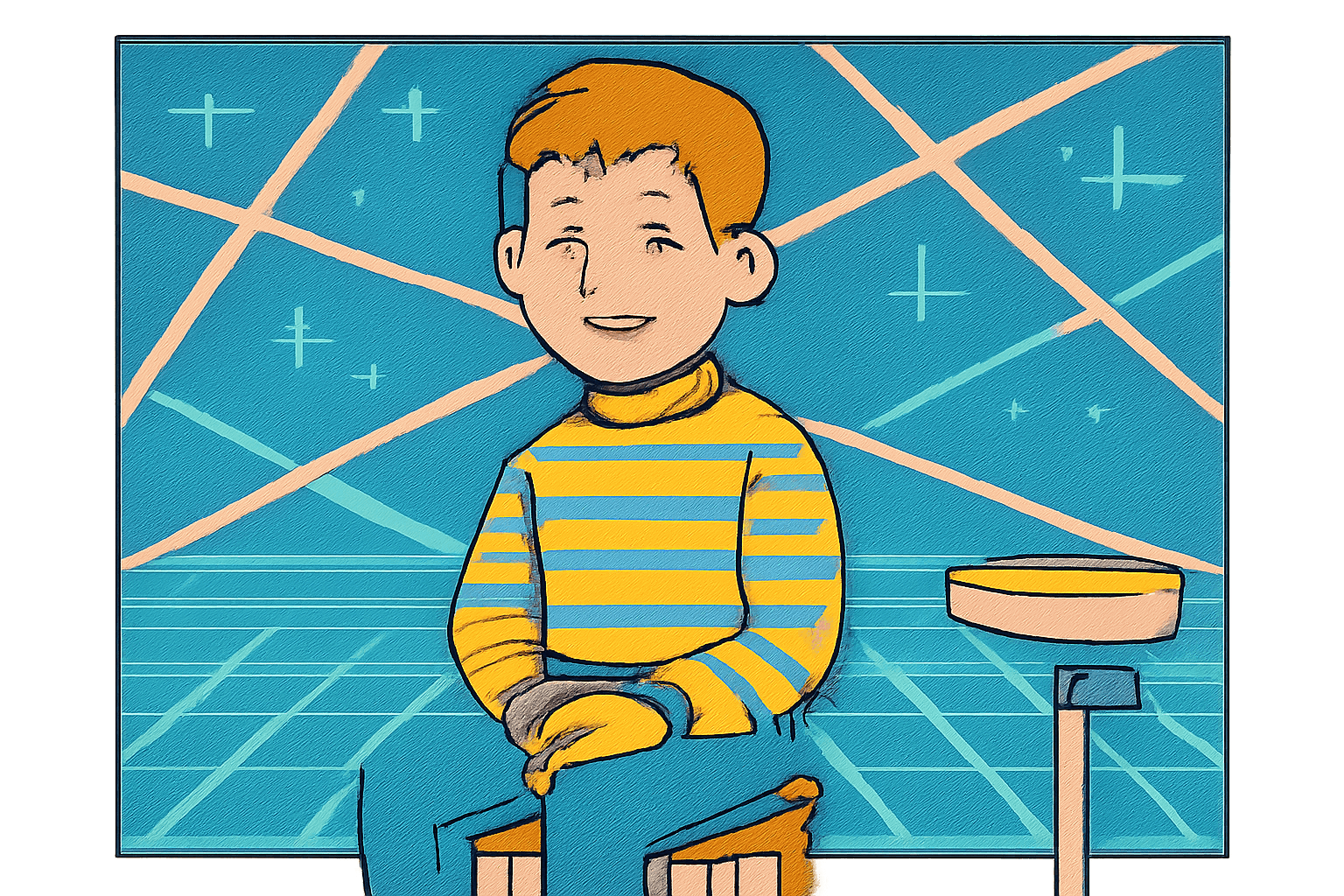
There is a photo of you somewhere. It is in a frame, or a drawer, or the bottom of a box marked memories in your mom's handwriting. You are ten. Your hair is doing something. Your collar is a little crooked. You are smiling with exactly the wrong number of teeth.
And behind you, over your shoulder, crackling like a science fair gone wrong, is a grid of blue laser beams shooting off into infinity.
Nobody asked for the lasers. Nobody said you know what would really capture Brandon's essence this year? A wireframe tunnel into the void. But there they were. Every third kid in the yearbook, haloed in tron-blue light like they were about to be beamed up by a very specific kind of alien.
The Default Setting
Here's the thing about picture day. You didn't pick the background. Not really. Your mom checked a box on a form she filled out at the kitchen table two weeks earlier, half-watching Wheel of Fortune, and the box she checked was whichever one cost the least. That's it. That was the process.
The laser background wasn't chosen. It was inherited, like brown eyes or a last name, or the particular shade of beige your mother kept painting the hallway.
The form had maybe four options. Traditional (gray clouds, looked like a funeral home). Autumn (fake leaves, looked like a Cracker Barrel menu). Spring (blurry flowers, for girls whose parents were Really Into It). And then. Contemporary. Which meant lasers. Which meant that a machine somewhere had decided your face would be forever backlit by what appeared to be the inside of a TI-83 calculator having a seizure.
Contemporary was cheapest. Contemporary was the default. Contemporary was a whole generation.
The Physics of It
Let's actually look at the background. I mean really look.
It was never the same twice. Sometimes it was a blue grid receding into a single vanishing point, like the opening credits of a 1984 movie about hackers. Sometimes it added pink. Sometimes there were little bursts of light, concentrated at random in the upper corners, suggesting that somewhere just out of frame a laser pointer was being held by an excited dog. Sometimes the grid tilted, and you leaned into it, and it looked like you were sliding sideways into cyberspace on roller skates.
The unifying theme was the future. Or someone's idea of the future. The future as imagined by a man named Gary who worked at a portrait company in a strip mall in Cincinnati and had seen Tron exactly once.
None of this matched the rest of the photo. You were wearing a turtleneck. Your hair had been wet-combed by your mother approximately forty minutes earlier. You were holding a plastic comb that the photographer had just handed to you. And behind you, the fabric of space and time was coming apart in a cool neon lattice, as if to say don't worry about the double chin, focus on the portal.
The Photographer Was Always Named Something Like Dale
The man taking the picture was always a guy. Not a photographer in any meaningful sense. He was a guy, in a short-sleeve dress shirt, who had been driving a van full of backdrops from elementary school to elementary school since the Carter administration.
Dale had a stool. Dale had a little stuffed animal on a stick that he'd wiggle next to his ear to make you smile. Dale had one joke, and it was say cheese, or don't, I don't care. Dale would position your chin with two fingers, like he was tuning a radio. Dale had deep opinions about head tilt.
- Little kids got the tiny stool
- Big kids got the taller stool
- The tallest kids just stood
- Nobody ever got an actual chair
- Dale adjusted the height with a knob that made a pneumatic hiss, and it was the only moment of drama in the entire process
Dale did not set up the laser background. The laser background was already there when Dale arrived. The laser background had been there forever, a cosmic constant, a Planck-length artifact of late-capitalist American childhood. Dale just rolled it down from a spring-loaded tube like a window shade and pointed at the taped X on the floor.
The Proof Sheet Was a Document From Another Dimension
Two weeks later a manila envelope came home. Inside, a proof sheet. Dozens of tiny versions of you, each one slightly worse than the last, arranged in a grid that echoed the grid behind your head. A little chart with package letters. A. B. C. D. E. Each one a different combination of sizes. Each one a different price.
The smallest wallets were for distribution. You'd cut them out with craft scissors, hand them to your four best friends, and say you have to sign the back. They'd write something like 2 cool 2 be 4gotten. Or stay sweet. Or the full lyrics to a song by Third Eye Blind, depending on how much space there was.
You were trading tiny pictures of yourself like baseball cards, and the baseball card back was a hallucination of the information superhighway.
The 8x10, if your mom ordered one, went on top of the television. If your mom was a hanger, it went on the wall in the hallway, alongside eleven previous versions of you, each one floating in its own laser storm, a documentary of how your face had been slowly assembled by genetics and orthodontia across a decade of Februaries.
The Retake
A small number of children got retakes. This was a negotiated process.
Reasons included: eyes closed, visible booger, hair cowlick that had achieved low earth orbit, a sibling on a different day making a face just off-camera, or the universal horror of a parent opening the envelope and seeing their child make an expression they had never made before in their life, like a very small man who had just tasted olives.
But the retake did not offer a different background. The retake offered the same background. You'd show up a week later, in a different shirt, and step back onto the taped X, and the lasers would resume their slow electric gossip behind your head like they'd never stopped, because they hadn't. Because they were the default. Because nobody had picked them the first time either.
The Aesthetic Nobody Named
Here's what I can't get over. The laser background wasn't weird to us. It was the water we swam in. When I saw my friends' school pictures, they had lasers too. When I saw my cousins' school pictures, lasers. When I flipped through the yearbook, I was looking at rows and rows of children in various stages of permanent tooth eruption, all of them being gently electrocuted by a cyan force field.
It looked, in retrospect, completely insane. Like picking kids up from karate practice and posing them in front of a screensaver. Like every child in America had briefly joined the cast of Quantum Leap. Like the portrait company had gotten confused about whether it was documenting grade school or documenting the birth of a digital consciousness.
And yet, here is the thing. When I pull out the photo now - the real one, the 5x7 in its little gold cardboard frame with the year printed in fake-embossed script - I don't think wow, what a strange background. I think there I am. There's the turtleneck. There's the crooked smile. There's the part in my hair my mom dampened with a spit-wet thumb in the parking lot.
The lasers don't look dated to me. They look like me, at ten, trapped in amber, or trapped in a grid, or trapped in the specific light that every 90s childhood was shot against whether we noticed or not. A backdrop we didn't choose that somehow chose us.
My mom has the 8x10 on her hallway wall. I'm at the end of a line of them, an ascending stairway of slightly larger versions of my face, each one floating in a slightly different color of electricity. She's never once said anything about the backgrounds. Not once. It wouldn't occur to her. To her, those are pictures of her son. The lasers are a part of the air. They don't need commenting on any more than the paint on the walls or the carpet on the floor. They were just what was behind you when they took the picture. They were just what was there.