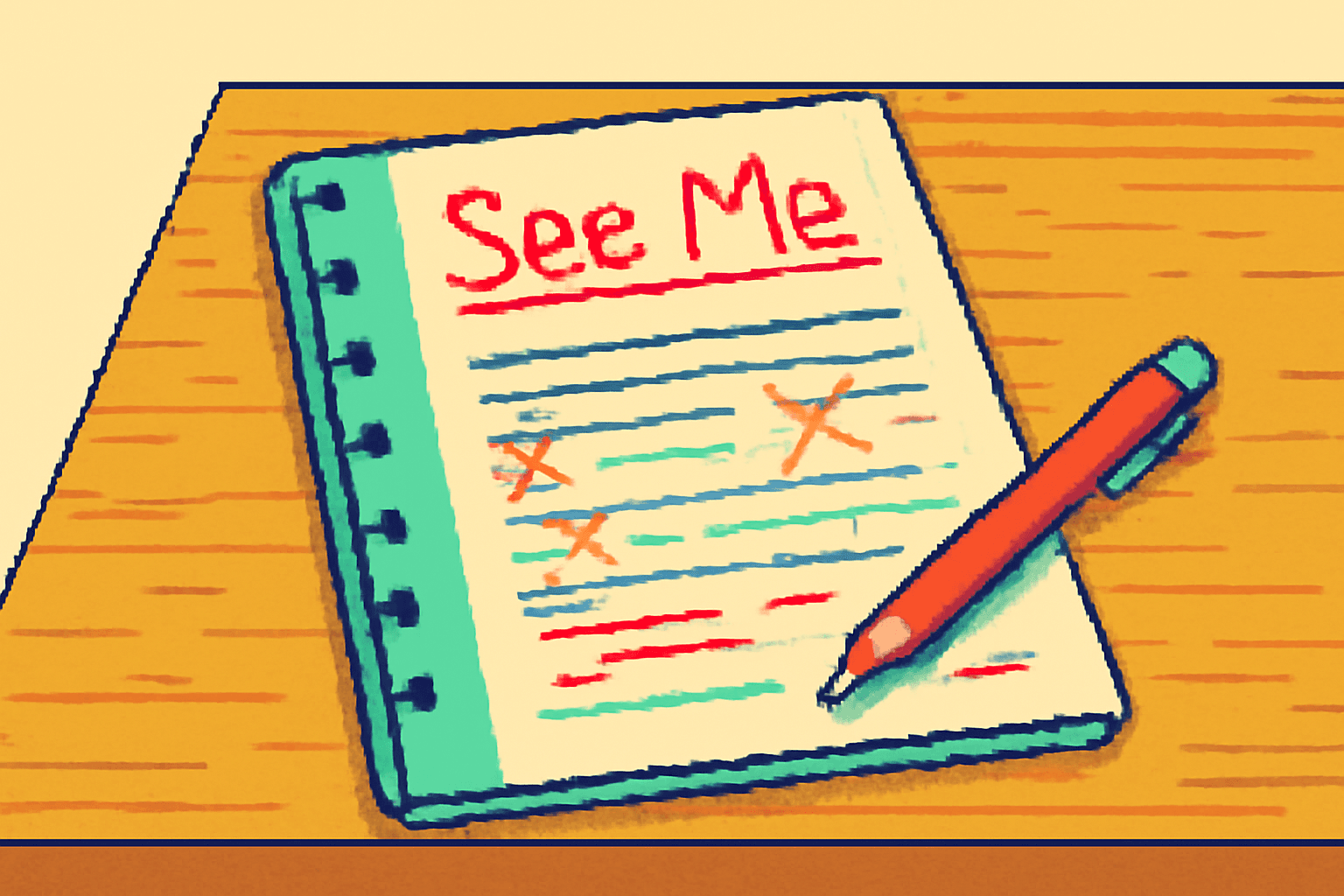
The handwriting was slanted and sharp, like it had been written in a hurry but also with intent. Red ink. Top right corner of my book report on Hatchet by Gary Paulsen. Two words, underlined once: See Me.
No period. No explanation. No smiley face to soften the blow. Just "See Me" - a summons from Mrs. Delvecchio, third period Language Arts, written in the color of emergencies and stop signs and things that are wrong. I folded the paper in half immediately so nobody at my table could see it. Then I folded it again. Then I shoved it into the back of my Trapper Keeper like I was hiding evidence of a crime. Which, for all I knew, I was.
That was the thing about "See Me." It gave you nothing. No context. No hint. Just a command and the vast, howling space of your own imagination to fill in the rest.
The Walk
You had to go up there. That was the deal. You couldn't ignore it. You couldn't pretend you didn't see it, because the teacher knew you saw it, and not going up there would make it worse. Whatever "it" was. You didn't know what "it" was. That was the entire problem.
The walk from your desk to the teacher's desk was maybe fifteen feet. It felt like a quarter mile. You were aware of every pair of eyes on you, even the ones that weren't actually looking. You carried the paper with you - the evidence, the document - and you placed it on the desk like you were turning yourself in at a police station.
"See Me" gave you nothing. No context. No hint. Just a command and the vast, howling space of your own imagination to fill in the rest.
And then you waited. Because Mrs. Delvecchio was helping another kid. Or she was writing something on the board. Or she was taking a sip of coffee from a mug that said "World's Best Teacher" on it, which in that moment felt like false advertising. You stood there at the side of her desk, paper in hand, while your brain cycled through every possible crime you might have committed. Did I plagiarize? I didn't plagiarize. Did I accidentally plagiarize? Is that a thing? Did I spell something so badly it looked like a different, worse word?
Sometimes it turned out to be nothing. "I just wanted to check - did you mean to turn this in without the second page?" Sometimes it was something. "This doesn't sound like your writing." Both options were devastating in different ways. One meant you were careless. The other meant you were a fraud.
The Red Pen Ecosystem
"See Me" didn't exist in isolation. It was the apex predator in an entire ecosystem of red pen communication that teachers deployed across your work. Every mark was a message. Every mark had a feeling.
The check mark was neutral. It meant "I read this and it exists." Not good, not bad. Just acknowledged. The check-plus was warmth. The check-minus was a warning shot.
The question mark in the margin was its own special torture. A red "?" next to a paragraph you'd worked hard on. What was confusing? What didn't make sense? You'd reread your own sentences ten times trying to see them through the teacher's eyes. Sometimes you genuinely couldn't figure it out, and then you were stuck in a loop - confused about why the teacher was confused, which made you feel doubly stupid.
The circled word with no note was similar. Just a red oval around "ubiquitous" or whatever vocabulary word you'd tried to deploy to sound smart. Did you use it wrong? Spell it wrong? Was the teacher impressed or concerned? The circle held no answers. The circle was a locked door.
And then there was the holy grail. "Nice work!" with an exclamation point and sometimes - if you were truly blessed - a smiley face drawn next to it. You'd stare at that smiley face like it was a love letter. Mrs. Delvecchio drew this. For you. She used her red pen, the instrument of suffering, to create joy. You'd show your mom. Your mom would put it on the fridge. For one evening you were a scholar.
The Report Card Comments
The red pen was immediate feedback, paper by paper. But report cards were the quarterly review, the big picture, the thing your parents actually cared about. And the comments section at the bottom - the little rectangle where the teacher had to write something about you as a person - was where the real verdicts lived.
"A pleasure to have in class." That was the gold standard. Five words that meant you were good. Not just at schoolwork - at being a student. At being a human in a room with other humans. Your parents read that line and exhaled. You were fine. Their kid was fine.
"Needs improvement in conduct" was the opposite pole. Your dad read that line out loud at the kitchen table while you stared at your plate of Hamburger Helper and tried to disappear. "Conduct" was such an adult word. You were nine. You didn't even know you had conduct. But apparently yours needed improvement, and now there would be a conversation about it, and the conversation would be worse than whatever you'd done in class, which was probably just talking too much.
"A pleasure to have in class" meant you were fine. Not just at schoolwork - at being a human in a room with other humans.
"Works well with others" was a relief unless it was conspicuously absent. "Shows potential" sounded like a compliment until you thought about it for two seconds and realized it meant you weren't living up to something. "Could benefit from more focus" was teacher code for "your kid stares out the window and I'm tired."
The comments were never longer than a sentence or two. Teachers had thirty kids and a tiny box to write in. But those sentences carried weight that the teachers probably never intended. I can still quote my fourth-grade report card. Mrs. Patterson wrote "a bright student who sometimes lets socializing get in the way of his work." I was ten. I've thought about that sentence for twenty-plus years.
The Signature Line
And then there was the final indignity. The parent signature requirement.
This was the school's way of making sure you couldn't intercept the report card like a spy and bury the evidence. You had to bring it home. You had to show your parents. And they had to sign it - proof of receipt, proof that they'd seen your grades and the comments and the conduct evaluation and whatever else was in there.
If the report card was good, this was a formality. Your mom signed it at the kitchen counter and you brought it back the next day, no big deal. If the report card was bad, the signature line became a ticking clock. You had it in your backpack. It had to be signed. Every hour you didn't produce it was another hour of dread. Some kids tried to forge the signature. Some kids "lost" the report card and had to get another one, buying themselves a few days. I knew a kid who claimed his dog ate it, which even in 1997 was not a believable excuse.
The signature meant your parents were now in the loop. The red pen marks on individual papers could be hidden, buried in the chaos of your backpack. But the report card with the signature line was accountability. It was the system making sure the message got through.
What the Red Pen Really Was
I'm a long way from Mrs. Delvecchio's classroom now. I understand, as an adult, that teachers were overworked and underpaid and grading papers at their kitchen tables at ten o'clock at night. I understand that "See Me" was probably just efficient communication - a way to flag something that needed a conversation, not a written note. I understand that the red pen was a tool, not a weapon.
But understanding that doesn't change what it felt like. And what it felt like was a verdict. Every paper that came back was a judgment not just on your work but on you. Your intelligence. Your effort. Your worth as a person in the classroom economy. An A meant you were smart. A C meant you weren't. A "See Me" meant something was wrong with you specifically, something so serious it couldn't even be written down.
We processed those marks alone, mostly. You got your paper back, you saw the grade, you saw the comments, and you sat with it. No therapist. No framework for understanding that a grade on a book report about Hatchet was not, in fact, a comprehensive assessment of your value as a human being. You just absorbed it. You folded the paper and shoved it into your binder and carried it with you.
I still have good handwriting. I think about that sometimes. How carefully I wrote in school, how neatly I formed each letter, because some part of me believed that if the penmanship was good enough, the red pen might be kinder. That if I made my words look right, they might also be right. I'm not sure I ever stopped believing that.