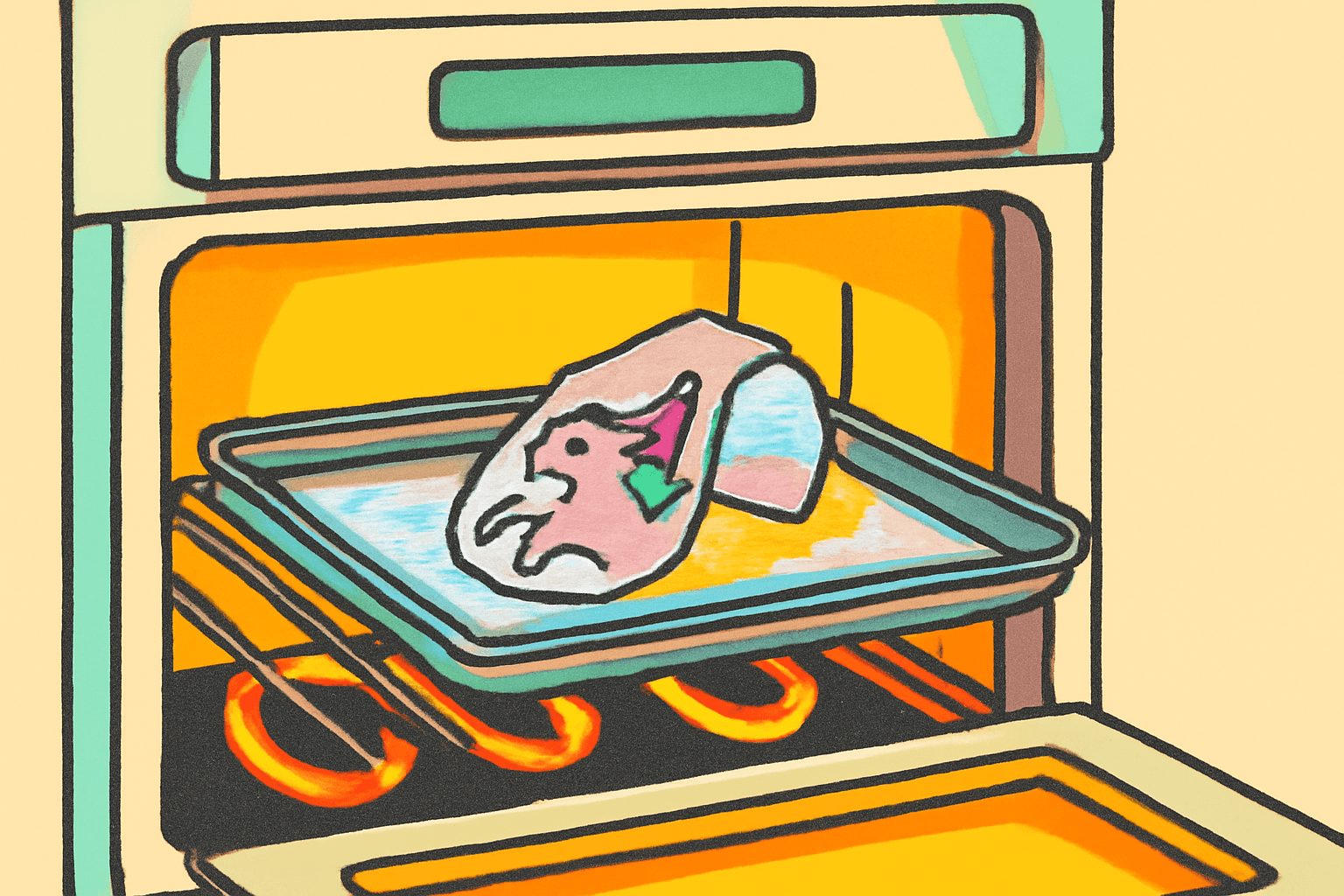
The first time you put one in the oven, you stayed by the glass. You had to. The instructions said two minutes, sometimes less, and you'd been told - by the box, by the older sister, by the babysitter who'd done this before - that there was a moment when the plastic would do something alarming and then go back to normal, and you should not, under any circumstances, open the oven during the alarming part. So you sat on the kitchen tile and watched.
For about thirty seconds, nothing happened. The flat sheet of plastic, with your unicorn drawn on it in colored pencil and one panicky line of Sharpie, just sat on a piece of aluminum foil on a cookie sheet, behaving normally. Then it lifted at one corner. Then both corners. Then the whole thing curled up into a tube and flopped over onto its side, like a pill bug startled by a finger.
You almost screamed.
And then, slowly, it relaxed. The plastic uncurled. It settled flat again. It was now a third of the size it had been ninety seconds ago. It was also, somehow, thicker than a credit card. Your mom said get back and pulled the cookie sheet out with a dishtowel. The unicorn was a thumbnail.
What It Was
The Shrinky Dink was a sheet of polystyrene - a #6 plastic, the same plastic as a yogurt container or the clear clamshell your grocery store mushrooms came in - rolled out into a thin, semi-rigid sheet about the size of a piece of paper. The plastic had a slight roughness on one side that took colored pencil. The other side was glossy and rejected pencil entirely.
You drew on the rough side. Then you cut out your shape with safety scissors. Then, critically, before baking, you punched a hole in it with a hole puncher, because you would not be able to do it afterwards. Afterwards the plastic was a tiny dense chip that no school hole-puncher could bite through. The hole had to exist as a future plan, in the present tense.
Then you went to your mom and asked if you could use the oven.
The oven was important. The Shrinky Dink wasn't a toy, exactly. It was a chemistry experiment that required adult supervision and the temporary transformation of a kitchen appliance into a craft station. Your mom had to be in a particular mood. She had to sigh, get the cookie sheet, line it with foil, and accept that for two minutes the apartment was going to smell like burning plastic. She did this for you because she loved you and because you had not stopped talking about it for forty-five minutes.
The Plastic Has a Memory
Here is the science, which I learned in middle school, after watching the curl about five hundred times.
The plastic sheet was made by a process called stretching. They took a thicker piece of polystyrene, heated it up, and pulled it out flat into a sheet, locking the molecules in a stretched configuration. The plastic wanted, at a molecular level, to go back to its original chunky form. The only thing keeping it stretched was that it had cooled before it could go home.
When you put it in the oven, the plastic remembered.
The molecules, given heat and permission, curled back into the shape they used to be. That's what the wild curling moment was. Not a malfunction, not a glitch, not a reason to call your mom in from the other room. The plastic was remembering. It was undoing whatever decade it had spent being a flat piece of consumer-grade craft material and going home to whatever cube or chip it had been in 1973.
The plastic was remembering. It was undoing whatever decade it had spent being a flat piece of consumer-grade craft material and going home.
The first thirty seconds, it got warm. Around sixty seconds, it lifted and curled into the most alarming taco shape you'd ever seen a piece of plastic make. Around ninety seconds, it relaxed and settled back down at one-third the size, several times thicker than it had been, with the colored design now compressed and saturated into something more vivid than what you'd drawn.
The colored pencil had migrated into the plastic. The Sharpie had darkened. The keychain hole was now actually a hole, big enough for a key ring, exactly because you'd thought ahead.
What You Drew On Them
Everyone drew the same things.
Your name. Your initials inside a heart. A unicorn. A dolphin. The Nike swoosh. A peace sign with a yin-yang in the middle. Your favorite Pokémon, copied as accurately as you could manage from the back of a card. Lisa Frank-anything: a cat with rainbow fur, a bear with stars on its cheeks, a planet with a smiley face. You signed it on the back. You always signed it on the back. The Shrinky Dink would shrink the signature too.
Some kits came with pre-printed designs that you just had to color in - a Disney character, a butterfly outline, a Beanie Baby tag. These ones behaved. The lines stayed inside the lines because someone older had already done the hardest part. The freehand ones were where the personality leaked in. You'd freehand a hand. The hand would shrink. The hand was now a thumbnail-sized hand, with all your bad anatomical decisions preserved at higher density, and you would put it on a keychain and hand it to your dad.
The Smell
We need to talk about the smell.
A Shrinky Dink in an oven smelled bad. Not catastrophically bad. It didn't smell like a fire. It didn't smell like the time your dad melted a Tupperware on the stove. But it smelled. It was a dense, sweet, chemical smell with a note of warm crayon and something more honest underneath, something that announced plastic is being heated in a way that no air freshener was going to fix.
Your mom would crack the kitchen window. The cat would leave the room. The smell would persist for an hour and a half after you were done. It would get into the curtains. It would, briefly, suggest that what you were doing was perhaps not fully a thing children should be doing, which made it more fun.
I won't pretend I know now what was off-gassing in there. Polystyrene at 325 degrees is doing some chemistry, and the chemistry is not entirely benign, and I'm sure if you'd asked the manufacturer they'd have shrugged and pointed at the use in a well-ventilated area line on the box. The Shrinky Dink was a product of an era when the general assumption was that if a thing had been sold to a child, it was probably fine, and if it wasn't, you would find out later, at a doctor's appointment.
The Failure Modes
The Shrinky Dink had a small but vivid catalogue of ways it could go wrong.
- Stuck in the curl. It went up but did not come back down. You now had a plastic taco that no amount of additional baking would unfold. Plastic taco was the final form.
- Welded to itself. It curled, touched itself, and fused. You'd open the oven to a tiny plastic bowtie that was supposed to be a butterfly.
- Stuck to the foil. A corner of the design fused into the aluminum, and now your dolphin had a permanent silver fin. Sometimes you could peel it. Usually you could not.
- Browned. Left in too long. The whole thing turned the color of a Hot Pocket and the design was no longer visible.
- Warped. It came out flat-ish, but slightly bowed, and on a flat surface it would rock.
The warped ones were the most common, and the most frustrating, and somehow the most accurate to whoever made them. The Shrinky Dink wanted to be flat at the end, but if you'd cut a long, thin shape - a snake, a banner, the word FRIENDS in cursive - the shrinking on different axes fought, and the plastic settled into a small saddle shape that looked sort of intentional. You'd put it on a keychain anyway. Your keychain didn't care.
The Keychain
I want to talk about the keychain for a second.
Every Shrinky Dink, eventually, became a keychain. There was no other place to put them. They were too thick to be stickers. Too small to be coasters. Too clearly made by a child to be jewelry on someone older than ten. The keychain was their natural home, threaded onto a metal loop, dangling next to your house key and the plastic Y of your library card.
You put it on your backpack zipper. Or your dad put it on his keys, briefly, because you had asked him to, and a week later he quietly moved it to the dish by the door. Or you put it on your bike key, the key to the lock you'd bought at the hardware store, the key you immediately lost in the bushes by the garage.
Every Shrinky Dink, eventually, became a keychain. There was no other place to put them.
These keychains had a half-life of about six weeks. The plastic was strong. The metal jump-ring you'd attached to it was not. One day the keychain would just be the dolphin, no key, lying at the bottom of a tote bag, having quietly divorced its keys at some point during the school day. You'd find it eight months later in the lining of a coat. You'd feel a small, weird affection for it. You'd put it back on a key ring. It would leave again.
The Microwave Question
I have to address this. Yes, you tried to do it in the microwave. Everyone tried.
The microwave didn't work. The plastic did nothing. Then the plastic did something - it bubbled in a way the oven version never did, it warped weirdly, it released a much worse smell than the oven ever did - and your mom unplugged the microwave and made a face that you remember to this day. You did not try this again. You went back to the oven, where the rules were different.
The microwave couldn't do it because the heat had to be even and slow and from the outside in. The microwave heated the plastic from the inside, where there was nothing to heat, in a way the molecules could not interpret as come home. The plastic refused to remember. The plastic just got mad.
What the Process Was Actually Teaching You
The Shrinky Dink was, in a quiet way, doing some teaching.
It was teaching you that materials have memory. That the things in your life had been shaped by something you didn't see, and given enough heat, they'd remember. That work expanded and contracted - that the careful hour you spent drawing the perfect Pikachu would come out the size of a postage stamp, and you would have to be fine with that.
It was also teaching you about commitment. You drew the design once. You couldn't redraw it after baking. There was no undo. When the plastic shrank, your decisions came with it, including the parts you'd messed up, the eraser smudges that wouldn't come off, the little wobble where you'd flinched at someone knocking on the kitchen door. The Shrinky Dink preserved your hesitations. It miniaturized your handwriting. It forced you, at age eight, to live with the work you'd made.
This is, in retrospect, a fairly rigorous craft posture for a kit that came in a cardboard sleeve next to the Easy-Bake Oven.
The Two Moms
Real fact: the Shrinky Dink was invented in 1973 by two moms in Brookfield, Wisconsin, named Betty Morris and Kathryn Bloomberg. They were running a Cub Scout craft project. They wanted something the kids could make and take home that day. They figured out that #6 plastic, which the local plastic supplier was happy to sell them in sheets for nothing because it was offcuts, did this strange shrinking trick at home oven temperatures. They called it Shrinky Dinks. They built a business around it.
I find this completely unsurprising. Of course the Shrinky Dink was invented by two moms running a Cub Scout meeting. Of course it came out of we need to keep these kids busy and we need them to leave with something. The whole product feels like that. It feels like an invention by people who had to run an after-school program and noticed the trash bin.
The Shrinky Dink was the rare 90s craft kit that worked, at home, every time, with a regular oven. It made a real object. The kid was proud of it. The kid took it home. The kid attached it to something they immediately lost. The product solved a problem that two moms had identified by living through the problem, which is, statistically, where most good products come from and almost none of the bad ones.
The Final Form
Look at one now, if you can find one. They're surprisingly heavy in the hand. Not heavy like a coin. Heavy like a guitar pick that's been forgotten about, a small, dense object whose weight is disproportionate to its size. The colors are still bright. The drawing is still you, frozen at the age you made it, in a plastic that has been crystallized and won't be giving any of that information back.
Mine is a poorly-drawn dragon. I made it at a friend's house in third grade. I lost it in my parents' couch in 1996 and found it again in 2014 when they finally got a new couch. It was sitting in the same crevice for eighteen years, more or less, perfectly preserved. It is now in a drawer in my apartment. It is roughly the size of a poker chip. The signature on the back, J age 8, is a quarter inch tall and perfectly legible.
I have no use for it. I will not throw it out.
The Shrinky Dink was a controlled burn. You spent forty minutes drawing on a piece of plastic. You spent two minutes watching it remember. You spent the next twenty years carrying it around in jacket pockets and finding it in the lint trap of strange dryers. The trick was that the time you put in did not translate cleanly to the thing you got out, and the thing you got out was very small, and you kept it anyway. The keychain is in a drawer. The plastic still remembers.