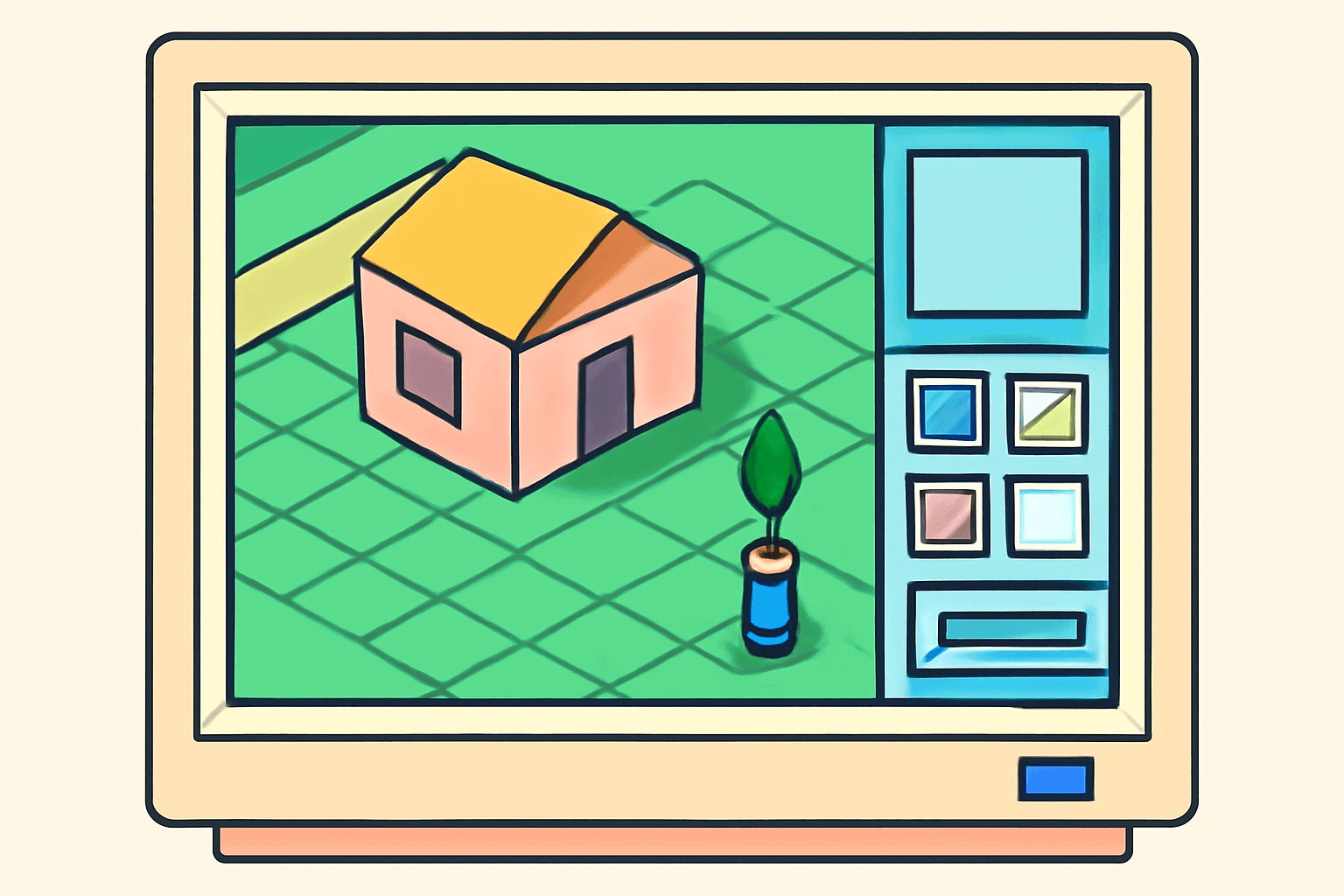
The first Sim I ever made was named Bob. Not because I was feeling creative - because the game suggested it and I was eleven and impatient. Bob had maximum neat points and zero cooking skill. He moved into a house that was essentially a plywood box with a toilet visible from the front door. Within twenty minutes of Sim-time, Bob set the kitchen on fire trying to make a salad. I didn't know a salad could catch fire. The Sims taught me that anything is possible when you're incompetent enough.
That was the year 2000. The game came in a massive PC box from Electronics Boutique, the kind of box that was twice the size it needed to be because PC games in 2000 were packaged like they contained state secrets. I installed it on the family Dell, the one in the den that still ran Windows 98 and made a sound like a jet engine when you asked it to do anything beyond word processing. And then I played for six hours straight without eating dinner.
My mom asked what the game was about. "You just, like, live," I told her. She stared at me. "You're playing a game about living?" She didn't get it. Nobody's parents got it.
The Cheat Code Was the Real Gameplay
Let's get this out of the way. Nobody played The Sims honestly. The moment you learned about rosebud, the game changed forever.
You'd press Ctrl+Shift+C and this tiny text bar would appear at the top of the screen like a secret passage opening in a wall. Type rosebud. A thousand Simoleons. Not enough. Not even close to enough. So you'd type rosebud;!;!;!;!;!;!;!;!;!;!;!;!;! because somebody on GameFAQs figured out that each ;! repeated the cheat, and you'd jam as many as the text field could hold. Your fingers hammering semicolon-exclamation like you were writing the angriest telegram in history.
Nobody played The Sims honestly. The cheat console wasn't a secret - it was basically the tutorial.
Later they just gave us motherlode. Fifty thousand Simoleons per entry. No tricks. It felt like Maxis looked at the playerbase and said, you know what, we see you, here's the bag. We'd type it four or five times in a row and suddenly we were digital millionaires. The fantasy was never about earning it. The fantasy was about having it. About loading up an empty lot and building something absurd because money was infinite and consequences were optional.
The Dream House That Nobody Could Afford
The building tools were the actual game for most of us. I know there were people who cared about the career tracks and the relationship meters and the day-to-day rhythms of Sim life. I was not one of those people. I was an architect. A deranged, eleven-year-old architect with unlimited funds and no understanding of structural engineering.
Every house started the same way. You'd lay down the biggest foundation the lot would allow. Then rooms - so many rooms. A living room. A den. A second den. A dining room that nobody would use because Sims always ate standing in the kitchen anyway. Bedrooms with individual bathrooms because shared bathrooms were for people who hadn't discovered motherlode yet.
The spiral staircase was the flex. It cost a fortune in Simoleons but it looked like you knew what you were doing. You'd place it in the center of the foyer like you were building the set of a soap opera. Then you'd go upstairs and realize you'd forgotten to leave room for a hallway and the whole second floor was just staircase. Didn't matter. It had columns out front. It was a palace.
Meanwhile, in the real world, I lived in a ranch-style house with one bathroom for four people and a garage that didn't fit a car in it. The cognitive dissonance was enormous and completely unexamined.
The Casual War Crimes
We need to talk about the pool ladder.
Everyone knows about the pool ladder. You'd build a pool. You'd tell your Sim to go swimming. And then you'd pause the game and delete the ladder. And the Sim - your Sim, the one you'd named and dressed and given a personality to - would just swim in circles. Panicking. Exhausted. Slowly dying. In their own backyard. Because you, their creator, their god, the person who chose their haircut, decided it would be interesting to see what happened.
It wasn't just the pool. You could wall a Sim into a one-tile room. No door, no windows, no toilet. Just a person and four walls and your absolute indifference. You could fill a room with cheap ovens and wooden chairs and rugs and wait for the inevitable fire. You could delete the door to a room while a Sim was inside and just leave.
We were ten, eleven, twelve years old doing this. We'd commit these tiny digital atrocities and then go have a snack. I don't think it made us bad people. I think it meant the game handed us total power and we immediately sprinted to find the edges of it. Every kid who played The Sims became a philosopher of cruelty for about forty-five minutes before going back to building kitchens.
The Expansion Pack Money Pit
If The Sims taught us anything about real-world economics, the expansion packs were the first lesson. Maxis - and then EA, because EA always shows up when there's money to extract - figured out the model before anyone else in gaming. Sell the base game. Then sell the same game again with a different hat on. Repeat forever.
That's over $230 in 2001 dollars. For one game. And every single expansion felt essential. You'd see the box at Best Buy or EB Games and your brain would short-circuit. Hot Date has downtown areas. You needed downtown areas. You didn't know you needed them until thirty seconds ago but now they were non-negotiable.
Each expansion stacked on top of the last. The load times got longer. The family computer got angrier. By the time you had four expansions installed, launching The Sims was a five-minute meditation exercise while the Maxis splash screen crawled past and the hard drive sounded like it was chewing gravel.
Downloading Skins From the Internet's Sketchiest Corners
And then there was custom content. Oh, the custom content.
If you were online in 2001, you found Sims fan sites. They were inescapable. Geocities pages with sparkly cursor trails and auto-playing MIDI versions of "Blue (Da Ba Dee)" and six hundred downloadable skins organized by aesthetic category. You want your Sim to look like Britney Spears circa the "Oops I Did It Again" video? Somebody made that. You want a couch shaped like lips? Someone modeled it. You want a complete recreation of the Friends apartment? It's a ZIP file on an Angelfire page with a visitor counter stuck at 0004 and it will give your computer a virus.
You'd download a .FAR file from a website called something like ~~SiMzPaLaCe2001~~ and drop it in your game folder and pray.
The custom content ecosystem was completely unregulated. No moderation. No quality control. You downloaded a file, extracted it to the right folder (and figuring out which folder was its own odyssey), and then launched the game to see if it worked or if you'd just bricked your Sims installation. Half the time you'd get a beautiful new skin. The other half you'd get a corrupted mess that turned your Sim's head into a geometric nightmare. It was a gamble every single time and we kept going back.
The Secret Curriculum
Here's what I didn't understand until years later: The Sims was sneaking us an education.
Your Sim had to get a job. The job paid a specific amount. Getting promoted required building skills - cooking, mechanical, charisma - and building skills took time. Time your Sim could have spent socializing. But if they didn't socialize, their social meter tanked and they went to work miserable and didn't get promoted. It was a resource management problem with no clean solution, which is basically what being an adult is.
You learned that cheap furniture made your Sims unhappy. That skipping meals had consequences. That friendships required maintenance or they'd decay. That you could do everything right and the kitchen could still catch fire. Will Wright built a domestic economics simulator and disguised it as a dollhouse game, and millions of kids absorbed lessons about budgeting and time management and social dynamics without ever realizing they were learning anything.
The Online Experiment Nobody Asked For
They tried to make it multiplayer. The Sims Online launched in December 2002, and it was - to be generous - a misunderstanding of what people liked about The Sims.
The whole appeal was the control. The total control. You were god. You decided who lived, who died, who got a pool, and who got a pool with no ladder. The moment you added other actual humans, the fantasy evaporated. You couldn't fast-forward through boring conversations. You couldn't pause while you redesigned the bathroom. You were just standing in a digital room with strangers, trying to make small talk in a game that was never designed for small talk. It stumbled along for a few years, rebranded itself as EA-Land in a desperate pivot, and was quietly shut down in 2008. Not every idea needs to be online. Some gods prefer to work alone.
I still think about The Sims sometimes. Usually when I'm doing something mundane - paying rent, cooking a meal that's more complex than I have energy for, staring at furniture I can't afford on a website. The game promised us that with enough money and the right couch and a high enough cooking skill, the comfort bar fills up and stays full. That happiness is a meter you can manage.
It lied about that part. But it was honest about the rest. The house is never really finished. The bills keep coming. Time runs out faster than you planned. And sometimes, despite your best efforts, the kitchen still catches fire.
At least nobody can delete my ladder.