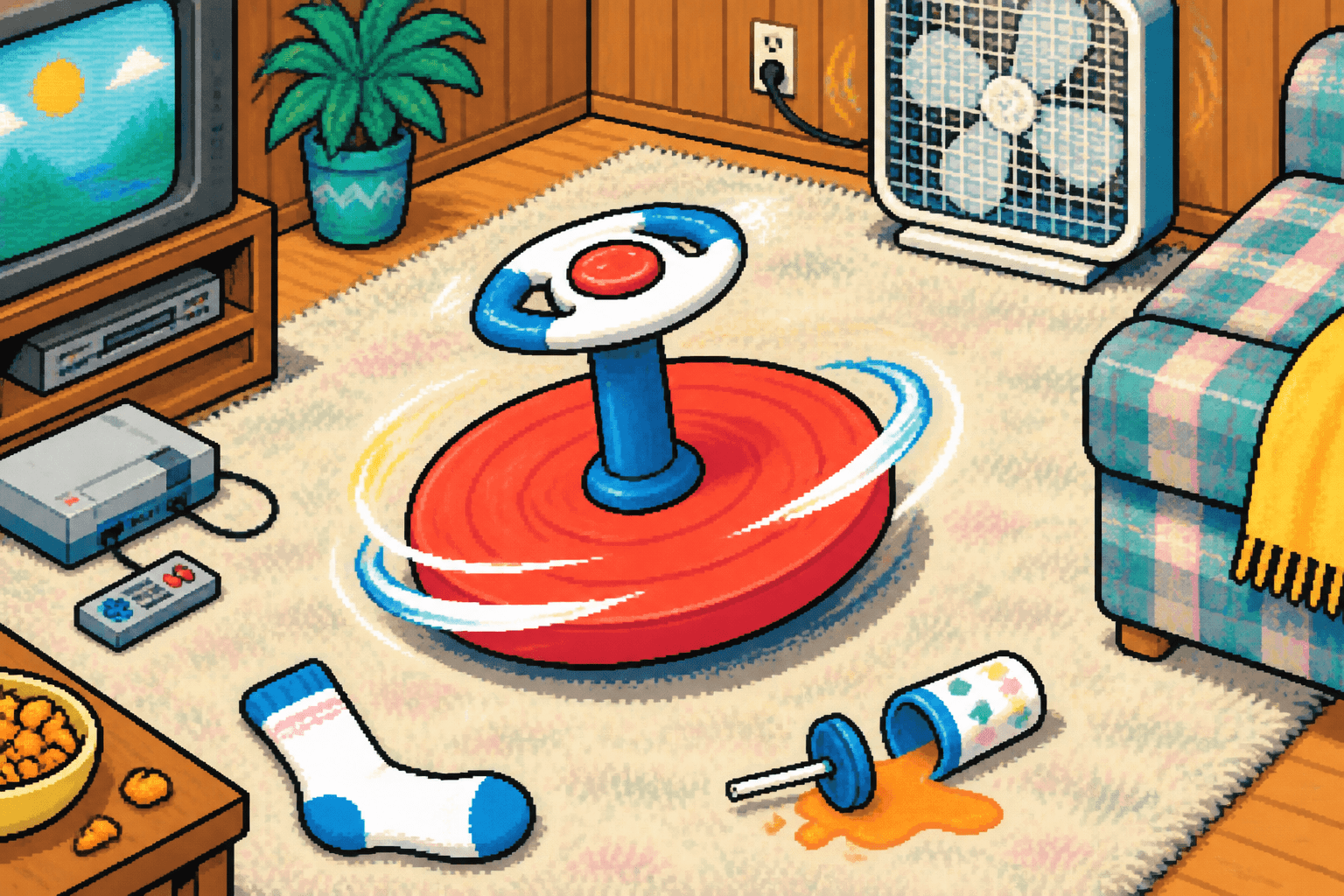
The Sit-and-Spin lived in the corner of the den, on the shag carpet, next to a plastic rocking horse whose eye was falling off. It was a red plastic disc about two feet across with a white ring and a blue ring and a yellow wheel in the middle that you gripped with both hands. It had no motor. It had no battery. It had no seat belt. It had a small sticker that said Little Tikes and a molded arrow that pointed in a direction that did not matter, because you were going to spin the other way.
You climbed on. You sat cross-legged on the blue ring, on the little dimpled area that was clearly the seat, and you leaned back so your center of gravity was slightly off the axis, and you pulled the yellow wheel toward yourself, and the whole disc turned about forty degrees, and you pulled again, and it turned another forty degrees, and after about six pulls you had built up enough angular momentum that the fourth pull was easy, and the fifth was easier, and by the eighth you did not need to pull at all, because you were spinning.
The Mechanic
The Sit-and-Spin was a lesson in physics you did not know you were taking.
The disc sat on a hidden ball bearing, or a lazy Susan, or some kind of low-friction plastic-on-plastic joint. Either way, it turned. Your job was to convert your body weight into rotation, and the only tool you had was the yellow wheel and your own torso. You could not push down. You could not stand up. You had to pull, in a repeating gesture, and the disc had to be on a surface hard enough to hold still under it. The rug worked. The tile worked better. The actual carpet, the deep pile in the living room, did not work at all - the whole disc would just judder in place while you got redder in the face.
The best surface, universally, was the linoleum square in the kitchen. You would drag the whole Sit-and-Spin from the den across the hall, and your mom would say not in here, I'm cooking, and you would say just one, and she would say fine, one, and the one would become eleven.
The Sit-and-Spin sat on a hidden ball bearing and turned your body weight into rotation. You did not know this. You knew that if you pulled the yellow wheel with both hands, the ceiling moved.
The Dizziness Curve
The dizziness came in three parts, and they were separated by about ten seconds each.
Part one was nothing. You spun, you felt fast, you felt in control. You were the operator of a small pleasure machine. You could see the room going by in stripes, and every stripe was a familiar object - the couch, the TV, the plant, the couch, the TV, the plant, the couch - and you were briefly in charge of how fast they came around.
Part two was interesting. The stripes started to blur into one continuous horizontal smear. Your inner ear, which had been quietly logging your rotation, started to disagree with your eyes. There was a small, distinct moment where your stomach registered that something unusual was happening, and this moment was, in retrospect, the exact window in which a smarter child would have stopped.
You were not that child. You pulled the wheel again.
Part three was what did I just do to myself. The dizziness ceased to be a background hum and became a specific event. You stopped pulling. The disc kept spinning, because you had given it enough momentum, and you were now a passenger. You gripped the wheel with both hands. You closed your eyes. This did not help. When you opened them, the couch was in the wrong place, and it was moving in a direction the couch had never moved before, and you understood, suddenly and completely, that you were about to get off.
Try It
Hold to spin. Pump for a shove. Watch the dizzy meter. When it hits 100, that's you. The floor tilts for a second after. That's the part they don't put in the box.
The Dismount
The dismount was where it went wrong.
You would put your feet on the carpet, one at a time, and stand up, and the room would still be rotating, but your body had stopped, and this created a mismatch that your four-year-old brain could not resolve. You walked, briefly, at a forty-five degree angle. You reached for the wall and missed it. You bumped into the coffee table, which had not moved, and looked at it with the mild betrayal of someone who had assumed the coffee table was on their side.
Your dad, from the recliner, would say don't throw up on the carpet, without looking up from the paper.
You did not, usually, throw up. You sat down, hard, on the carpet, and you waited. You waited for the room to stop being a carousel. This took, in the worst cases, about a full minute. During that minute you were not thinking. You were not remembering. You were not planning. You were a small mammal recalibrating the horizon, and you were, in a real sense, closer to a golden retriever after a car ride than to a person.
Then the room stopped. And you looked at the Sit-and-Spin. And you got back on.
You were a small mammal recalibrating the horizon, and you were, in a real sense, closer to a golden retriever after a car ride than to a person. Then you got back on.
The Little Tikes Palette
Every Sit-and-Spin was the same color scheme.
Red outer ring. White middle ring. Blue inner ring. Yellow center wheel. This was not, I think, an accident. This was the same palette as the American flag with a coin of sunshine glued to the middle, and it read, at kid distance, as fun. Every other Little Tikes product used the same four colors. The Cozy Coupe. The little kitchen. The turtle sandbox. The kid slide. The whole product line was, at any given moment, roughly the palette of a Fisher-Price flag.
This palette carried a specific promise: you cannot break me, and I cannot break you. Which was, mostly, true. The plastic was thick. The edges were rounded. The bearing was hidden. There were no small parts. There was no cord. If you dropped it on your foot it hurt, but it did not draw blood. If it broke, which it almost never did, it did not shatter. It cracked, once, and then it kept working.
- The kitchen linoleum (elite)
- The vinyl floor of the sunroom
- The hallway hardwood (fast, but you slid)
- The wooden deck (splinters, ask permission)
- The low pile in the dining room (workable)
- The Berber in the office (barely)
- The shag in the den (do not attempt)
- Grass (why)
The Sibling Amendment
If you had an older sibling, the Sit-and-Spin acquired a second mode.
The second mode was: your sibling spins you.
You sat on the disc, cross-legged, holding the yellow wheel with both hands, and your sister put her foot on the outer red ring and pushed, hard, and the whole thing accelerated to a speed you could not have achieved yourself. You went from a manageable rotation to an uncontrolled one in about two seconds. You lost the wheel. You stayed on because centripetal force was pinning you to the outer edge, and you were, briefly, laughing so hard you could not breathe, and your sister was laughing too, and you knew, at the exact same time she did, that she was about to be in trouble.
She was. Your mom came in. There was a what are you doing to your brother and a he asked me to and a don't listen to him he doesn't know what he's asking for, and the disc slowed down on its own, and the argument moved to the kitchen, and you sat on the disc, alone, and thought, do it again.
The Threshold
The Sit-and-Spin worked from about two to about six.
Before two, you could not build up the pull. After six, you were too big. The disc was scaled for a specific age range, and you outgrew it in a real, physical way. Your knees no longer folded easily onto the seat area. Your center of gravity was too high. You could still spin, but you had to squat awkwardly, and the whole event became a joke you were performing for a younger cousin, and the dizziness that had, at four, been a whole afternoon's entertainment, at seven, was just an unpleasant sensation you were trying to force yourself to enjoy because you missed liking it.
At some point, you got off, for the last time, without knowing it was the last time. The Sit-and-Spin sat in the corner. It became a place to put a stuffed animal, or a stack of Little Golden Books, or a Cabbage Patch doll whose leg had come off. Eventually it went to the garage. Eventually the garage got cleaned. Eventually it was on a curb with a free sign, and a neighbor with a smaller kid took it, and it lived another life in another den, and you did not, exactly, mourn it.
The Argument
I want to give the counter-argument, because it deserves airtime.
The counter-argument is that the Sit-and-Spin was a device that induced repeated, mild vestibular distress in preschoolers, sold to parents on the premise that keeping a four-year-old occupied for eleven minutes at a stretch was, on balance, worth whatever it was doing to the developing inner ear. There are actual pediatric occupational therapists who use spinning discs, on purpose, to work with kids who have sensory processing difficulties, and they are careful about it. The Sit-and-Spin was not careful. The Sit-and-Spin was a mass-produced consumer good with no dosage, no supervision, and no off switch. Nobody, in 1993, was tracking whether an extended session on a Sit-and-Spin was a good idea for a particular kid.
You could also argue that the toy was, functionally, a delivery system for the same experience kids already sought out on their own - spinning in the yard until they fell over, twirling in the grocery store until their mother said stop that - and that all Little Tikes did was give it a name and put it in a box and mark it up thirty dollars. Kids have been intentionally getting dizzy, alone and in groups, since forever. It's a very old game. Little Tikes did not invent it. They productized it.
The Other Side
But here is the thing.
Kids want to be dizzy.
I say this with confidence, because I have watched a two-year-old spin himself in a circle in a parking lot, on purpose, until he sat down on the pavement laughing, and then get up, wobble briefly, and spin again. Nobody taught him this. Nobody rewarded him. He was doing it because it felt like something, and the something was interesting to him, and he wanted to feel it again.
The Sit-and-Spin was an acknowledgment that kids do this. That there is a thing kids like doing, and it's spinning until they can't stand up, and that a well-designed toy would let them do it faster and more efficiently and without falling into a bookshelf. It was, in a real sense, a piece of empathy. Somebody at Little Tikes said what if we let them have the thing they clearly want, and made a plastic disc that made the thing more possible, and put it in a box with red-white-blue-yellow graphics, and it sold for a decade.
Somebody at Little Tikes said what if we let them have the thing they clearly want, and made a plastic disc that made the thing more possible.
I don't know that a lot of adult products come from that place. Most adult products come from what would you buy if we told you to. The Sit-and-Spin came from what are you already doing on the carpet at 3 p.m. that we could make less structurally unsound. That is a nicer question. It is a nicer origin.
The Ceiling Fan
I want to end with a specific memory that is not, I think, mine alone.
You are on the Sit-and-Spin. You have been on it for a while. You have stopped pulling. The disc is coasting. You are looking straight up, at the popcorn ceiling of the den, and specifically at the ceiling fan, which is on the low setting, and which is turning in one direction while you turn in the other, and there is a specific moment, at a specific speed, where the blades of the ceiling fan appear to stop moving. They are frozen. They are hanging in the air. This is because your rotation matches theirs, and your brain, briefly, subtracts one motion from the other, and you get a still image of a fan blade in the middle of a room.
It lasts about a second. Then the fan blades start moving again, because you are slowing down, and the illusion breaks, and you close your eyes, because the dizziness has arrived, and you sit on the disc and let the room catch up.
You are four. You have just, without knowing it, discovered the strobe effect. You will not have language for what happened for another fifteen years. You will not encounter it again on purpose until college, when someone shows you a video of a helicopter blade at the wrong shutter speed, and you will say oh, I have seen this before, on a Sit-and-Spin, looking up at my parents' ceiling fan.
That is the thing you got, for thirty dollars in 1993, from a toy that had no batteries. A first, small, private encounter with the fact that your senses can be tricked. Delivered on the floor of a den. By a plastic disc your dad had assembled in twelve minutes, from a box, on a Christmas morning.
My Sit-and-Spin got donated in 1995, along with a Playskool workbench and a Fisher-Price barn whose animals had all vanished. I don't remember the day it left. I remember the last time I sat on it - I was six, my knees didn't fit, I pulled the wheel three times and gave up, and my mom said something like are you done with that, and I said yeah, and I meant yeah in the specific way that meant I would never touch this again.
My niece has one now. It is not a Little Tikes. It is a knockoff, from a company I have not heard of, and it lights up, because everything lights up now, and it plays a song when she spins fast enough, because everything plays a song. She does not care about the lights. She does not care about the song. She sits on the yellow center and pulls the wheel with both hands, and she gets dizzy, and she falls off, and she sits on the carpet for a second, and she looks at the ceiling fan, and she gets back on.
I did not tell her about the strobe effect.
She'll get there.