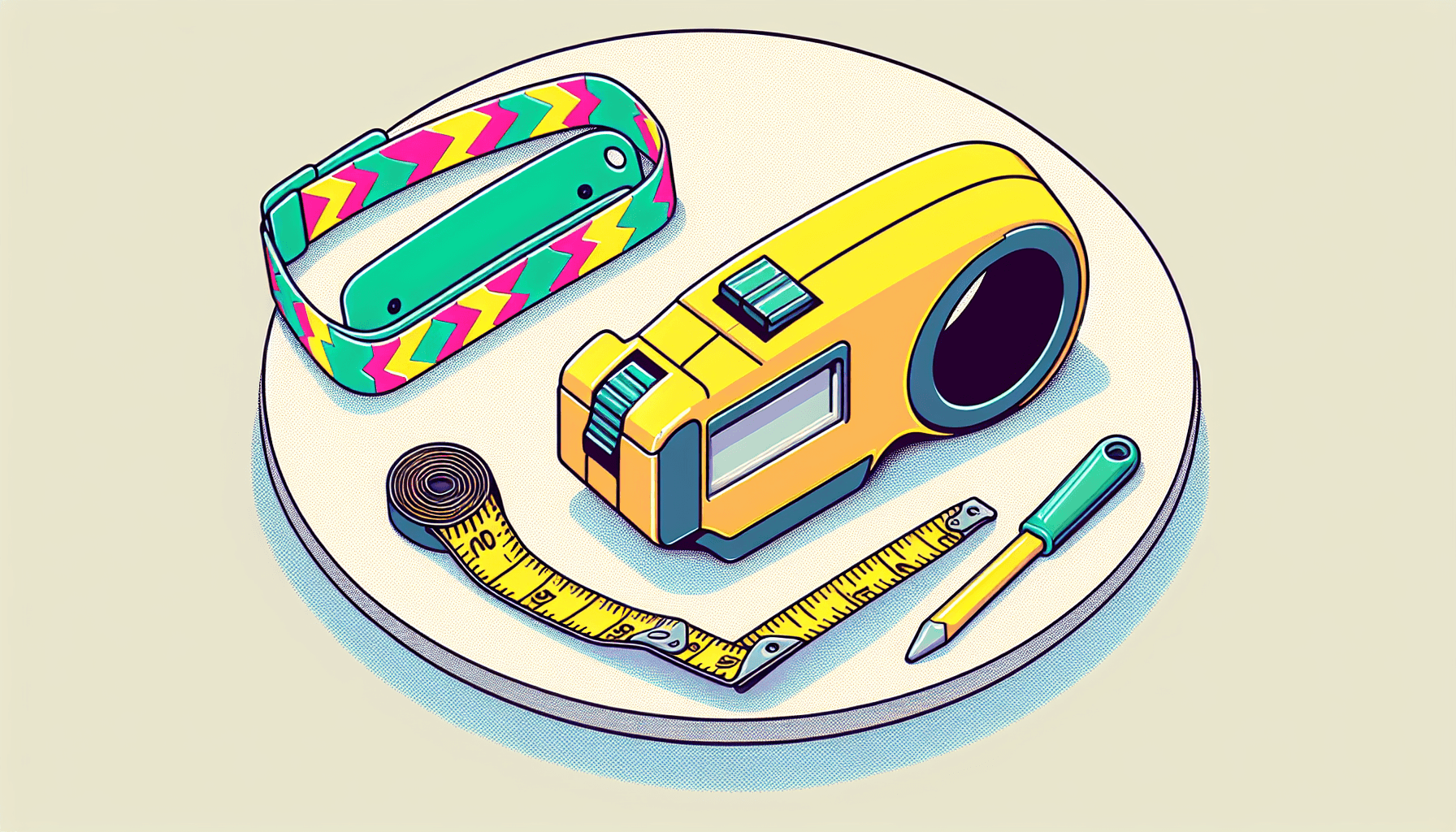
The first time someone slapped one on you, you didn't see it coming. You weren't supposed to. That was the whole appeal of the toy and also the entire problem with it.
A friend was standing behind you in line at the cafeteria. They had something flat in their hand. It looked like a thin stiff ruler made of cloth. You looked away for a second. There was a sound, tk-thwap, and a flat strip of neon zigzag was suddenly wrapped around your wrist in a tight, perfect circle. The friend was laughing. You stared at the bracelet on your arm. You had not been wearing anything on your arm a second ago. Now you were. The toy had transferred itself onto your body without your input.
You did the only thing you could do. You uncurled it, made it flat again, and slapped it onto the next kid you saw.
The Mechanism
A slap bracelet was about nine inches long and an inch wide and stiff. You held it flat between two fingers. It wanted to stay flat. The fabric on top was cloth - polyester, satin, sometimes a velour - printed with whatever pattern was getting kids' attention that month. Underneath was a thin springy steel strip that looked, at first glance, like a piece of metal ribbon.
It was not a piece of metal ribbon. It was a bistable steel band, which is a mechanical engineering term that means: this object has two stable states and will violently snap between them under almost no provocation. State one: flat. State two: rolled into a tight coil. It does not want to live in between.
When you held it flat, you were holding it in a metastable state. The steel had been pre-curled, in the factory, into a tight roll. You had pulled it open. The energy required to keep it flat was being supplied, the entire time, by the tension in your fingers. The instant you brought it down onto a curved surface like a kid's wrist, the steel went home. Bend it past its yield point and it snaps into the rolled state in maybe forty milliseconds. The fabric on the outside followed.
That was the thwap. That was the magic. The steel had been holding its breath, and you had let it exhale.
What It Actually Was
Here is the part nobody told us, until much later.
A slap bracelet was, mechanically, a piece of carpenter's tape measure.
Specifically: the springy curved blade of a self-coiling tape measure - the silver one with the markings, the one that snaps back into the housing when you press the button - is the exact same kind of pre-curved spring steel. The same gauge. The same heat treatment. The same self-locking curl. The slap bracelet was that blade, cut to length, with a piece of nylon-acetate fabric glued to one side and the edges sewn around it.
The original patent, filed in 1983 by a high school shop teacher in Wisconsin named Stuart Anders, calls the toy a "Slap Wrap" and describes it as a "flexible, resilient strip" with "two opposite stable states." Anders did not call it a tape measure with a costume on. He didn't have to. Anyone who'd ever flicked the wrong end of a Stanley FatMax knew what he was working with.
The toy was a piece of construction equipment that some adult had decided to wrap in fabric and sell to a child for two dollars at a Hallmark.
The slap bracelet was a piece of construction equipment that some adult had decided to wrap in fabric and sell to a child for two dollars at a Hallmark.
The Patterns
The fabric was the bracelet's whole personality.
You had a stack in your locker. Leopard print. Neon zigzag. Tie-dye, badly. Glow-in-the-dark stars on a navy background that you slept with under your pillow, half-hoping. Lisa Frank rainbow gradients with dolphins. A black one with white piano keys, which was rare, and which one girl in your class owned, and which she let you borrow for one period of social studies and which you never forgot.
The patterns were always slightly off-register. The print would be misaligned by half a millimeter. The colors had the slightly muted look of a screen-print done at scale. Nothing on a slap bracelet was finely made. The whole product was budgeted around the cost of the steel.
You could buy a pack of three at any drugstore. Five or six dollars. The fabric came off the bracelet eventually, almost always at one of the ends, and you'd have a flap of polyester hanging off the metal that you'd worry between your fingers in math class.
The Slap
Here's the thing nobody fully reckoned with.
A slap bracelet required a slap. You could put it on yourself, sure. You'd hold it flat in one hand, slap it onto your other wrist, and it would coil around. That worked. That was the official intended use. That was the version depicted on the packaging, with a child smiling.
That's not how anyone used them.
You used them on each other. The toy was designed to apply force at the moment of contact. The whole appeal was the thwap. So you'd come up behind a friend, holding the bracelet flat, and you'd slap it down onto their forearm or their shoulder, and the bracelet would deploy, and it would, briefly, hurt. Not badly. The fabric softened the strike. But it was, unambiguously, a percussive impact. The sound was the same sound a swat made.
This was the social use. You walked around school with a bracelet at the ready. You snuck up on people. They snuck up on you. Sometimes a kid had three or four bracelets stacked up their arm at once, the result of a morning of being ambushed in the hallway. There was no consent model. There was no ritual. There was just the bracelet, the wrist, and the thwap.
I want to be clear. The toy was, on its face, a small handheld weapon for the lower elementary social order. We loved it. We did not think about this. We were eight.
The Inevitable Failure
The bracelets did not last.
The fabric was glued. The glue was cheap. The bracelets were being rolled, unrolled, slapped, peeled, stacked, and stuffed into backpacks at a rate that no consumer textile was engineered to survive. Within two or three weeks, a corner of the fabric would start coming up, and you'd pick at it without thinking, and within a month a strip of the fabric was hanging off and the steel was visible underneath. Silver. Surprisingly thin. With edges.
The edges were the problem.
A piece of bistable spring steel does not have a finished edge. It has a cut edge. When the slap bracelet was made, somebody ran a stamping tool through a long roll of pre-treated steel and cut it into nine-inch lengths, and the edges of those lengths were as sharp as anything in a metal shop. The fabric was the only thing between the kid and the metal.
When the fabric came off, the toy was now an exposed strip of folded carbon steel, snapping closed at speed against a child's skin.
Predictably, kids got cut.
- Weeks 1-2: Tight, unbroken. The bracelet behaves. The slap is satisfying.
- Weeks 3-4: Fabric corner lifts. You pick at it in class. A friend pulls the loose flap and rips two more inches.
- Week 5: Bare metal visible at one end. You can feel the edge with a fingernail.
- Week 6: A small red mark on a kid's forearm. Then a paper-cut-style slice on a wrist. Then a bigger one.
- Week 8: The school office has a Ziploc bag in a drawer of confiscated bracelets. The principal looks tired.
- Week 10: Banned.
The Ban
The slap bracelet was, as far as I can reconstruct, the first toy of my childhood that got banned.
The bans were specific and they cascaded. Suffolk County, New York, in 1990. Several school districts in Massachusetts shortly after. Pieces in the New York Times with the kind of headline that gets a generation of moms to call the school. Reports of cuts. Of stitches. Of one case of a tendon laceration that made the local news. The Consumer Product Safety Commission issued advisories. The cheap knockoffs, made overseas with even thinner fabric, were singled out specifically.
The official story was that the knockoffs were the dangerous ones and the original Slap Wrap was fine. This was not strictly false. It was also a little convenient. The original was a piece of spring steel with cloth glued to it, and so was the knockoff. The official version had marginally more fabric. That was the safety feature. More fabric.
By 1991 or 1992, depending on your school, the bracelets were either confiscated on sight or quietly tolerated until someone bled. They went into a drawer. They came home in a Ziploc. They got handed back at the end of the school year in some districts, or thrown out, and the era ended, briefly, before it un-ended.
The Spring Steel Was Honest
I keep thinking about the slap bracelet as a piece of design.
Most toys hide their mechanism. A Furby has a motor and a tilt sensor and a microphone, and the kid never sees them - they see the fur and the eyes and the beak. A Bop It has a circuit board and three electromechanical inputs, and you'd need a screwdriver to even confirm that. The toy is hiding the toy. The product is the costume.
The slap bracelet was the opposite. It put the mechanism right at the surface. The fabric peeled, and the steel showed up, and what was underneath was not surprising, exactly, but it was real. The bracelet was showing you what it had always been. You had been wearing a piece of carbon-steel ribbon on your wrist all along. The fabric was a courtesy.
You can read this charitably or uncharitably. Charitably: the slap bracelet was the only toy of its era that was honest about its physics. The energy you felt when it snapped was the energy of bent metal returning to its rest state. The toy didn't lie about that. You held it, you slapped, the steel did the work. There were no batteries. There was no firmware. There was just spring tension and a kid.
Uncharitably: an entire generation of children spent two years carrying around small, exposed pieces of construction equipment, slapping each other with them in the hallway, while the manufacturers glued two dollars of fabric over the steel and called the fabric a safety feature. The toy was banned because of what we'd been told it wasn't, which it actually was.
The toy was banned because of what we'd been told it wasn't, which it actually was.
What's Left
You can still buy them. They never quite went away. The modern versions are softer - rubber over a more flexible band, with rounded edges, with thicker fabric, with the safety language all over the package. They feel slightly wrong in the hand. The snap is muted. The toy is calmer.
I tried one at a kid's birthday party last year. A six-year-old slapped it onto her own arm and beamed at me. The fabric was thick. The metal didn't ring. There was no thwap. There was a tup.
I missed the bad version. I shouldn't, probably. The bad version cut kids. The bad version was a piece of structural metal in a child's locker, ready to be deployed against another child, with a fabric cover that was already coming loose. The bad version was a small cultural mistake we mostly survived.
But the bad version was also the only toy I can remember that worked because of pure mechanical honesty. The steel curled because steel curls. The slap was the slap because the steel actually slapped. Nothing was simulated. Nothing was wrapped in software or animatronics. You held a small dangerous piece of carpentry, you let it find its rest state on a kid's wrist, and the toy was over.
The thing on the shelf now is a slap bracelet. The thing in our drawers in 1991 was a tape measure with a costume on, and we wore them stacked four-high, and we slapped each other with them in the hall, and the principal had a Ziploc, and we never thought about it once.
Spring steel does not forget what shape it was made in. You can keep it flat, briefly, with effort. The instant the effort stops, it goes home. There is something almost moral about a toy whose entire mechanism is a piece of metal returning to its previous self, twenty years before any of us could read the metaphor. We were bending the same piece of steel against the same wrist. We thought we were the ones in charge.