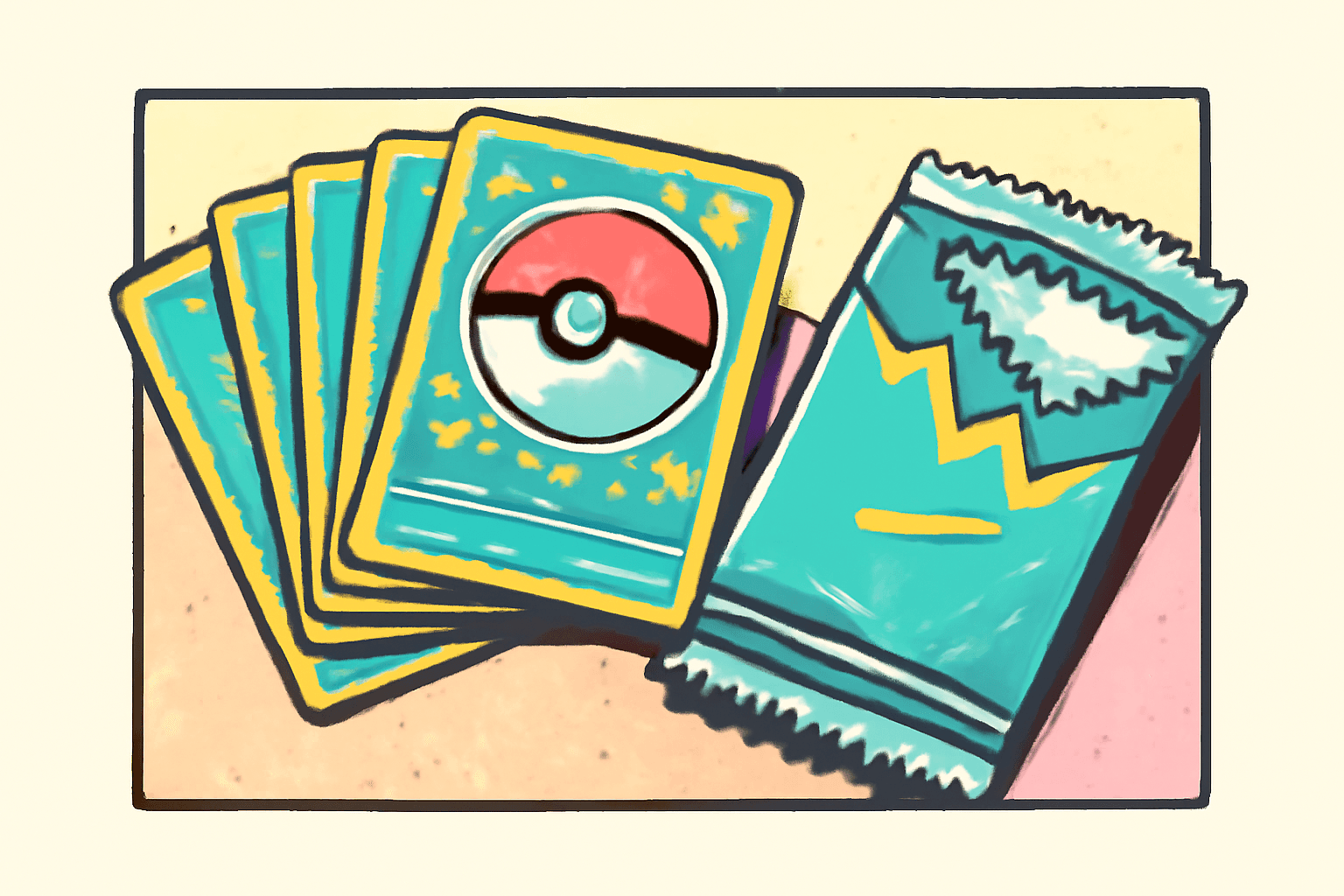
The smell hit you before you even saw the cards. You'd tear the foil wrapper - that little silver pouch with the artwork on the front - and this wave of something would rise up. Ink and cardboard and a faintly chemical sweetness that didn't smell like anything else in the world. Not like a new book. Not like a fresh pack of baseball cards. Pokemon cards had their own smell, and if you held one up to my nose right now, thirty years later, I'd be back in the parking lot of a Toys "R" Us before I opened my eyes.
Eleven cards per pack. That was the deal. $3.29 at retail, though the price floated depending on where you bought them. And you didn't just rip the pack open and flip through them like a normal person. There was a process.
The Ritual
You held the pack in your hand for a second. Felt the weight of it. Tried to sense through the foil whether this was the one. Then you tore the top - some kids tore from the side, which was chaotic and wrong - and slid the cards out in a single stack. The top card was always an energy card or a common. You knew that. Everyone knew that. The good stuff was in the back.
Eleven cards per pack. $3.29 at retail. A one-in-who-knows-how-many chance at a holographic Charizard. And every single time, you believed this was the pack.
So you fanned them. Slowly. One at a time, peeling the top card back just enough to see the edge of the next one. You were looking for that shimmer. That holographic glint at the bottom of the card that meant you'd pulled something real. The commons went by fast - another Rattata, another Ponyta, fine, whatever - but you slowed down as you got deeper into the pack. The rares were in the back. The holo, if there was one, was the very last card before the energy.
Some kids fanned from the back instead, going straight for the reveal. Those kids also probably read the last page of books first. I didn't trust them.
The Economy
By third grade, the playground had a functioning economy more complex than anything we'd learn about in social studies for another five years. Everyone knew the values. A holographic Charizard was the apex - the hundred-dollar bill, the thing nobody actually had but everyone claimed to have seen. Below that, the holographic Blastoise, Venusaur, Alakazam, Chansey. Then the regular rares. Then the uncommons. Then the commons, which were basically currency - you needed enough of them to make a trade happen, the way you'd break a twenty into singles.
- Holographic Charizard: Untouchable. You didn't trade this. You showed it.
- Other holographics: Worth 3-5 rares, depending on who wanted them
- Rares (non-holo): Worth a handful of uncommons
- Uncommons: Filler. Padding for trades.
- Commons: You had seventy of the same Weedle and they were worthless
- Energy cards: Not even part of the conversation
The trades happened at recess, near the benches or against the wall of the school where the teachers couldn't see exactly what was going on. You'd bring your binder - the three-ring binder with the clear plastic card sleeves, nine pockets per page - and you'd flip through it like a catalog. I need a Ninetales. What do you want for it? And then the negotiation started, and it could last an entire recess, because nobody wanted to feel like they got ripped off and everybody was pretty sure they were about to get ripped off.
The scams were legendary. Every school had a kid who convinced someone to trade a holographic for five commons. But it's five cards for one card - you're getting way more. And the kid who fell for it would realize by lunchtime what had happened and spend the rest of the week trying to undo it, and the teacher would get involved, and suddenly Pokemon cards were a disciplinary issue.
The Ban
It was inevitable. The trades got heated. Someone cried. Someone's parents called the school. And then the announcement came, in that particular tone principals used when they were delivering bad news they personally didn't care about: Pokemon cards are no longer allowed on school property.
The ban was devastating and also completely ineffective. Kids just moved the cards from binders to pockets. Trades happened in the bathroom, at the bus stop, in the ten seconds between the bell and when the teacher actually started paying attention. The underground economy didn't stop. It just became an underground economy.
The ban was devastating and also completely ineffective. Kids just moved the cards from binders to pockets. The underground economy didn't stop. It just became an underground economy.
Teachers confiscated decks the way they confiscated everything - into a desk drawer, promised back at the end of the day or the end of the week or possibly never. Some kid always lost a rare to a confiscation and talked about it like a war story. Mrs. Patterson took my Mewtwo. She still has it. She's never giving it back. For all I know, there are holographic cards sitting in teacher desk drawers in elementary schools across America to this day, aging like fine wine in the dark.
The Hunt
You could buy booster packs in more places than you'd think. Toys "R" Us had the best selection - full booster boxes behind the counter, theme decks on the shelves, the whole spread. Target had them in the toy aisle and sometimes near the registers. But the truly dangerous place was 7-Eleven.
7-Eleven kept booster packs right at the checkout counter, eye level for a nine-year-old, right next to the Slim Jims and the Blow Pops. You'd go in with your mom to get a Slurpee and there they were. Three dollars and change. You had your allowance. The math worked. You could feel the foil between your fingers before you even asked.
And there was the Beckett price guide - that little magazine-sized book you'd find at Barnes & Noble or Walden Books, crammed with tiny print listing every card and its market value. You'd stand in the bookstore aisle and flip to the Charizard page and see $80, $100, whatever it was that month, and your brain would do the math on how many packs you'd need to buy and the odds and whether the universe owed you one.
- Toys "R" Us: The mothership. You were going to spend everything.
- Target: Safer, because your mom was also shopping and might not go down the toy aisle.
- 7-Eleven: Impulse buy central. The pack was in your hand before your brain caught up.
- Walgreens/CVS: Surprisingly well-stocked. A sleeper threat.
- The card shop at the mall: For the serious collectors. The kids who knew what "first edition" meant.
The card shop at the mall was a different world entirely. That was where the older kids went, the ones who actually played the game instead of just collecting. They had single cards in glass cases with price tags on them. They had first edition base set packs that cost real money. Walking in there at nine years old felt like walking into a casino - technically allowed, clearly out of your depth.
The Binder
The binder was everything. It was your collection made physical, portable, displayable. You organized it by set, or by type, or by Pokedex number if you were that kid. The holographics went in the front page - obviously - so when you opened it, the first thing anyone saw was your best stuff.
The plastic sleeves kept the cards clean, kept the edges from bending, kept the holographic coating from getting scratched by other cards. You learned the value of preservation at eight years old. You learned that a card in mint condition was worth more than a card with a crease in it, and you learned to handle them by the edges, and you learned that the kid who shuffled his cards like a deck of playing cards was a monster.
I don't know where my binder ended up. Garage sale, maybe. A box in my parents' attic that's been through two moves and a flood. Wherever it is, it's probably worth something now - not enough to retire on, but enough to make me wince when I think about it.
But that's not really the part I miss. I don't miss the cards themselves, not really. I miss the moment just before. The sealed pack in your hand, the foil still intact, the eleven cards inside still unknown. The three seconds between tearing it open and fanning through to the back, when a holographic Charizard was still possible. When the smell hit and the world narrowed to this tiny stack of cardboard and ink and whatever future was hiding behind the next card.
That's the thing about hope when you're nine. It fits in a foil wrapper. And it smells like nothing else.