You were seven. It was a Sunday. Your grandma had one on top of her console TV, next to a bowl of butterscotch candies, and the moment you picked it up she said go ahead, in the tone she used when she wanted you to be occupied in the next room for forty-five minutes.
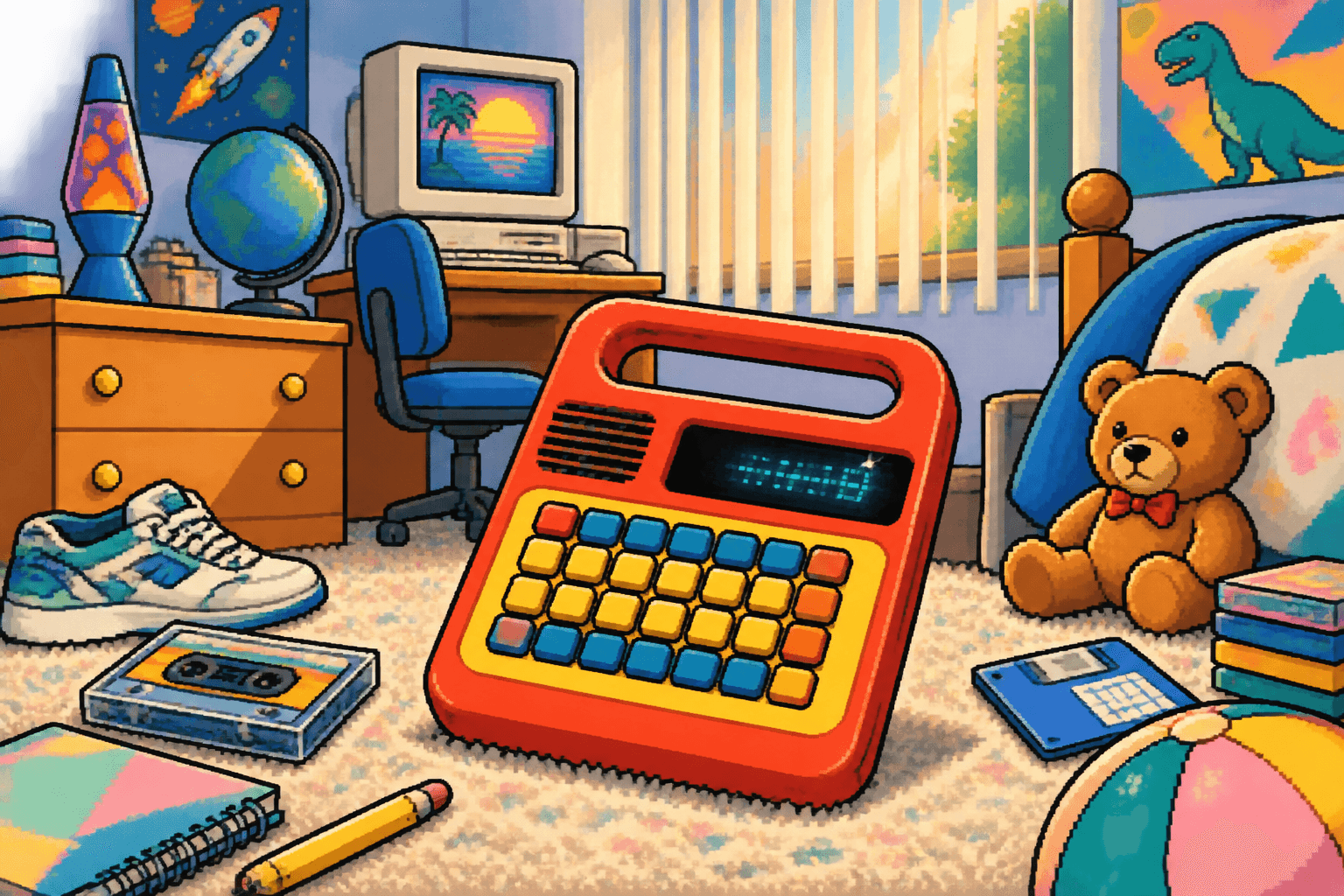
The Speak & Spell was orange-red plastic. It was heavier than it looked. It had a keyboard laid out in a grid that was not, in any recognizable sense, a real keyboard - the letters were in alphabetical order, six across, five rows, chiclet-flat, and they made a small dry tock when you pressed them. Above the keyboard was a display that glowed a specific electric orange, the kind of orange that only came out of a vacuum fluorescent tube in 1978 and never quite got made again.
You pressed the yellow button that said ON.
The speaker on the front, a single round grille the size of a nickel, made a small crackling breath, and then a voice - a voice that was not a voice, exactly, but the idea of a voice, filtered through a chip that had been designed to hit a price point - said:
Spell.
Fudge.
The Voice Was a Man From Dallas
The voice was engineered.
Texas Instruments hired an actual person, a radio announcer from the Dallas area, to record a corpus of English phonemes at a Dallas studio in 1978. They took his recordings and ran them through a compression algorithm called linear predictive coding, which threw away most of the audio and kept only the vocal tract shape, and stored the shapes on a chip that could fit in a red plastic toy. When the toy spoke, it was not playing the man's voice back. It was rebuilding his mouth from a mathematical model, from scratch, in real time, on a five-dollar chip.
The result was a voice that was, at various points: soothing, robotic, sinister, sad. It said the word knight the same way every time. It said Wednesday by pronouncing every letter in Wednesday, including the D and the second D and the S, which was, technically, wrong, and was in fact the reason the word was on the list. It was teaching you to spell a thing it could not correctly say.
When the toy spoke, it was not playing the man's voice back. It was rebuilding his mouth from a mathematical model, from scratch, in real time, on a five-dollar chip.
Nobody explained any of this to you. You were seven. You just knew that a small red slab on your grandma's TV had asked you to spell fudge, and if you did not spell fudge in the next few seconds, it was going to say something about your performance.
The WRONG
If you got the word right, the voice said That is correct.
If you got the word wrong, the voice said Wrong.
Then, after a beat, it said Wrong. Try again.
Then, after another beat, it said That is incorrect. The correct spelling of FUDGE is F-U-D-G-E, and it pronounced each letter separately, with a small pause between them, in the exact tone of a man who had lost his patience with you specifically, in a small studio in Dallas, twenty years before you were born.
The WRONG was a two-syllable word coming out of a speaker that was structurally incapable of nuance. There was no smile in it. There was no oh, sweetie, try again. There was no adult in the room to see it happen. Your grandma was in the kitchen. You were on her couch, in her house, with a plastic square that had just called you wrong, and there was no available social move.
You spelled fudge again.
Try It
Press SPELL. Wait for the word. Type it on the keyboard (or on your actual keyboard). Get it wrong at least once. Get told, clearly, that you got it wrong.
The Keyboard Was Alphabetical
The keys were in ABC order.
I want to sit with this for a second, because it is a decision that was made by an engineer at Texas Instruments in 1978, and the decision was: children do not know QWERTY. Children know the alphabet song. If you put the letters on the keyboard in alphabetical order, a five-year-old can find any letter in about two seconds, because they will sing the alphabet under their breath and count on their fingers until they get there.
This was, at seven, my introduction to typing. It was the wrong introduction. I spent the entire third grade hunt-and-pecking on the family computer, singing A, B, C, D under my breath while looking for the G, because that is how I had learned that a keyboard worked. My mother watched this happen for a year before she bought a copy of Mavis Beacon, and Mavis Beacon, patient woman that she was, undid what the Speak & Spell had done, but only partially. I still, at forty-two, look at the F key before I press it. That is not on Mavis. That is on Texas Instruments.
The alphabetical keyboard was a bet. The bet was that children would learn to spell before they learned to type. It was a fair bet, at the time. It was, in retrospect, backwards.
It was, at seven, my introduction to typing. It was the wrong introduction.
The Modes
The toy had modes, and they were listed on the top edge in raised plastic letters, in the language of a product that assumed you had, at least, learned to read.
SPELL was the main mode. The robot said a word. You spelled it. It told you if you got it.
MYSTERY WORD showed a row of blank underscores across the display and gave you six guesses. It was hangman. It was hangman for a seven-year-old with no drawing of a hanging man, which, in retrospect, was a significant improvement on the source material.
SAY IT let you type any word and press GO and the robot would try to pronounce it. This was the mode where you learned how bad the phoneme library was, because you could type BUTT and the robot would say BUTT, correctly, without hesitation, in the voice of a Dallas announcer.
SECRET CODE was a substitution cipher. Nobody used it.
LETTER made the robot say individual letters, which was for the four-year-olds. You skipped this.
The button that mattered most, and that everybody pressed constantly, and that was, in a real sense, the reason you owned the toy, was SAY IT. Because if you typed BUTT and pressed GO, the robot said BUTT, and if you typed PENIS and pressed GO, the robot said PENIS, and if you typed a curse word your father had used at the dinner table when he was trying to open a jar, the robot would say it back, in the voice of a Dallas announcer, at whatever volume the toy's speaker could produce, which was: not much, but plenty.
The robot did not know it was cursing. The robot was a linear predictive codec running on a TMS5100 chip. The robot had no concept of a curse. The robot had a concept of a phoneme, and if you gave it the right phonemes in the right order, it would say a thing it had never heard before, and it would say that thing in the same voice it used to tell you that the correct spelling of FUDGE is F-U-D-G-E.
This was, at eight, my first encounter with a machine doing something the adults who built it had not fully thought through.
The Cartridge Slot
There was a slot in the back.
The slot took cartridges - hard plastic modules the size of two stacked matchbooks, with names like Vowel Ventures and Mighty Verbs and Basic Builders - and each cartridge added another eight hundred or so words to the toy's vocabulary. You could not use the cartridges without the base unit. You could not use the base unit without the batteries. You could not use the batteries without your dad, who owned a screwdriver.
The cartridges were sold separately, at prices your parents did not want to discuss, at the same aisle at Kay-Bee Toys where you had first pointed at the base unit and said this one. You owned, if you were lucky, three cartridges. You owned, if you were normal, one. You knew a kid in your class who owned seven, and he brought them all to school in a Ziploc bag once, on the last day of second grade, for reasons he could not articulate, and the teacher took them away and gave them back at the end of the day, and he cried on the bus, and nobody made fun of him because everybody, in some sense, understood.
The cartridge slot was your first experience of a walled-garden ecosystem. It would not be your last. Every closed platform since - the Nintendo cartridge, the iOS App Store, the printer that only takes its own ink - is the direct descendant of the slot in the back of that Speak & Spell, and every parent who sighed at a checkout counter and bought a Vowel Ventures cartridge for eleven ninety-nine because the base unit alone was, quote, boring after a while, was practicing for a future that had not yet been invented.
- Basic Builders 1 (came with it, or was supposed to)
- Vowel Ventures (the good one, actually)
- Mighty Verbs (unclear what it did)
- Homonym Heroes (this may not have existed, but I remember it)
- Super Stumpers (words nobody in second grade could spell)
- The one from a Chuck E. Cheese prize wall (broken)
The Cousin
There was a whole family.
Speak & Math was the same body in a different color, and it did arithmetic instead of spelling, and the voice was the same voice, and it said That is correct in the same tone, and it said Wrong in the same tone, and if you got 4 + 5 wrong it told you the answer in a voice that made you feel like you had let down a small, patient man in Dallas who had really wanted this to go well for you.
Speak & Read was the same body again, and it did phonics. The voice pronounced at and bat and cat in a way that sounded like the toy was chewing.
Speak & Music existed. I have no memory of it. I looked it up while writing this. It was a rhythm and pitch trainer. It flopped.
They were all built on the same chip. They were all the same voice. They were all, in a real sense, the same object, which had been dressed up for four different lessons, and each lesson had cost your parents thirty dollars, and each one was in your house because your parents wanted, more than anything, for you to be educated in a way that did not require them to sit next to you.
Each one was in your house because your parents wanted, more than anything, for you to be educated in a way that did not require them to sit next to you.
The Chip Made E.T. Talk
I want to mention this, because it is true, and because it is the kind of fact that adults love and children have to be told twice.
The speech chip in the original Speak & Spell - the TMS5100 - was the chip that was used, in 1982, to produce the voice of E.T. in E.T. the Extra-Terrestrial. Steven Spielberg's production team, or somebody working for them, took the guts out of a Speak & Spell and wired them into the E.T. puppet, and the raspy, half-choked, extraterrestrial phone home that made a generation of moviegoers cry was, mechanically, the same voice that had, in a hundred thousand living rooms across America, called their children wrong.
The E.T. voice was slowed down. The E.T. voice was filtered. The E.T. voice was blended with a recording of a woman named Pat Welsh, who had been a chain smoker for forty years and whose voice quality was, per the sound designer Ben Burtt, exactly what an alien should sound like. But the mechanical spine of it - the ragged synthesis, the almost-but-not-quite-human quality - was Speak & Spell.
In the movie, E.T. builds a communicator out of a Speak & Spell, an umbrella, a coffee can, and a saw blade. He is not, as a plot point, using the Speak & Spell for its intended purpose. But when he speaks the words E.T. phone home, on a hillside, at dusk, in front of a homemade antenna, he is using a Texas Instruments TMS5100, which was, at that same moment, in a thousand American living rooms, saying That is correct.
The Argument
I want to give the counter-argument, because it deserves airtime.
The counter-argument is that the Speak & Spell was, functionally, a piece of hardware designed to replace an adult in a specific interaction - the let me quiz you on your spelling words interaction - and that this replacement was, on balance, worse. An adult, quizzing you on spelling words, will notice when you are frustrated. An adult will slow down. An adult will say good try, but the D is silent, and will point at the silent D and say there is a D here but you do not say it, isn't that weird. An adult will make the silent D into a small joke that you will remember for the rest of your life, and you will spell Wednesday correctly at forty-two because of that joke.
The Speak & Spell will not do any of this. The Speak & Spell will say Wrong. Try again. It will say it in a voice that has no feelings. It will not slow down. It will not explain the silent D. It will tell you, after two tries, the correct spelling, and it will do this in a tone that is not encouraging.
You could argue that this was fine, because most kids had adults in their lives who were doing the encouraging, and the Speak & Spell was just for practice. You could argue that the flat affect of the machine was actually pedagogically sound, that it took the emotional stakes out of getting a word wrong, that a robot calling you wrong is easier to shake off than a parent calling you wrong.
I don't know. I remember what the WRONG sounded like. I don't remember what my mother sounded like when she was quizzing me on words. That could mean the Speak & Spell was more memorable, and therefore more effective. It could also mean it hit harder.
The Other Side
But here is the thing.
The Speak & Spell did not care if you were smart.
I say this with confidence, because I have spent most of my life around learning software that cares, in some subtle way, whether you are smart. Learning software has, in the last twenty years, gotten very good at being encouraging. It says nice try when you get a thing wrong. It gives you a little animation of a fireworks display when you get a streak of five in a row. It adapts, quietly, to a difficulty level that will make you feel good.
The Speak & Spell did not do this. The Speak & Spell had a fixed list of eight hundred words, and it did not care which of them you got. If you got cat wrong, it said wrong, in the same tone it used to tell a seven-year-old the correct spelling of psychiatrist. It did not know that cat was easy. It did not adjust. It did not track you. It did not follow up next week to see how you were doing.
It was, in a strict sense, a fair machine. It did not know your history. It did not know your name. It did not know that your mother was in the kitchen and your father was on a business trip and your dog had died in April. It knew a list of words, and it knew whether you had typed them correctly, and it knew what to say in each case, and that was the full scope of its interest in you.
There is something I miss about that. Not the WRONG. Not the flat affect. The bounded scope. The way a machine could sit on a couch, say a word, hear an answer, and be, in every meaningful way, done with you until you pressed the button again. A machine that does not follow you home. A machine that has forgotten you the second you turn it off.
A machine that does not follow you home. A machine that has forgotten you the second you turn it off.
The Successor
The Speak & Spell is gone.
Texas Instruments discontinued it in the early 90s and rebooted it a couple of times, most recently as a plastic novelty that says a smaller number of things and does not have a cartridge slot. You can find one on eBay for twenty-eight dollars, sold as vintage decor, from a seller who has taken a photograph of it on a knitted blanket in front of a lava lamp.
The rest of the category has moved on. There is now Duolingo, which speaks the word for you in a much better voice, and which shows you an owl that is dying of neglect if you skip a day. There is Reading Eggs. There is IXL. There is a spelling app on your kid's iPad that shows a cartoon fox jumping between letters when she gets the word right, and shows the fox sitting down and looking sad when she gets it wrong, and the fox, over time, has developed a small personality that my kid has told me about, at dinner, unprompted, for the last six months.
The apps are, in most ways, better. The words are more numerous. The voices are more natural. The tracking is more thorough. The rewards are more numerous. My kid can spell better, at nine, than I could at nine.
The apps are, in one important way, worse.
They will not call her wrong. They will never call her wrong. They will say not quite or let's try that again or close one, and the fox will look concerned but not disappointed, and the app will show her a hint before she has asked for one, and the app will let her get the word right on the third try and give her the same rewards as if she had gotten it on the first, because that is how you keep a nine-year-old opening the app tomorrow.
The Speak & Spell would not have done any of this. The Speak & Spell would have said WRONG, once, in the voice of a Dallas announcer who did not know her name and did not care about her retention metrics, and then it would have said the correct spelling and moved on, and she would have carried that WRONG around for a day or two, and she would have, probably, remembered how to spell fudge for the rest of her life.
What The Robot Actually Sounded Like
My Speak & Spell is in a box in my parents' basement, next to a copy of Encarta '95 and a Zip drive with no cables. I know this because I asked. My dad said yes, and then he said, do you want it, and I said, maybe, and he said, when you come home next let me know, and we both, I think, understood that I was not going to take it. It would sit in my house, on a shelf, and it would not work, because the D-cell batteries have leaked, and even if they had not, the plastic has yellowed, and the vacuum fluorescent display has probably lost half its segments. The voice, wherever it lives, is still a chip in a plastic slab in a box in Ohio. It is not on. It has not been on since 1993.
My daughter uses a spelling app. The app is very good. It has, per its own reporting, taught her seventeen hundred words. She has, per her mother, gotten most of them right on the first try, because the app is calibrated to her level, and because the app does not want her to feel bad, and because the app will not stop being encouraging until she uninstalls it.
I asked her, last week, to spell WEDNESDAY. She thought for a second. She said, W-E-N-S-D-A-Y. I said, close. She said, is that not right. I said, there is a D in it. She said, where. I said, right after the N. She said, that is stupid. I said, I know. She said, why is there a D there. I said, I don't know. She said, okay, W-E-D-N-E-S-D-A-Y. I said, yes.
She got it. She got it because I told her. She got it because I was there, on the couch, saying the letters in an order that a Texas Instruments engineer had, forty-six years ago, encoded in a chip so that it could tell a version of me the exact same thing.
The chip is in a box in Ohio. I am in a house in a different state. The D is still silent. My daughter can spell it now. The Dallas announcer is presumably retired. Nobody said WRONG. Nobody had to. That was the trade.