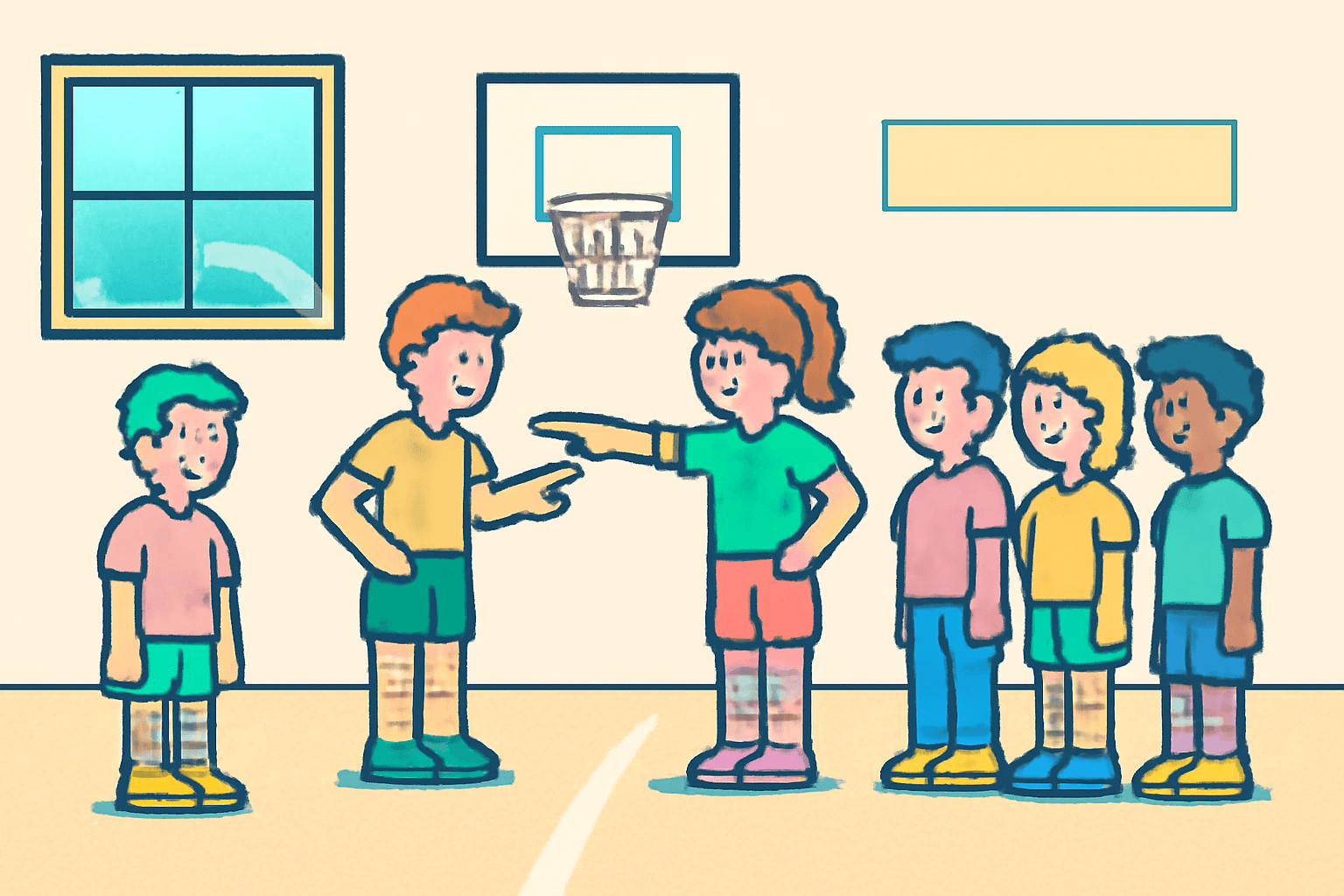
Tyler Briggs and Marcus DeWitt were standing at half court, arms crossed, scanning the rest of us like we were livestock at auction. It was a Tuesday in 1996. Fourth period. The gym smelled like floor wax and sweat and the particular despair of thirty kids who knew what was about to happen. Mrs. Hendricks had just said the four worst words in the English language: "Captains, pick your teams."
I was standing near the back, next to the folded-up bleachers, trying to look like I didn't care. I cared enormously. Every kid in that gym cared, even the ones who were going to get picked first. Especially them, actually, because being picked first was its own kind of currency, and they intended to spend it.
Tyler pointed. "Jake." Jake jogged over. Marcus countered. "DeShawn." DeShawn walked over cool, unhurried, like he had somewhere better to be. The first four or five picks happened fast - the athletes, the tall kids, the ones who could actually throw a spiral or make a layup. This was the easy part. The draft's first round. Nobody sweated the first round.
It was rounds four through eight where things got ugly.
The Middle Picks
The middle of the draft was where social dynamics got weird. This was where captains stopped picking based on pure athletic ability and started making political calculations. Your best friend might get a bump up a few spots. The girl Tyler had a crush on moved up three slots despite being openly hostile toward all organized sports. Someone's cousin got picked earlier than they deserved. Alliances were being formed. Debts were being repaid.
And the whole time, the group of unpicked kids shrank. You could feel it happening without looking. The space around you got emptier. The gaps between bodies got wider. At the start, you were anonymous - just one of twenty-five kids standing against the wall. By the middle rounds, you were one of twelve. Then eight. Then five.
Five kids standing against a cinder block wall in a gymnasium, trying to perform a very specific kind of acting - the kind where you pretend the thing that is clearly happening to you is not happening to you.
Everyone had their technique. Some kids stared at the ceiling. Some kids studied their shoes with the intensity of a forensic scientist. I personally favored the "casual lean against the wall" - arms folded, weight on one foot, expression carefully arranged into something I hoped read as bored indifference rather than the creeping humiliation it actually was.
The Pause
The worst part wasn't being picked last. The worst part was the pause.
"I'll take..." And then nothing. A silence that lasted maybe two seconds but felt like the heat death of the universe. The captain scanning the remaining kids - the unathletic, the uncoordinated, the small, the heavy, the weird, the new - and visibly calculating which of you would damage their team the least. Not who they wanted. Who they could tolerate. You could see the math happening behind their eyes.
Sometimes they'd sigh first. That was a nice touch. A small, audible exhale of resignation before pointing at you, like selecting you for their kickball team was a burden they were heroically choosing to bear. "I guess... Kevin." I guess. Two words that told you everything about where you stood.
The genuine last pick didn't even get that. The genuine last pick got assigned. The captains had exhausted their choices, and you were simply the remainder. The leftover. You walked to your team and nobody said anything and the game started and you stood in right field or at the back of the formation where you could do the least damage, and that was your afternoon.
- Kickball: Last pick goes to right field. Stands there for three innings praying nobody kicks it their direction. Somebody always does.
- Dodgeball: Last pick gets targeted immediately. Becomes a cautionary tale within the first thirty seconds.
- Basketball: Last pick is told to "just play defense." Touches the ball maybe twice. Both times are turnovers.
- Flag football: Last pick is assigned to block. Nobody explains blocking. They just stand there.
The Mercy Pick
There was a variant that was almost worse - the mercy pick. This happened when a captain picked you earlier than your athletic ability warranted, not because they wanted you, but because they felt bad for you. You could always tell. The energy was different. Their friends would give them a look - a quick "really?" glance - and the captain would shrug or mouth something like "shut up." You'd been charity-cased. Adopted out of pity. And you were supposed to be grateful for it.
I got mercy-picked exactly once, in sixth grade, during a basketball unit. A kid named Aaron Kessler picked me seventh, which was absurdly high for someone of my abilities. I knew it, he knew it, the entire gym knew it. I spent the whole game trying to justify his investment and failing completely. Missed every shot I took. Passed the ball to the wrong team once. Aaron never picked me early again.
The mercy pick taught you something the last pick didn't. The last pick taught you that you were bad at sports. The mercy pick taught you that everyone knew you were bad at sports and some of them felt sorry for you about it. I'm honestly not sure which lesson was worse.
The Teachers
Here's the thing I keep coming back to, decades later. The teachers were right there. Mrs. Hendricks was standing at the free throw line with a whistle around her neck, watching this tiny public humiliation unfold, and her contribution was to tell us to hurry up so we could start the game. She'd been teaching gym for fifteen years. She'd watched this ritual play out hundreds of times. She'd seen the faces of the last-picked kids. And her professional assessment was that this was a fine way to form teams.
I don't think she was cruel. I don't think most gym teachers were cruel. I think they genuinely didn't register what was happening. To them, it was logistics - a quick way to divide a class into two groups. The emotional carnage was invisible to them, or at least ignorable, the way background noise becomes ignorable if you hear it every day.
Every adult in the building understood that you shouldn't rank kids publicly by academic ability. Nobody would have posted test scores on the gymnasium wall. But athletic ability? Social standing? Have at it. Twice a week, in front of everyone.
Some schools eventually figured this out. By the late nineties and into the 2000s, a lot of districts started banning captain-picks entirely. Teachers switched to counting off, or pre-assigned teams, or random drawings. I remember reading about it and feeling a strange mix of relief and something almost like jealousy. They fixed it. Good. But also - where was that fix in 1996? Where was that fix for the kid leaning against the bleachers trying to look like he didn't care?
What It Did
I don't want to overstate this. Being picked last for kickball didn't ruin anyone's life. We all survived. Most of us turned into reasonably functional adults who can laugh about it now, or at least talk about it without our voices doing anything weird.
But it did something. It taught you, at eight or ten or twelve, that there was a public ranking, and you were near the bottom of it, and everyone could see. That's a specific piece of knowledge to carry around. It's not trauma, exactly. It's more like a dent - something that didn't break the structure but changed its shape a little. You learned to pre-reject yourself before anyone else could do it. You learned to opt out of things you might fail at. You learned that the safest place to stand was the place where nobody was looking.
I coach my son's rec league soccer team now. Eight-year-olds. When I need to make teams for a scrimmage, I count them off. Ones and twos. Takes four seconds. Nobody gets ranked. Nobody gets the pause.
One of the kids asked me once why I don't just let them pick. "It's more fun that way," he said. He was fast and confident and would have been picked first every time.
"It's more fun for some people," I told him.
He didn't get it. I hope he never does.
The gym is empty now. All those cinder block walls repainted, the floor refinished, Mrs. Hendricks long retired. But somewhere a version of me is still leaning against those bleachers with his arms folded, watching the group get smaller, rehearsing the face he'll make when his name is the last one called. He's gotten very good at that face. He'll use it for years.