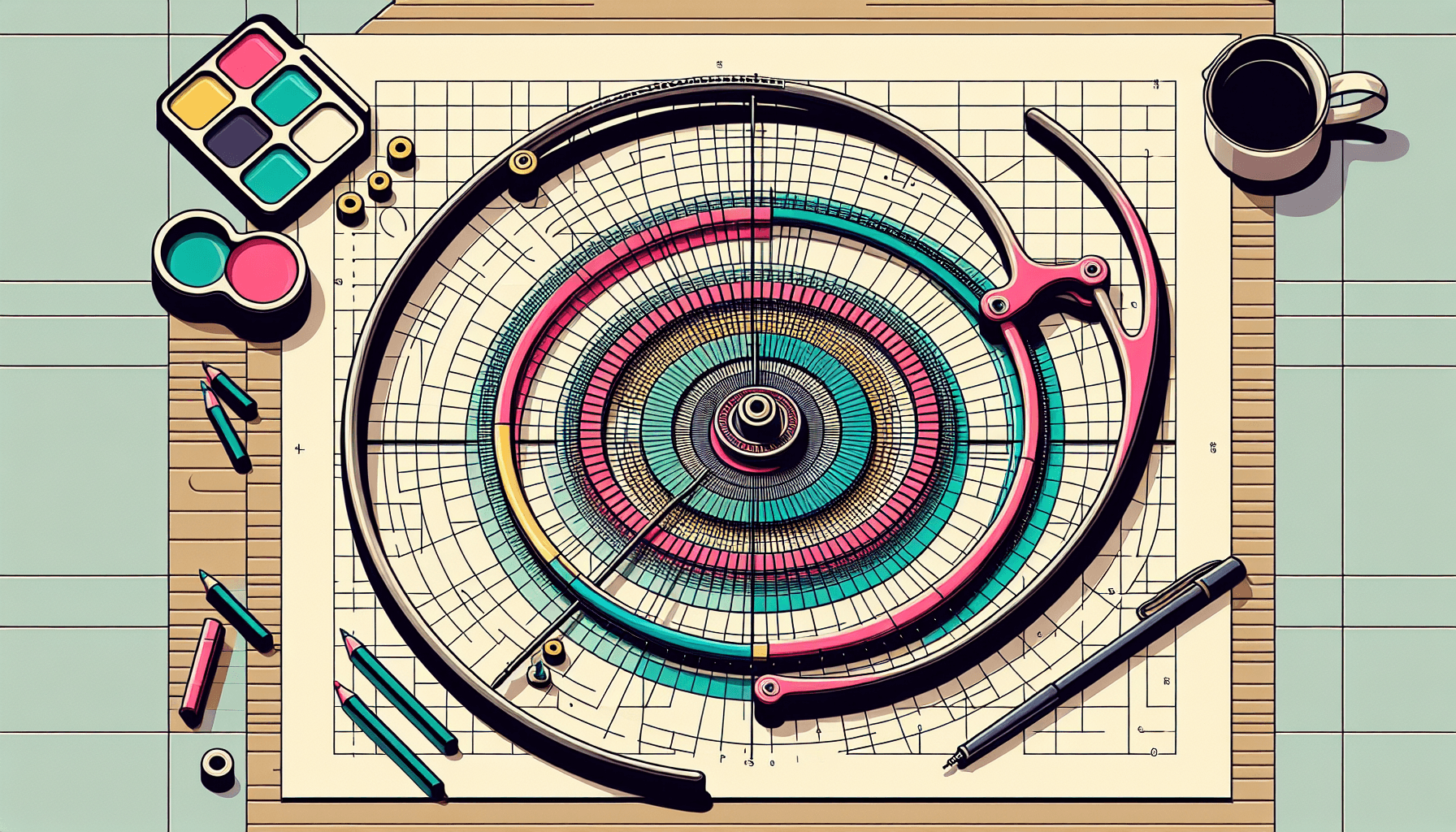
The kit came in a flat box. You pulled the lid off and inside there were a dozen translucent plastic gears in graduated sizes, two big rings, a sheet of pins, a pad of cream paper, and four ballpoint pens with the caps already lost. Everything was the color of stained glass. The box smelled like new plastic and old cardboard. You had no idea what you were supposed to do with any of it.
Then your aunt sat you down at the kitchen table, pinned the big ring to the paper through a piece of cardboard, dropped a small gear inside, slid a pen through one of the little holes, and started rolling. A line appeared. The line came back to where it started but offset. The line came back again. After about ninety seconds the line was a flower. You said whoa. You took the pen from her. You spent the next four hours making flowers.
The Mechanism
The big ring had teeth on the inside. The small gear had teeth on the outside. You set the small gear inside the big ring and the teeth meshed and that was it - that was the whole machine. There were no batteries. There were no instructions. There was a piece of paper, a pin, a ring, a gear, a pen, and a hand.
You held the pen in one of the numbered holes drilled through the gear. You moved the pen in a circle. The gear rolled along the inside of the ring. The pen, because it was off-center, traced something that was not a circle. It traced a curve that came back near where it started, missed by a few degrees, and started over. Hundreds of times. You were drawing a flower with a hundred petals because the gear and the ring did not divide evenly into each other and the curve had to keep going until they did.
This was a hypotrochoid. Nobody told you this. You were eight.
You were drawing a flower with a hundred petals because the gear and the ring did not divide evenly into each other and the curve had to keep going until they did.
The Holes
There were maybe seven small holes in each gear. They were drilled at different distances from the center. Each one made a different shape.
The hole closest to the center made tight, fat curves that barely strayed from a circle. The hole farthest from the center made loopy, lacy patterns that kissed the outer ring. The middle holes made the good shapes - the textbook spirograph flower, the one your mom would put on the fridge. You learned this through experiment. You drew the same gear with all seven holes in a row and compared. You picked a favorite. You used it forever.
This was, if you think about it, your first variable. Hole one. Hole four. The shape was a function. The function had inputs. You changed the inputs and the output changed. You were doing parameter sweeps in your aunt's kitchen with a Bic pen.
The Pin
You needed a pin to hold the big ring in place. The pin pressed through the ring, through the paper, through a piece of cardboard underneath, and into the kitchen table.
This was the part everyone hated. The pin made a hole in the table. The pin sometimes went sideways and bent. The pin, in our house, was banned by the second week, and we learned to hold the ring down with one hand while running the gear with the other. This worked, sort of. The ring shifted. The teeth slipped. The drawing got weird. Everyone in America who ever used a Spirograph has at some point had a parent yell about a pin in the dining room table. This is part of the toy.
The Slip
Now we have to talk about the slip.
The teeth on the gears were not, by the standards of any actual machine, very precise. The gears were stamped plastic. The teeth were maybe a millimeter deep. If you rolled the gear too fast, or pressed too hard, or held the pen at the wrong angle, the teeth would skip - one tooth would jump over another - and the gear would suddenly be in the wrong place. The pen, still drawing, would fly across the paper in a straight line, leaving a streak that did not belong to your beautiful flower. The streak would go all the way across. The flower was ruined.
You could do nothing about this. The line was in pen. The pen was on the paper. The flower was now a flower with a scar.
There was a moment, a kind of grief, where you'd look at it and consider tearing it up. And then you'd shrug and put a different gear in and start a new flower around the scar, because the alternative was tearing the page and doing it again, and you were eight, and you had a limited supply of paper.
The Math You Were Doing
Here is the equation for what you were drawing. I am sorry.
A point on a small gear of radius r, rolling inside a big ring of radius R, with the pen at distance d from the gear's center, traces:
x = (R - r) cos(t) + d cos(((R - r) / r) t)
y = (R - r) sin(t) - d sin(((R - r) / r) t)
This is a hypotrochoid. It closes into a flower when R/r is rational. It draws forever when R/r is irrational. The number of petals is R/gcd(R,r). The pointiness of the petals depends on d/r. Every gear in the box was a different rational number. Every hole was a different d. The "good" hole was the hole where d was about two-thirds of r, which is where the curves get the most lacy without touching the center.
You did not know any of this. You knew that the 32-tooth gear made tight little flowers and the 80-tooth gear made big sloppy ones and the medium one was the prettiest. You had distilled the math down to this gear is good. This was correct.
You had distilled the math down to "this gear is good." This was correct.
What the Toy Was Actually For
Here is the slightly cynical read of the Spirograph.
You did not draw the flower. The geometry drew the flower. You provided the rotational input. The toy did the curve. If you had handed the same gear and the same pen to your dog, and the dog had managed to roll the gear around the inside of the ring with its mouth, the dog would have drawn the same flower. The flower was determined the moment you picked the gear and the hole. Everything after that was just waiting for the curve to finish.
This is not, on its face, a great pitch for a creativity toy. Buy our toy. The toy makes the picture. You watch.
But the more charitable read - the read I prefer - is that the Spirograph was the first time most of us encountered the idea that a system can make something beautiful that neither the system nor the user could have made alone. The gear is dumb. You are clumsy. The paper is just paper. Together you produce a thing that, for thirty seconds, looks like it was rendered by a Cray. Three pieces of plastic and a pen and a kid who can't draw a face, and the output is a fractal.
The Kid Who Could Draw
There was always one kid who didn't need a Spirograph. They could draw a horse. They could draw a face. They could draw a spaceship in three-quarter view with the engines glowing and shadows on the hull. To this kid, the Spirograph was a curiosity. A gimmick. They'd politely make one flower at the sleepover and go back to sketching a unicorn.
The Spirograph was for the rest of us. It was for the kids who knew, by age six, that we were not going to be artists. We could make something with the toy that approached the look of art, and we could put our name on it, and our parents would tape it to the fridge, and for one afternoon we'd be a kid who made a thing. The toy let us pass.
I want to say something dismissive about that and I find I can't. There is a real argument that this is what all tools do. A camera lets you take a picture without being able to paint. A synthesizer lets you make a melody without being able to play. A spell-checker lets you write without being able to spell. The Spirograph let you draw without being able to draw. We've spent the last thirty years building bigger and bigger Spirographs.
The Drawer Full of Half-Done Pages
Every kid who had a Spirograph has, somewhere in their parents' house, a manila folder or a drawer or a box with forty incomplete pages of overlapping flowers in red and green and blue and black ballpoint. Each page has one good flower, one mediocre flower, two starts that didn't go anywhere, and a long pen scar from a slip. The pages are 8.5 by 11. The pen has bled through to the back of every one. Nobody has looked at these pages in twenty years.
You won't throw them away when you find them. You'll flip through them, and try to remember which gear made which flower, and put them back in the drawer.
What I Made With Mine
I cannot remember a single specific Spirograph drawing I made.
I remember the act - the gear rolling, the pen making the soft scrape against the paper, the moment a flower closed and you knew it was done because the pen tip arrived at the dot you'd marked when you started. I remember the tooth-skip and the long ugly streak. I remember running out of cream paper and using a piece of computer paper from my dad's printer, which had a perforated edge, and the gear kept catching on the perforations. I remember picking blue ink because red ink made me think of a teacher's pen.
I do not remember a single drawing. Not one.
This is, I think, the actual contract of the Spirograph. The drawings were not the point. The drawings were the evidence that something had happened. The flowers stayed in the drawer. The hour of running the gear around the ring at the kitchen table on a winter Tuesday went into wherever those hours go. You can't get them back, but the drawer is still full.
If you're looking for your old Spirograph - the original, the 1967 Kenner one in the yellow box, or the early-90s reissue with the slightly worse plastic - it's almost certainly in your parents' attic, in a box marked GAMES, with three gears missing. The 24-tooth and the 40-tooth are gone. They've been gone since 1994. They are in the same place as the Lite-Brite pegs and the Magna Doodle pen and the third die from your Yahtzee box. They are not coming back. You do not need them. The 32, the 52, and the 64 are still in the box. That is enough to make a flower. That has always been enough.