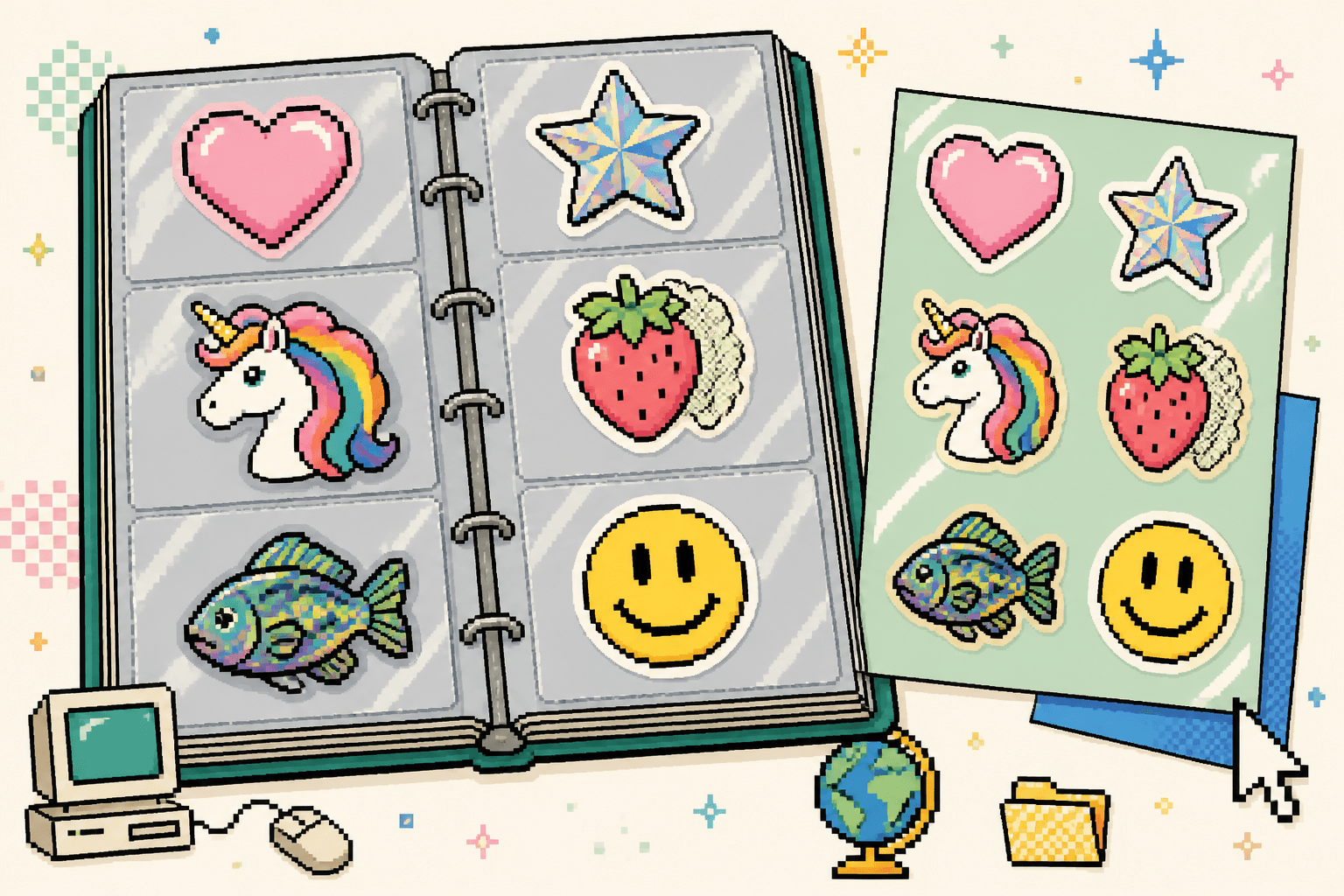
The book was almost always pink. Vinyl. Slightly tacky to the touch, which was by design. You opened it to a two-page spread of glossy, non-stick sheets - the kind you could place a sticker on and lift back off, forever, which was the whole point. Your sticker was never going to live on a notebook or a water bottle or a lunchbox. It was going to live in the book, in a loose approximation of a layout, and you were going to turn to it maybe four times a year and then close it again.
You collected stickers to collect them. Using one was for people who didn't understand.
The Taxonomy
There were categories, and the categories had a hierarchy, and the hierarchy was obvious to every seven-year-old in the greater metropolitan area but has never been written down in a single place. So.
The puffy sticker was baseline currency. A bulbous little heart or star or dolphin, slightly spongy under your thumb, with a shiny top coat that caught the light. Nice. Fine. Everybody had puffy stickers. You weren't going to brag about them, but you also weren't going to turn one down.
The scratch-and-sniff was the gimmick tier. You bought it because you wanted to smell a strawberry that had been made in a factory in Ohio and then photocopied onto a plastic film. Half of them smelled right. The grape one smelled like Dimetapp, which was fine, because so did the actual grape. The pizza one smelled like cheese dust and shame. You still have one in a box somewhere that still works, somehow, thirty years later, which is both impressive and alarming.
The pizza one smelled like cheese dust and shame. You still have one in a box somewhere that still works, somehow, thirty years later, which is both impressive and alarming.
The holographic was the flex. Foil. Prismatic. You tilted it and it did a little rainbow trick. The scarcity made it currency - these came one to a sheet, maybe two, floating around the puffy stars like they were being guarded. The holographic you got from a vending machine at the roller rink was worth four regular stickers in any schoolyard trade and you knew it.
The oily was a cult favorite. The kind filled with liquid and little floating glitter or beads or - rarely, gloriously - a tiny fish that moved when you squeezed it. These were a hazard to the whole collection. They leaked. They separated. One summer in a hot drawer and your prize oily sticker was a flat, cracked plastic pocket with a dried streak of blue dye inside. You kept it anyway.
The Lisa Frank was its own weather system. The dolphins. The leopards. The sunglasses on a cartoon panda. Rainbows that could be seen from space. Lisa Frank stickers were technically all the other categories at once - puffy, holographic, oily - but also somehow a separate category by sheer force of personality.
The Mrs. Grossman's was the quiet one. A small, flat, minimalist sticker on a long thin strip, usually a line of cats or hearts or stars. These came in sheets your mom bought at a stationery store, and they felt grown-up, and you respected them, and you did not peel them.
The Book
The book itself was a system. Some pages were themed - the dolphin page, the cat page, the "cool shapes" page that was mostly geometric foil and the occasional yin-yang. Some pages were chronological, which no one else could decode but you. Some pages had been reorganized three times and still looked like a crime scene.
The important thing was that the stickers could be moved. You could reposition them. You could lift a puffy heart from the top-left corner of page 4 and put it on page 7 because it looked better next to the horse. You could reunite the two halves of a sticker you'd gotten in two different trades. The book was infinitely re-editable, which meant it was permanent, which meant it was precious, which meant you spent a lot of time curating a thing that no one else would ever see.
Your friend would come over and you'd get out the book and show them your book and they'd get out their book and you'd compare books, and you'd each take a page out of your respective books and look at them, and then you'd both put the pages back.
The Trade
Here's where it got interesting. The sticker book was mostly for display, but a sticker was still, technically, worth something, and the economy around that was unregulated and run by children.
- Full sheet, intact: Not for trade. Sacred.
- Loose sticker, puffy: 1-for-1, easy.
- Loose sticker, holographic: 2 puffy, or 1 scratch-n-sniff plus something else.
- Oily, still liquid-y: 3 puffy, non-negotiable.
- A whole page of your sticker book: You are either dying or you really like this person.
- A sticker you were given by someone's grandmother: Priceless, no trade, do not even show.
Trades happened at recess, on the bus, at a sleepover around 11 PM when everyone was overtired and someone had just gotten a new sheet. Trades were accompanied by long negotiations that would have been embarrassing to witness as an adult. "I'll give you two puffy and the scratch-and-sniff watermelon but you have to also give me the sparkly rainbow and I get to pick which cat." The counterparty would weigh this seriously. "The watermelon still smells?" "Yeah." "Fine, but the cat has to be the orange one." "Deal."
Sometimes a trade went bad. You'd peel a sticker off your book and hand it over and realize three seconds later that you'd given up the only holographic unicorn in your collection for a puffy frog, and you'd be sick about it for days, and the frog would sit in your book like a bad decision in a frame.
The Restraint
But the real thing - the thing I didn't understand at the time and only kind of understand now - is that we had learned, somehow, as children, the specific pleasure of not using something.
Your mom gave you a sheet of stickers at the grocery store. You could have put every one of them on a notebook that afternoon. You didn't. You put them in the book. You looked at them. You did not use them up. You made a sheet of stickers last twelve years.
We had learned, as children, the specific pleasure of not using something.
This was training for something. I'm not sure what. Collecting as adults mostly feels embarrassing now - the special-edition sneakers, the limited-run tote bag, the "I have the vinyl" thing - and most of it is bad. But the kid version was pure, in a way, because nothing you were saving was going to appreciate. A puffy sticker was never going to be worth money. You weren't holding on to it as an asset. You were just practicing not consuming a thing you had. Which, looking at my phone, I appear to have un-learned.
The Lost Sheet
Every collector had one. The sheet you lost before you got to put it in the book.
You carried it home from the drugstore in a paper bag, next to the box of markers your mom was also buying for your sister. You put the bag on the kitchen counter. You went outside for twenty minutes. You came back in and the sheet was gone, and nobody knew where it went, and you looked under every piece of furniture in the house, and you accused your sister of taking it, and your mom said "it'll turn up," and it didn't turn up, not that week, not that year, not ever.
Years later your mom moved and you found it folded in half inside a cookbook. The adhesive had gone yellow. Two of the stickers had cured into the backing paper. The holographic star still worked.
You put it in a drawer.
The Album Now
My book, pink vinyl, three-ring, is in a bin in a closet in a house my parents don't live in anymore. I know this because my mom asked me three years ago if I wanted it back and I said yes and then neither of us did anything about it. It's still there. The stickers inside are still arranged in whatever order made sense to me in 1996, which I will not understand when I open it. There will be a puffy heart from a sheet my aunt gave me and a holographic dolphin from a vending machine and a Mrs. Grossman's cat on a thin paper strip and a scratch-and-sniff strawberry that will not smell anymore and I will be mildly sad about that for about four seconds.
I will not peel any of them. The whole point was never to peel any of them.
I'll turn the pages. I'll put the book back in the bin. I'll put the bin back in the closet. And at some point, maybe in another ten years, I'll get it out again and look at the exact same stickers in the exact same arrangement and feel the exact same small, specific feeling, which is that I was once the kind of person who could want a thing badly and then simply have it, intact, in a book, without needing to do anything with it at all.
Which, I think, might be the only kind of having that lasts.