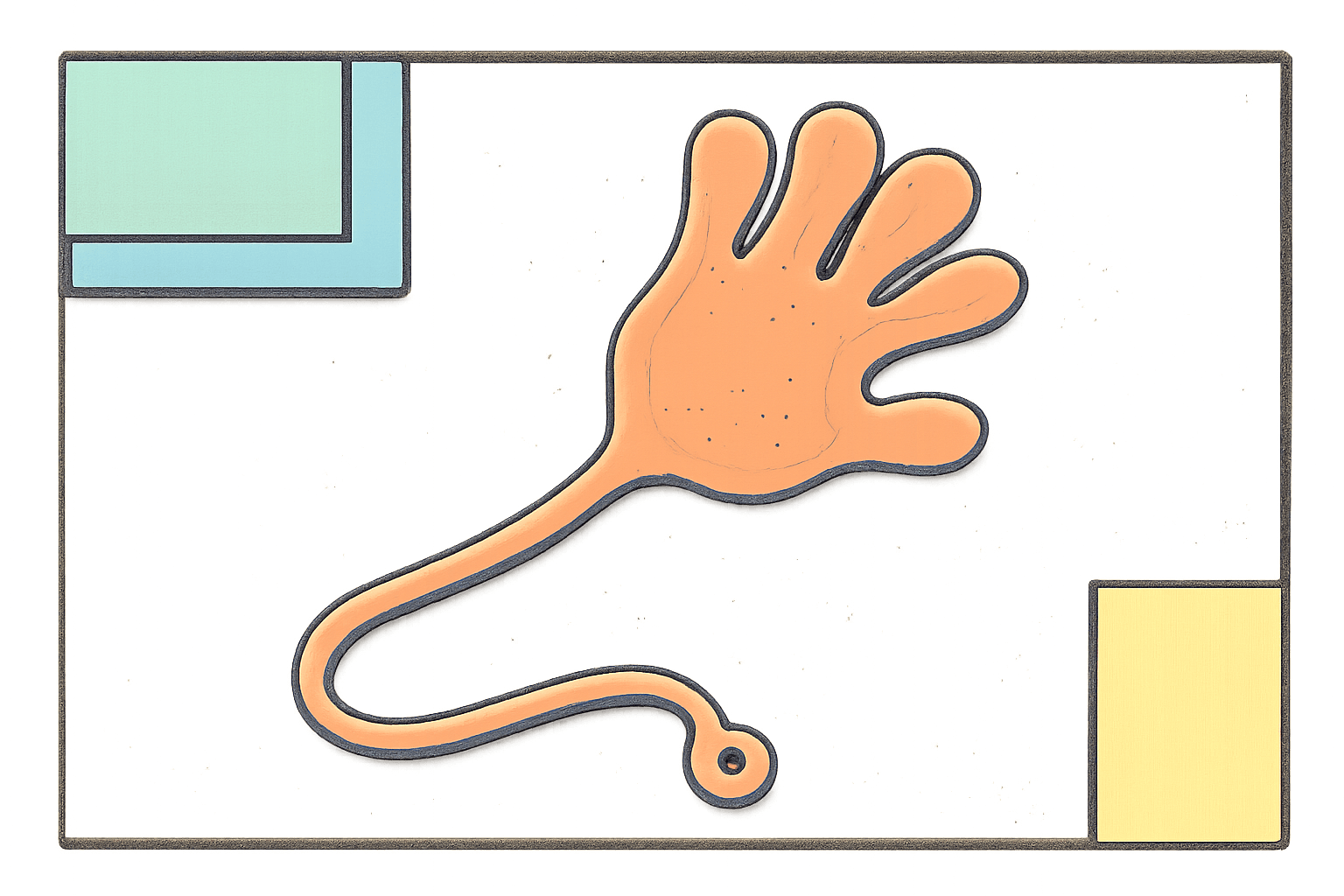
You knew which machine it came from. Not the one with the jawbreakers. Not the one with the temporary tattoos. Not even the one with the little rubber bouncy balls, though that one was also acceptable. No - it was the one with the capsules. The clear plastic capsules that you could see through the foggy dome of the machine, each one containing a small, coiled, impossibly promising object.
You put your quarter in. You turned the knob - that satisfying metallic crunch of the mechanism accepting your money and then the thunk of the capsule dropping into the tray. You cracked it open. And there it was. A sticky hand.
Flesh-colored. Vaguely translucent. A flat, five-fingered hand on the end of a long, stretchy, gelatinous string. It was beautiful. For about thirty seconds, it was the best thing you had ever owned.
The First Throw
You threw it at the wall.
Of course you threw it at the wall. That was the entire point. The sticky hand existed for one purpose and one purpose only: to be hurled at a flat surface, where it would splat with a satisfying wet sound and then - this was the miracle - stick there. Actually stick. Gravity-defying, physics-bending adhesion. You'd rip it off the wall and there'd be a faint mark, a little circle of residue, a ghost of contact. Evidence that something remarkable had occurred.
The sticky hand was a toy with a half-life measured in minutes. Peak performance was throw number one. Everything after that was managed decline.
Then you threw it at the ceiling. Harder this time, because the ceiling was farther and because you were testing the limits of this incredible technology. It hit, it stuck, it dangled there like a little rubber stalactite, and you felt like a god. You peeled it down, leaving a faint gray smudge your mom wouldn't notice for three weeks.
You threw it at the window. At the fridge. At your sister. Each throw was slightly less satisfying than the last, but you couldn't stop, because stopping meant acknowledging that the sticky hand's best days were behind it, and you'd only had it for four minutes.
The Decline
Here's what they don't tell you about the sticky hand. It was a trap. A perfect, quarter-priced trap.
Because every surface it touched gave it something. The wall gave it paint dust. The carpet gave it fibers. The dog gave it hair. Your own hand - just by holding the thing - gave it a thin film of sweat and whatever residue was left from the bag of Doritos you'd had at lunch.
- Minute 0-1: Pure joy. Maximum stickiness. Unlimited potential.
- Minute 1-5: Slight loss of adhesion. First carpet fiber acquired. Still functional.
- Minute 5-15: Visible hair and dust coating. Sticks to itself more than to walls. Questionable.
- Minute 15-60: No longer sticky. Covered in a fur of household debris. Used as a whip instead.
- Hour 1+: Found under couch cushion three days later. Unrecognizable. Thrown away by parent.
By the tenth throw, the sticky hand wasn't sticky anymore. It was fuzzy. It had become a tiny, hand-shaped lint roller that had rolled over every surface in your house and retained all of it. It looked like it had been dragged through a barbershop floor. It looked like something you'd find in a shower drain. It was, objectively, disgusting.
But you kept throwing it. Because what else were you going to do? You'd spent a quarter on it. That quarter could have been a gumball. It could have been two of those flat pressed pennies from the machine at the zoo. The sunk cost was real and you were seven years old and you were committed.
The Whip Phase
This is the part nobody talks about. The sticky hand had a second life - not as a sticky thing, but as a weapon.
Once the stickiness was gone, you discovered that the long, stretchy cord made it an excellent whip. You could wind up and snap it and it would make a sound like a wet towel hitting a locker room bench. It stung, too. Not badly enough to cause real harm, but badly enough to make your brother scream and your mom say that's enough and your dad say where did you even get that thing.
Every sticky hand eventually became a whip. This was not a design flaw. It was a second act.
The whip phase lasted longer than the sticky phase. This was the dirty secret of the sticky hand economy. You weren't buying a novelty adhesive toy. You were buying a two-stage entertainment system. Phase one: wall-slapping. Phase two: sibling warfare. Both phases ended with someone crying, but they were different someones, and that felt like range.
The Ceiling Problem
At some point, in some house, in some suburb of America, every sticky hand found its way to a ceiling. And some of them stayed there.
You threw it too hard, or the ceiling was textured, or the sticky hand was still in its prime and doing its job too well. It stuck up there. And it did not come down. You jumped for it. You threw other things at it. You dragged a chair over and stood on your tiptoes and still couldn't reach. Your mom said just leave it and you did, because what other option was there, and for weeks or months or possibly years there was a small rubber hand dangling from the ceiling of the family room like a weird little chandelier.
Eventually it fell. They always fell. Usually in the middle of the night, when the house was quiet and the adhesive had finally, mercifully surrendered to gravity. You'd hear a soft thap on the carpet at 2 AM and know, without getting up, exactly what it was. The sticky hand had come home.
The Machine Itself
Can we talk about the machine for a second? Because the machine was its own experience.
It lived in the vestibule of the grocery store, or the lobby of the pizza place, or that weird no-man's-land between the inner and outer doors of a Kmart. Always in a transitional space. Always where you'd pass it on the way in and then need it on the way out, when you'd been good for forty-five minutes and your parents owed you something.
The machine was a dome of clear plastic filled with those capsules, each one a different color. You could see what was inside some of them. You could press your face against the glass and try to predict which one you'd get. The sticky hand was the best possible outcome. There were also spider rings, tiny plastic dinosaurs, and something called a finger trap that was just a woven tube that tightened when you pulled. But the sticky hand was the prize. The sticky hand was the jackpot.
- Temporary tattoos that lasted four hours and smelled like vinegar
- Rubber bouncy balls that bounced exactly once in the direction you intended, then disappeared forever
- Stickers of characters from shows you didn't watch
- A miniature plastic skateboard for your fingers, somehow worse than just using your fingers
- The aforementioned finger trap, which was a lesson in not panicking
And the knob. The metal knob you had to turn. It had resistance to it, a mechanical heaviness that made you feel like you were operating real machinery. You were seven, and you were turning a crank, and something was happening. The internal mechanism would catch and release, the quarter would disappear into the guts of the thing, and a capsule would tumble out and you'd grab it and crack it open and for one perfect moment, before the sticky hand touched a single surface, everything was possible.
Why It Worked
The sticky hand cost twenty-five cents and delivered approximately ninety seconds of genuine delight. On a per-second basis, that's a terrible deal. A movie ticket would have gotten you two hours. A library card was free. But the sticky hand had something those things didn't: immediacy. There was no waiting. No planning. No asking permission or driving somewhere or looking up showtimes. You saw the machine, you had a quarter, and thirty seconds later you were throwing a rubber hand at a window and watching it stick. The entire transaction - desire, payment, product, joy - happened in under a minute. It was the most efficient dopamine delivery system available to a child in 1996.
And then it was over. The stickiness was gone. The hand was furry. The string was stretched out and wouldn't retract. You put it in your pocket, where it would bond permanently to a tissue and a movie ticket stub, and you went about your day. By dinnertime you'd forgotten about it. By the next week it was in a junk drawer or a trash can or stuck to the underside of a car seat, gathering dust in the dark.
But for those thirty seconds - for that first throw, that first satisfying splat against the kitchen wall, that moment of genuine astonishment that a thing this cheap and this simple could actually work - you had something. Not a toy, exactly. Not a tool. Just a sticky rubber hand on a string, perfect and new and yours, holding on to whatever you threw it at for exactly as long as it could.