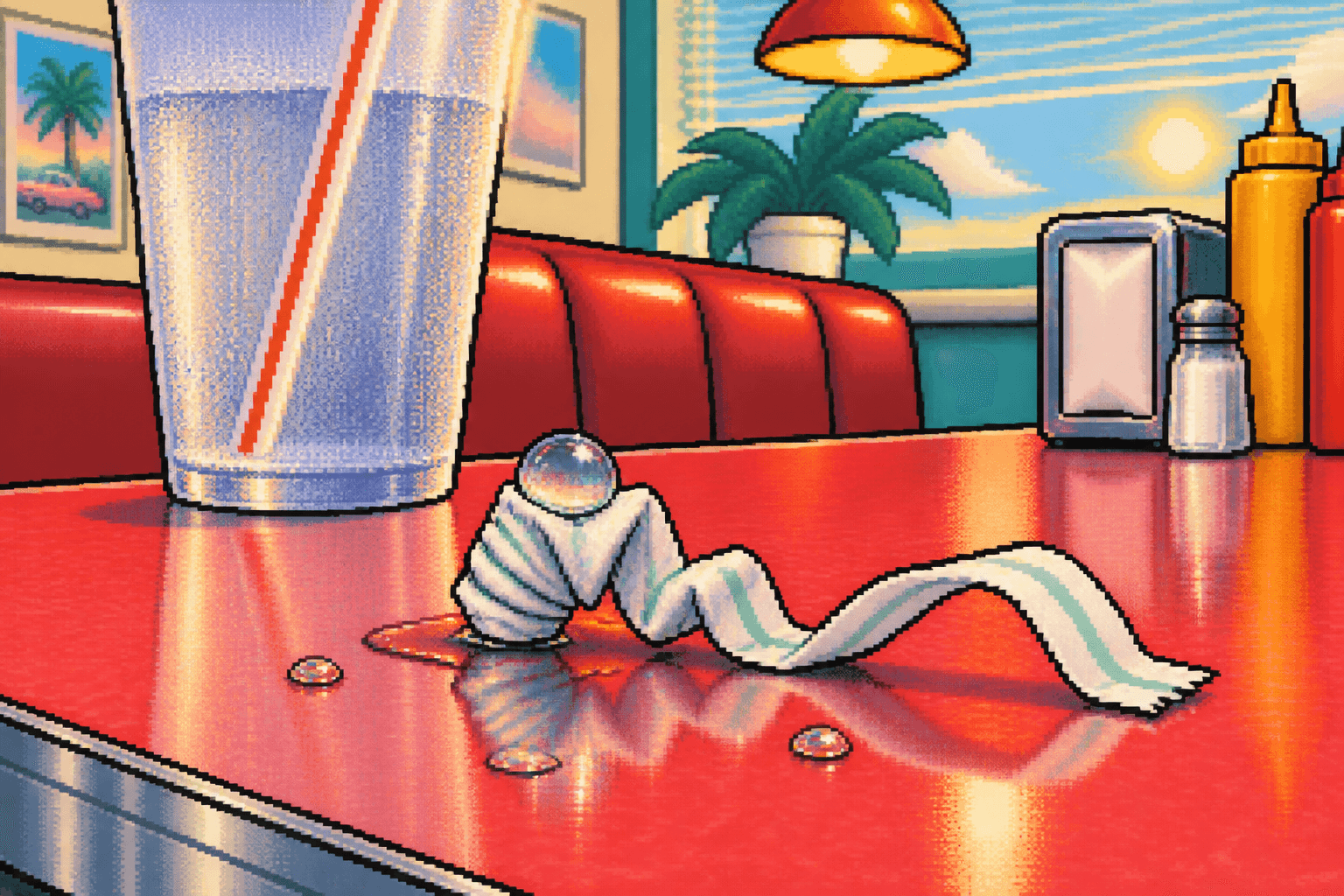
You were eight years old at a Denny's. It was 7:40 on a Saturday. Your parents were talking about something you did not care about. Your brother was drawing on the back of the placemat with a broken red crayon. The waitress had brought waters and left. There would be no food for a long time. There was, in front of you, a straw.
You took the straw and pushed the paper wrapper up from the bottom, then peeled it off from the top in one clean motion, the way your dad had shown you. You now had a paper wrapper. Empty. Slightly waxy. Roughly seven and a half inches long. You put it on the table in front of you.
Then you scrunched it up.
The Scrunch
The scrunch had a technique.
You held both ends of the wrapper between the thumb and forefinger of each hand. You pushed them toward each other along the length of the paper. The paper resisted for about a second and then went. It bunched. It gathered. It concertina-ed into a tight little accordion the length of a fingernail, and every fold in the accordion was clean, because that is what paper does when you compress it from the ends.
You did not roll it. You did not crumple it. You did not tear it. You compressed it. And when you were done, sitting on the table in front of you was a little segmented cylinder of paper about the size of a green army man's shoe, and it looked like nothing on Earth so much as a caterpillar.
The wrapper was now a caterpillar. This was step one.
You did not roll it. You did not crumple it. You did not tear it. You compressed it. And when you were done, sitting on the table in front of you was a little segmented cylinder of paper about the size of a green army man's shoe.
The Drop
The drop was the whole thing.
You took your straw. You put it in your water. You did not sip. You held the top of the straw closed with your index finger, sealing it with a little dome of skin, and you lifted the straw out of the glass. Now there was a column of water inside the straw, held there by air pressure and your finger, and you did not fully understand the physics of this and neither did I, but you knew that if you moved your finger a millimeter you would get one perfect drop.
You held the straw over the caterpillar. You lifted your finger a hair. A single drop of water fell about six inches through the air and landed on the paper.
The paper drank it.
Try It
Scrunch the wrapper. Drip the water. Wait.
The Grow
Here is what happened next.
The paper, which had been folded into a tight compressed accordion of dry fibers, began to absorb the water. The dry fibers on the outside of the fold expanded before the dry fibers on the inside of the fold. This is because water diffuses. It goes where it can go first. And so the paper, which had been holding its accordion shape only because it was dry and springy and compressed, began to release. Slowly. Wetly. Undulating.
The caterpillar grew.
It stretched from a fingernail to two fingernails to the length of a triple-A battery. It curled slightly to one side, because the water had landed off-center and one side was wetter than the other. It flexed, once, in a way that was frankly not okay, and then it stopped, and it sat there on the diner table like a small pale worm, glistening, roughly the length of a peanut, in a puddle of its own water.
You had made this. Out of a paper straw wrapper. In roughly ninety seconds. Nobody had taught you. Or, technically, your brother had taught you. He had learned from a cousin. The cousin had learned from a babysitter. The babysitter had learned from her older brother. And so on, backward, in a chain of children, all the way to whatever kid, in whatever diner, in whatever year, first noticed that a paper straw wrapper, when compressed and moistened, will do this.
You looked at the worm. You looked at your brother. Your brother nodded, one time, small.
The Water Was the Point
You had access to unlimited water.
This was a big deal. At home you had water, sure, but at home you had to get it, or ask for it, and there was some kind of quantity limit imposed by a parent who did not want you drinking soda before dinner. At the restaurant, there was a full glass of water on the table in front of you, and a full pitcher on a tray at the waitstaff station, and a waitress who would bring you a refill unprompted every fifteen minutes because she needed a task and you were her task. Water was infinite. Water was the environment.
Which meant the worm could be scaled.
You could make one worm. You could make three worms. You could line up the three worms end to end on a Denny's placemat and try to build a snake. You could drip water on a worm that already existed to make it grow bigger, and it would, up to a point, and then it would just start to disintegrate, and you had discovered a limit, which is what boredom made you do.
You could also flick the water off the tip of your straw at your brother. This was a related but different activity and it usually ended the worm project.
- The worm: universal, self-explanatory
- The snake: aspirational, for a larger one
- The caterpillar: technical, before water
- A wet noodle: my mom's phrase, dismissive
- A magic worm: only when a smaller sibling was watching
- A finger: only after two glasses of Sprite
- What are you doing over there: what an adult would say
The Table Was a Lab
You have to understand something about the restaurant table.
The restaurant table, in 1994, was one of the last places on Earth where a child had access to unstructured time and a horizontal surface and some materials and was expected to entertain themselves for forty minutes without help. There was no screen. There was no phone. There was no iPad slotted into the high chair. There was a placemat, a set of crayons in a plastic sleeve, a glass of water with a straw, a paper straw wrapper, a saltshaker, a pepper shaker, a small ceramic ramekin of jelly packets, a metal napkin dispenser, and sometimes, in the corner, a small chrome jukebox thing that took quarters and did not work.
Given those materials, you invented things. You made the worm. You built a wall of sugar packets around your water glass. You unscrewed the top of the saltshaker and left it barely balanced so that when your dad picked it up he got a mountain of salt on his eggs. You colored the placemat maze with the broken red crayon. You did the placemat word search until you found NOAH hidden in it and then lost interest.
The worm was the best of these because the worm did something. The worm changed. The worm had a before and an after. The worm was chemistry. The worm was, in a very small way, a magic trick you performed on yourself while your parents talked about your uncle's divorce.
The worm was, in a very small way, a magic trick you performed on yourself while your parents talked about your uncle's divorce.
The Argument
I want to give the counter-argument, because it's not small.
The counter-argument is that you were littering.
You were making a small pile of wet paper. On the table. In a restaurant. Where someone else - specifically, a waitress named Debbie, who had four other tables and had been on her feet since noon - was going to have to clean it up. The worm did not walk itself off the table when the check came. The worm sat there, in its little puddle, and disintegrated slowly, and became a small streak of wet paper pulp on a Formica surface, and Debbie had to wipe it with a rag when she bussed the table, and the rag had to be washed at the end of the shift, and none of this was your problem because you were eight, but it was somebody's problem.
I want to be honest about that. I made a lot of worms. I did not think, ever, about Debbie. I do not think it was the worst thing about the American service industry in 1994 - the worst thing was the tipping structure, which is a different essay - but I want to say out loud that the worm was, in the ledger, a very small extraction of labor from an underpaid adult, and multiplied across a Denny's, across a decade, across a country, that is not zero.
The other counter-argument is that the paper straw is no longer really a thing. In 1994 every straw came in a paper wrapper. By 2010 most restaurants used plastic-sleeved straws or bare plastic straws. By 2020 many places used paper straws, which is a different situation entirely and does not accept a scrunch. The worm, as a genre, requires a paper wrapper on a plastic straw, and that combination is now vanishingly rare, and the worm has gone with it.
The worm, as a genre, requires a paper wrapper on a plastic straw. That combination is now vanishingly rare. The worm has gone with it.
The Other Side
But here is the thing I want to hold onto.
The worm was not really about the worm. The worm was about the forty minutes.
There was, in the middle of a restaurant meal, a forty-minute stretch during which nothing was going to happen. The food was not there. The food was coming. The food was, according to your dad, five minutes away, come on, and it had been five minutes away for twenty minutes. And in that stretch, a kid had to do something. And what a kid did, if a kid had been shown how, was: make a worm.
The worm gave the forty minutes a shape. It had a phase. It had a payoff. It had a small controlled outcome that you produced with your own hands out of the materials the restaurant had put in front of you. It did not require batteries, an adult, permission, or an app. It required a straw wrapper, a drop of water, and the willingness to sit still and watch a small piece of paper move.
That last part is the piece I miss. Not the worm. The stillness. The idea that a kid, sitting at a table, waiting for food, could look at a small object on the table and pay attention to it, and it was enough.
What Replaced It
The forty minutes has been solved.
The forty minutes is now the parents' phone in the kid's hands, or the tablet in the kid's high chair, or the kid's own phone if the kid is older, and the forty minutes has been replaced by a series of six-second videos of a stranger's dog. The kid does not need to invent anything. The kid does not need to look at the straw wrapper. The kid does not need to notice that a compressed dry piece of paper, when wet, will expand along its length in a specific way. The kid is fine. The kid is quiet. The kid is not making a mess for Debbie.
The kid is also, in a small way, not learning that a piece of paper can do a thing you did not know it could do.
I do not want to be dramatic about this. Kids will figure out other things. Kids have always figured out other things. My grandfather used to make a coin disappear behind his ear, which was also a small magic trick in a restaurant, and my grandfather did not have a phone either, and the coin was not, ultimately, better than the worm. It was just what was available.
The worm is what was available in 1994. I am glad I got the worm.
The Worm Is Still On the Table Somewhere
The last time I made a worm was 2011. I was at a diner in Pennsylvania, waiting on a friend who was running late. I ordered coffee and water. The water came with a straw. The straw came in a paper wrapper. I peeled the wrapper off out of habit. I looked at it. I scrunched it up before I even thought about it. My hands remembered. I dipped my straw in the water, capped it with my finger, held it over the little paper caterpillar, and let one drop fall. The paper drank it. The worm grew. I watched it for the ten seconds it took to finish growing. Then I sat there in the booth with my coffee and looked at a wet paper worm on a Formica table in a diner in Beaver Falls and I thought: I have not done this in about fifteen years and my hands remembered every step. My friend showed up. She sat down. She looked at the worm. She said, oh my god, I forgot about those. She peeled her own wrapper off her own straw and made her own. We were both thirty. Neither of us said anything about it. When the check came we both wiped up our own worms with our napkins before Debbie could get to them, and this time we tipped extra, and this was not, we both knew, remotely the same thing.