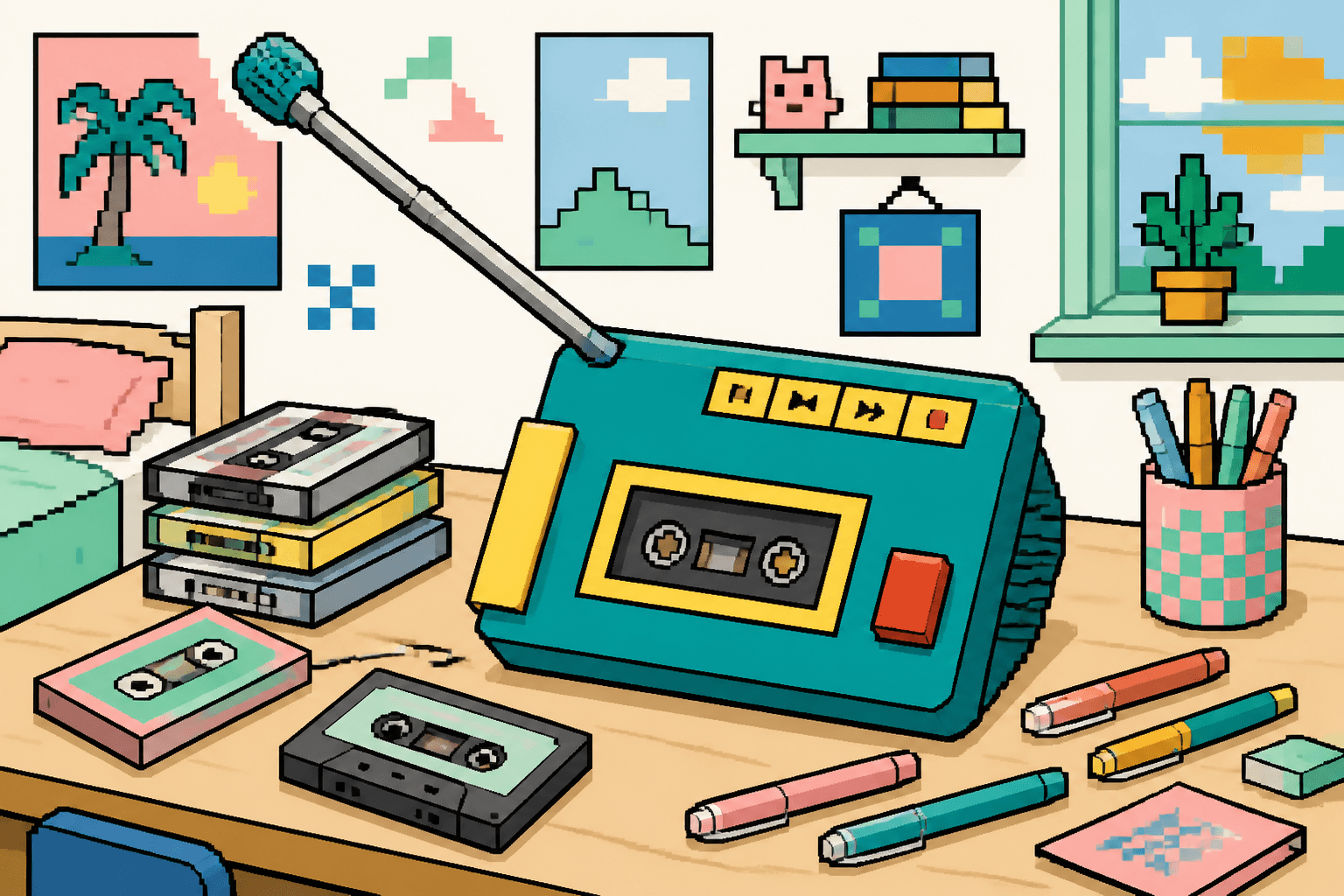
The switch was on the side. Two positions. NORMAL and SLOW. That was it. That was the entire pitch of the toy.
You slid it down to SLOW. You held the microphone up to your face - the microphone was a plastic boom that telescoped out on a little metal rod, and it did nothing acoustically that a hole in the case couldn't have done, but the boom was the point, because the boom made it look like a news anchor's microphone and you were seven years old and being a news anchor was a valid career aspiration. You pressed the big red REC button on top with your thumb. It clicked down under your thumb with a specific hollow satisfaction that a toy button had no business having. You said, in the highest voice a first-grader could manage:
Hi honey, I'm home.
You slid the switch back to NORMAL. You pressed PLAY.
The tape came back out of the little speaker at half speed, one octave down, and it was, unmistakably, a man's voice. A tired, forty-year-old, coming-through-a-doorway man's voice. Your voice. In there somewhere. Sanded down by a piece of consumer electronics into something that Kevin McCallister could plausibly have used to check into the Plaza Hotel.
You laughed so hard you fell off the bed.
The Movie
You have to talk about the movie. It's the reason the toy existed.
Home Alone 2: Lost in New York came out in November 1992, and in it, Kevin, the eight-year-old, uses a handheld cassette recorder to trick a hotel front desk into thinking his father is calling to book a room. He records his dad saying various phrases in front of the TV. He plays them back into the phone at strategic moments. He books a suite. He orders room service. He gets a limo. He does all of this because, in the world of the movie, a tape recorder with a slow switch is functionally a synthesizer, and a synthesizer is functionally a fake dad.
The prop in the movie was a Fisher-Price PXL-2000, or a mockup of one, tricked out with extra stickers and a bigger microphone to be more visually legible on film. The prop did not really exist as a consumer product. But by December of 1992, Tiger Electronics had licensed the name, molded the shell in bright yellow and teal, slapped HOME ALONE 2 on the packaging, and shipped a real thing to real Toys R Us stores. It was called the Talkboy. It was the number one toy of Christmas 1993. It sold out. It kept selling out. Parents drove to three stores to find one.
A tape recorder with a slow switch was, in the world of the movie, functionally a synthesizer, and a synthesizer was functionally a fake dad.
The whole product was a movie tie-in that had been reverse-engineered from a prop that had barely been a prop. This was, in 1993, a completely new kind of thing. Kids had licensed toys before - action figures, cereal, sneakers - but a licensed tool? A licensed thing you did stuff with? That was different. You weren't buying a toy of Kevin. You were buying the toy Kevin used. You were buying, effectively, admission to his plan.
The Object
The real Talkboy was smaller than the one in the movie. Everybody noticed. Nobody cared.
It was maybe seven inches long, molded in that specific 1993 teal-and-yellow color combination that has never been used before or since on any object that wasn't trying to signal for children, and its face was covered in a speaker grille that made noise but not, if we're being honest, very good noise. It ran on four AA batteries that lived in a little compartment on the back that you had to unscrew with a coin. It took standard mini cassette tapes, which came with the unit but which you could - and would - lose immediately.
The microphone extended.
This was, mechanically, the greatest part of the object. The mic was on a segmented telescoping arm, like a car antenna scaled down to child size, and you pulled it out with a tiny satisfying series of metallic shicks and then folded it back down against the body when you were done. It served no acoustic purpose. The mic capsule was in the body of the unit; the boom was just plastic and metal, empty inside, doing nothing. But you could point it at somebody's mouth and say any comment on the game today, sir? and they had to answer, because you had a microphone.
- One big red REC button on top. Recessed slightly so you didn't hit it by accident, which you always hit by accident.
- One PLAY button, one REWIND, one FAST-FORWARD, one STOP. All molded from the same yellow plastic.
- A speed switch on the side. NORMAL / SLOW.
- An extendable microphone boom, three or four telescoping segments, that folded flat against the top when retracted.
- A cassette door on the front with a window so you could see the tape moving.
- A hand strap on the back, which was a real hand strap and not decorative, because at seven ounces plus batteries the thing was heavy enough that you'd drop it.
- A little wheel counter that counted tape in an arbitrary unit. Nobody knew what the unit was. Everybody reset it to 000 obsessively.
The cassette door had a window. This mattered. You could watch the little tape reels spin, and the whole product came alive as a machine, not a toy - it had moving parts you could see through a plastic window, and moving parts you could see were, for a certain kind of kid, the most important thing an object could have. A Game Boy had a screen. A Talkboy had a mechanism.
The Slow Switch
The slow switch was the whole toy. Everything else was scaffolding.
The switch worked by cutting the tape transport speed in half. That's it. That's the whole engineering. The motor that pulled the tape past the head just ran slower on playback than it had on record, which meant every waveform on the tape got stretched to twice its length and dropped an octave, and your seven-year-old voice came back as a grown man's voice, and this was such an obvious physical trick that when you learned, years later, how it worked, you would say oh, that's it? And it was. That was it. Halved the motor speed. Deep voice. Ten dollars retail.
But at seven, you did not know how it worked. At seven, the SLOW switch was magic. It was a piece of consumer electronics that transformed you. It was the closest thing you had ever owned to a costume. When Kevin used it in the movie, he became his father. When you used it in the family room, you became somebody who could plausibly call in sick from work.
The reverse - sliding the switch to SLOW during recording, and back to NORMAL for playback - made you sound like a chipmunk. This was also funny, but funny in a way that felt like a bug. The deep voice felt like a feature. The chipmunk felt like an accident.
What You Actually Recorded
Almost nothing useful.
You recorded your mother saying put that thing away, and played it back to her at dinner, and she said put that thing away. You recorded the dog eating. You recorded the sound of the microwave. You recorded thirty seconds of yourself just breathing into the mic to see what breathing sounded like on tape, and it sounded like breathing, and you found this vaguely disappointing. You recorded prank phone calls you never made. You recorded the theme song of Full House off the TV and played it back on the school bus.
You recorded your sister singing and threatened to blackmail her with it, and then didn't, because the tape was in your only tape and you needed the tape for other things.
You attempted, one time, to record and play back at the phone the way Kevin does in the movie. You attempted this by holding the Talkboy up to the receiver and pressing PLAY while your friend's mom was on the line. The tinny speaker went through the tinny phone into her tinny ear and she said what? and you said nothing and you hung up. This was the extent to which the toy's cinematic premise translated to real-world execution.
The toy's cinematic premise translated to real-world execution roughly as well as a seven-year-old holding a plastic speaker up to a phone.
The Talkboy was not a communication device. The Talkboy was a voice-doing device. What you did with the voice was a private matter between you and your bedroom door.
The Talkgirl
They released a Talkgirl in 1994.
It was, and I want to be clear about this, functionally identical. Same slow switch. Same telescoping boom mic. Same mini cassette. Same speed transport. It was pink and purple instead of teal and yellow and it had, if I remember correctly, a slightly different-shaped body and a little decorative bow-shaped decal near the strap. It was tied in to no movie. It just existed, because Tiger Electronics had noticed - correctly, as it turned out - that girls also enjoyed sounding like a forty-year-old man.
I bought one for my sister. She used it more than I used mine.
Nobody has ever satisfactorily explained why the whole toy category needed a gendered second SKU, and the answer, presumably, is that it did not, and Tiger Electronics wanted a second Christmas. Fair enough. The Talkgirl also sold out.
The Batteries
The Talkboy ate batteries.
Four AAs, and they lasted about a week of active use, which is to say they lasted about four days. You would go to record something urgent - a joke you had just thought of, a sound your dad had just made - and the motor would spin down, mid-record, into a low sad groan, and the tape would slow to nothing, and the little tape reels in the window would stop, and you would run to the kitchen drawer where the batteries lived, and there would be one AA in there and it was the one that had been in there since Christmas 1993 and was, by any reasonable metric, dead.
You would put it in anyway. You would put in three dead batteries and one live one and press PLAY, and the Talkboy would emit a single low groan, and you would take it out again.
The specific relationship between American children in the mid-nineties and the AA battery drawer is under-documented in the historical record. Everything ran on AAs. Nothing had AAs when you needed them. Every parent said we just bought some, and every parent was correct, and yet.
The Death
The Talkboy died the way tape recorders die.
The rubber pinch roller inside the transport hardened and stopped pulling the tape past the head cleanly. The tape started to warble on playback, which was, for a device whose entire premise was messing with the pitch, a fatal condition, because you could no longer tell the deliberate slow from the accidental one. You'd play back your recording and the deep voice was there but also the tape was going wow-wow-wow around the vowels, and you would say to yourself, this doesn't sound right, and it never sounded right again.
The mic boom lost one of its telescoping segments in the couch. The REC button started sticking. The cassette door would spring open when you didn't want it to and close when you did. By 1996 the Talkboy lived in the same drawer as the Game Genie and the parachute-guy from a Happy Meal, none of them quite working, none of them thrown out, all of them being kept for reasons nobody could articulate.
I found one in a bin at an estate sale about four years ago. Twelve dollars. Teal and yellow. The mic boom still telescoped. The cassette door still had its window. I put four AAs in it - I keep AAs in a drawer now, because I am an adult, and this is one of the small dignified victories of adulthood - and I loaded the mini cassette that came with it and I pressed REC, and I said, in the highest voice a forty-year-old man could manage:
Hi honey, I'm home.
I slid the switch to SLOW. I pressed PLAY.
The voice that came back was not Kevin McCallister's father. It was mine, dropped one octave, and it sounded, unmistakably, like a man who had been up too late talking into a plastic microphone in his kitchen while his kid slept upstairs. There was no magic in it. The switch was doing exactly what the switch had always done - halving a motor speed, stretching a waveform, no more. The magic had been the seven-year-old.
I sat there in the kitchen and rewound it and played it again. It still just sounded like me. I extended the mic boom all the way out and folded it back down, four little shicks. I put the Talkboy on the counter. It sat there, in that specific teal, doing nothing.
I put my thumb on the REC button. I said, into the mic, in my normal voice:
This is Kevin. Please deliver the pizza.
I didn't play it back. I didn't need to. I already knew what it sounded like.