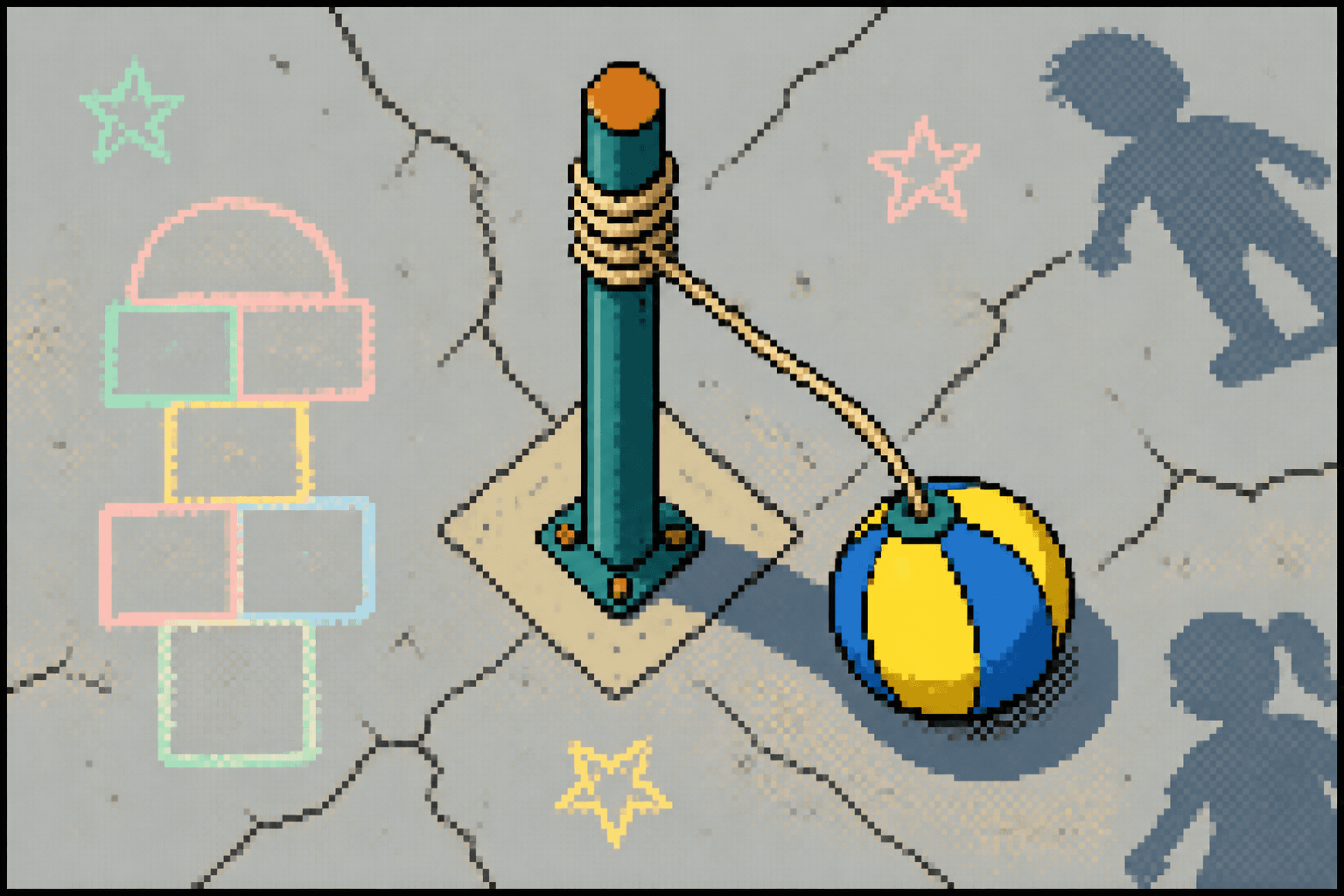
The pole was hot.
It was August, and it was blacktop, and it was 2:15 in the afternoon, and the pole had been standing in direct sun for six hours, and if you grabbed it with your bare hand, which you did, because you needed something to lean on while you argued about whether that last hit was a hold or a carry, you would feel the heat for a full ten seconds after you let go. The pole had a memory. The pole was going to remember you.
The tetherball dangled from the top on a length of yellow nylon rope. The ball was yellow and blue, sectioned like a beach ball, and the seams had gotten a little furry where a thousand kids had struck the exact same spot with the exact same open palm. It was slightly deflated. Every tetherball was slightly deflated. The ball had never once, in the entire history of American recess, been at regulation pressure.
You were third in line. You watched the sixth grader wrap the ball around the pole in about forty seconds. You watched him do it with one hand while pointing at the loser's shirt with the other hand, saying pow, pow, and loser. You watched the loser walk off toward the four square court to try to be seen doing something else.
The line moved up. You were second.
The Object
The tetherball was a specific ball. It was not a volleyball. It was not a soccer ball. It was not anything you could buy in a normal aisle at the store. It was, structurally, a slightly under-inflated rubber sphere with a metal grommet punched into the top, through which a length of yellow braided nylon rope had been threaded and knotted, and that knot was the first thing to fail. The knot always failed. Every school in America had one tetherball with the rope replaced, and it was replaced by a janitor named Ron, and Ron had used a knot he learned in the Navy.
The pole was a length of galvanized steel pipe about ten feet tall, cemented into the blacktop with a small concrete collar that had cracked over the years and now held a permanent ring of dirt and small pebbles. The pole was slightly bent. Every tetherball pole was slightly bent. You could not stand five feet away and swear it was straight. Something in the way ten thousand impacts had been absorbed at roughly the same height had produced a very subtle curve at hip level, like the pole had been ducking.
Every tetherball pole was slightly bent. You could not stand five feet away and swear it was straight.
The rope had a knot in it, at about waist height, from where somebody's brother had cut the ball off in 1994 and Ron had spliced it back on. The knot was the wrong size to fit through the grommet, so the ball hung six inches shorter on that side, which affected the physics in ways that only registered as a vague sense that the game was unfair.
The Rules
There were no rules.
Or - there were rules, but they were verbal, and they were transmitted the way folk songs are transmitted, through slightly wrong copies passed between generations of nine-year-olds, and by the time they reached you they were entirely local. The rules at your school were not the rules at your cousin's school. The rules on the north playground were not the rules on the south playground. There were fifth-grade rules and sixth-grade rules and the specific rules that Kevin had made up that morning to disqualify a kid he didn't want to lose to.
The core rule was this: hit the ball so it wraps around the pole. Whoever wraps the rope all the way to the top wins. That was it. That was the entire game. Everything else was, technically, a house rule, and every house was different.
- No holds. You couldn't catch the ball, adjust your stance, and hit it again. Except when Kevin did it.
- No carries. You couldn't push the ball with an open palm across your body. Kevin's push was a hit.
- No double hits. You couldn't hit the ball twice in a row. Unless the first one didn't count, which was Kevin's call.
- No ropies. You couldn't hit the rope instead of the ball. Ropies were only called on people not named Kevin.
- The higher grade calls fouls. Kevin was in fifth grade. Everyone playing him was in fourth grade. Kevin was the higher grade.
- First serve to the winner. Kevin was the winner because Kevin served first. Kevin served first because Kevin was there first. Kevin was there first because the line hadn't started yet.
You did not argue with Kevin. Or rather, you did argue with Kevin, and Kevin invoked a rule you had never heard of, and there was no manual, and the yard duty was over by the drinking fountain telling a fourth grader to spit out his gum, and by the time you looked back, Kevin had wrapped the ball around the pole four more times, and the game was over, and Kevin was pointing at your shirt.
The Physics
The reason tetherball was a game and not just a hit the ball until you're bored was the rope.
The rope was the whole thing. The rope changed length. As you hit the ball around the pole, the rope wrapped around it, and each wrap took a little bit of rope away, so the next orbit was tighter, and the ball moved faster. This was a real physics thing, and if you had ever taken high school physics, which you hadn't, because you were nine, you would have known that a mass on a shortening tether conserves angular momentum, and its angular velocity has to increase to compensate.
You did not know this. You only knew that at the start of the game, the ball moved at a lazy, waist-high pace, and by the fourth wrap it was a yellow-and-blue blur that clipped the top of your head if you didn't duck.
By the fourth wrap the ball was a yellow-and-blue blur that clipped the top of your head if you didn't duck.
This is why the person losing had the harder job. If you were winning, all you had to do was keep hitting the ball in the same direction, and it kept getting faster, and it kept winding up the pole, and eventually gravity and geometry cornered your opponent into a decision between getting hit in the face and forfeiting. If you were losing, you had to reverse the direction of a spinning yellow projectile that was now moving at approximately the speed of a fastball, using an open palm, while standing in a chalk box.
The reversal, when it worked, was the best moment in the game. You'd time it right. You'd catch the ball with the flat of your hand at the exact right instant on its downswing, and you'd redirect it backward, and it would unwind a full wrap of rope in your favor, and the whole crowd of second-graders who had gathered to watch would go oooooh, and for a second, briefly, you had a chance.
Then Kevin would hit it back and it would be over.
Rope Burn
There was a specific injury.
The rope was yellow nylon. Yellow nylon rope, on bare skin, at the speeds involved in a fully wound tetherball match, produced a burn. Not a cut. Not a bruise. A burn, in the strict sense - a friction burn from the rope moving fast across skin that was not designed to have rope move fast across it. The most common location was the inside of the forearm. The second most common location was the neck.
You'd finish a game and look at your arm and there'd be a red stripe, about a quarter inch wide, running across the underside of your wrist, and it would sting, and you'd walk into the bathroom to run cold water over it, and the water would make it sting more, and you'd tell yourself it was fine, and you'd go back outside.
Rope burns were a badge. You did not go to the nurse. If you went to the nurse, you were saying tetherball is dangerous, and if tetherball was dangerous, they would take away tetherball, and then what would you have. Foursquare. You would have foursquare. Which was fine but it wasn't the same and you knew it.
- Location: forearm. You were losing. You tried to block a fast wrap with your arm. It didn't work.
- Location: neck. You were losing badly. The rope was fully wound and you did not duck.
- Location: side of the hand. You were winning. You were hitting the ball so hard the rope was scraping past your knuckle.
- Location: palm. You were hitting flat. This was correct and also, this is what a palm was for.
- Location: cheek. You were behind Kevin. Kevin swung. Kevin apologized. Kevin was not sorry.
Take a swing
The ball starts on your side. Hit it when it swings into your zone. The other kid is going to hit it back. Three full wraps and the rope hits the pole. Winner stays.
If you serve and the ball just orbits at the same speed forever, that is not a stalemate, that is you failing to hit it. Nobody at the school is going to intervene.
The Line
There was always a line.
The line was the whole social geometry of the game. If you won, you played again. If you lost, you went to the back of the line. The line at Pole #3 was six kids deep by 1:15 and eleven kids deep by 1:45, and if you got to the front and the bell rang, you did not get to play, and there was no appeals process.
The winner stayed, and the winner was almost always the tallest kid. Being tall was tetherball's original sin. If you were tall, you could hit the ball from higher up, which meant you were hitting a shorter section of rope, which meant your hits were closer to the top wrap, which meant the game ended in your favor faster. Tetherball was mostly a game about height and speed and whether Kevin was in the line. Skill was a factor but it was, at most, the third factor.
Being tall was tetherball's original sin.
The kids who won at tetherball were the same kids who won at every other playground game, and the reason for this is that the playground was already a small preview of the rest of your life, and one of the things you were finding out was that in most systems, being taller and older and more confident got you disproportionately more of the outcome. This was not made up for by any part of the tetherball rules. In fact the rules, being invented by the winners, tended to make it worse.
You waited in the line. You watched Kevin win. You watched Kevin win again. You watched Kevin win a third time and then Kevin got bored and walked away to look at something in the grass, and the game finally opened up to the rest of the line, and you played, and you lost, and you went to the back, and you got in line again.
The Argument
Every essay about a specific piece of childhood culture, eventually, wants to argue that the thing was good. That the tetherball court taught us physics, or negotiation, or resilience, or the necessity of losing gracefully to someone bigger than you as preparation for being an adult in a functioning society.
I want to make that argument. Some of it is true.
The tetherball did teach you angular momentum. Not the words. The feeling of it. You could feel the rope shorten in your palm. You could feel the ball speed up. You could feel, in your body, that the same amount of energy going in circles at a smaller radius produced a faster loop, and you did not know that this was physics, but when you did learn the physics ten years later you thought oh, that. I know that. This was a legitimate thing tetherball did.
It also taught you that people who make the rules will change them when they start losing. This was a lesson you could not have gotten anywhere else at that age, and it prepared you badly for adult life in the exact way it should have prepared you.
But it also, structurally, taught you that some kids just won. That there was no way to argue your way into fair play once the game had been rigged by tradition and physiology. That the yard duty, if she was watching at all, was not going to intervene, because the yard duty was there to stop bleeding, not to enforce the social contract. Tetherball was the first place a lot of kids learned that authority sometimes just isn't going to help you.
Tetherball was the first place a lot of kids learned that authority sometimes just isn't going to help you.
I don't know what to do with that. It was a good game and it was also, in a very quiet way, an unfair one, and every 90s kid who played it can tell you within thirty seconds which of those two things they think mattered more.
I mostly think about the rope burn.
The Bell
The bell rang.
You'd been in line for eleven minutes. You had played exactly one game. You had lost. You had a red mark on your wrist and the pole had made a specific rust smell come off on the palm of your hand and the ball was still slightly deflated and the sixth grader who had beaten Kevin - because someone did, eventually, beat Kevin, and it was a sixth grader with braces and a Hypercolor shirt that had turned dark at both armpits - had walked off with the tetherball tucked under his arm to return it to the office.
The pole stood there, still. The rope hung down empty. The concrete collar around the base held its ring of small pebbles. The chalk marks on the blacktop were faded from the last rain and you could barely see the circle anymore, but you knew where it was, and everyone knew where it was, and if you came back tomorrow at 1:15 the line would form again, and it would be six deep by 1:20, and Kevin would be at the front of it.
You went inside. You washed your hands in the boys' bathroom sink. The rust smell came off. The rope burn didn't, not for the rest of the day, but it faded by dinner, and it was gone by morning, and the next day you went to Pole #3 and you got in line again, because the game had rules, and one of them, the only real one, was that you kept coming back.