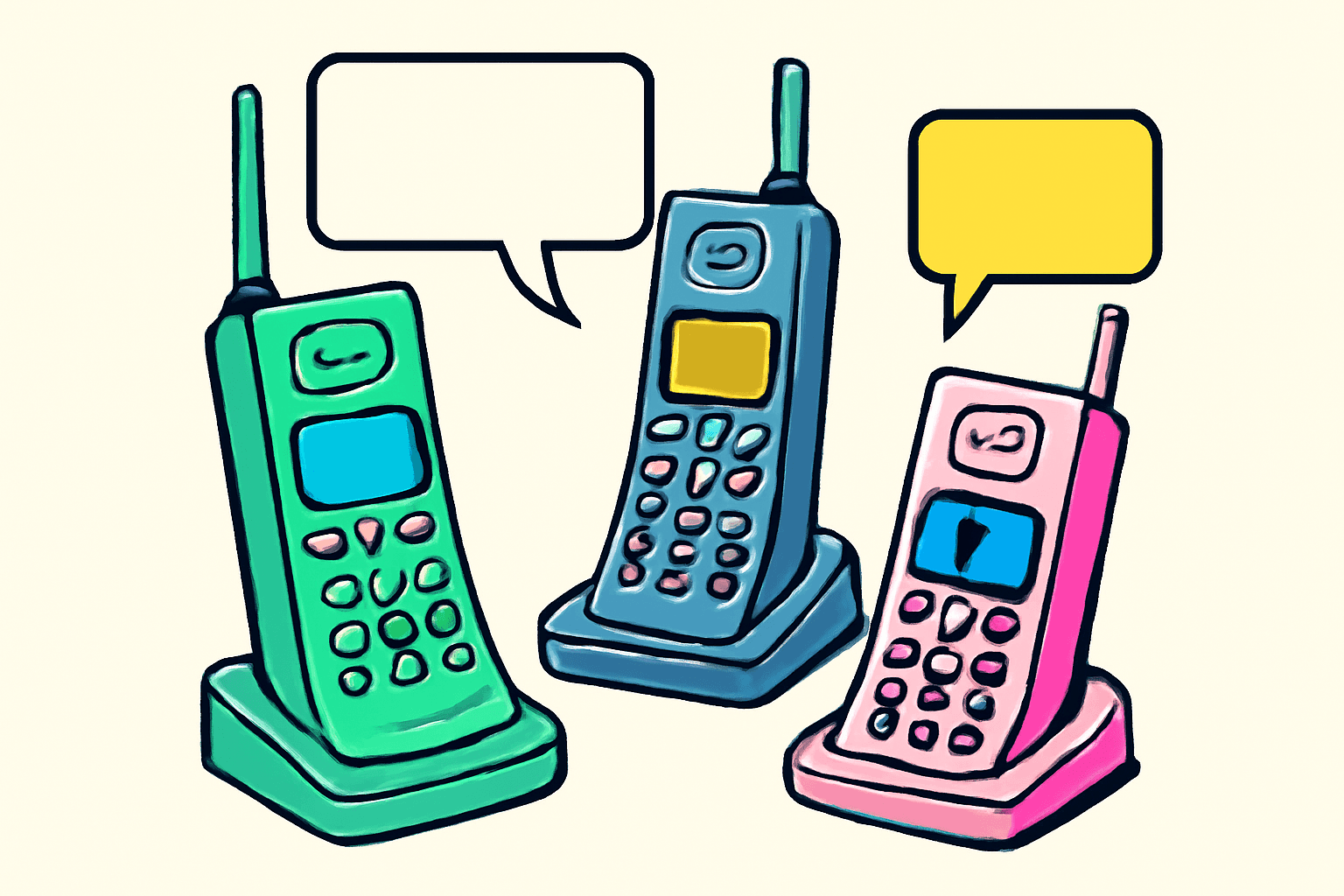
The first time I got three-way called, I didn't even know the feature existed. It was 1996. My friend Danielle called me after school, asked me something ordinary about math homework, and then casually said, "So what do you really think about Jessica?"
I had opinions about Jessica.
I shared them.
Somewhere in the background, underneath Danielle's practiced "mm-hmms," there was a faint click. I didn't think anything of it. Maybe her mom picked up the kitchen phone. Maybe it was nothing.
It was not nothing. It was Jessica.
The Mechanics of Destruction
For anyone who somehow avoided this particular form of psychological warfare, here's how three-way calling worked. You called Person A. You talked for a bit. Then you hit the flash button on your phone - that little plunger thing on the cradle, or the actual Flash button if your family had a phone from this decade - which put Person A on hold. You got a dial tone. You called Person B. Person B picked up. Then you hit flash again, and suddenly all three of you were on the same line.
The technology itself was simple. Bell Atlantic charged like three bucks a month for it. Your parents probably added it to the phone plan without thinking twice about it.
They had no idea they were funding an intelligence operation.
The three-way call was the 90s kid's wiretap. No warrant required. No oversight. Just a flash button and bad intentions.
Because the intended use of three-way calling - three friends chatting together about whatever - was maybe ten percent of how it actually got deployed. The other ninety percent was pure espionage. One person calling another, secretly patching in a hidden third listener, and then steering the conversation toward maximum damage.
The setup was always the same. The caller was the handler. The person who didn't know was the target. And the silent third party was the asset, sitting there in the dark with their hand over the mouthpiece, barely breathing, hearing every single word.
The Script
It followed a pattern so consistent you could teach a class on it. The handler would call the target and build up slowly. Small talk first. School stuff. Whatever was on TGIF that week. Then a careful pivot.
"So... can I ask you something? And you have to be honest."
Nobody in the history of that sentence has ever followed it with something harmless.
"What do you actually think about [name of the person who is silently listening right now]?"
And here's the thing. The target almost always took the bait. Because in the 90s, your landline was your confessional. You'd stretch that curly cord into the bathroom, shut the door, sit on the edge of the tub, and say things you would never say to someone's face. The phone felt private. It felt safe.
It was a trap.
The Hierarchy of Three-Way Call Betrayals:
- Finding out someone you trusted was the handler who set you up
- Being the silent listener and hearing your best friend trash you
- Accidentally making a noise and blowing the whole operation
- Being the handler and watching it all spiral out of control
- Finding out you were three-way called last week and nobody told you
The Click
Every three-way call veteran knows about the click. When the handler merged the lines, there was sometimes - sometimes - a faint click or a subtle change in the background hum of the call. A tiny sonic fingerprint that said: you are not alone on this line.
Some people swore they could always hear it. Those people were liars. The click was inconsistent. It depended on your phone, your carrier, the alignment of the stars. Sometimes it was obvious. Sometimes it was imperceptible. Sometimes you'd get paranoid and hear a click that wasn't even there.
"Did you hear that? Is someone else on the line?"
"What? No. It's just my phone, it's been weird lately."
That sentence - "it's just my phone, it's been weird lately" - was spoken more times in the 1990s than "you've got mail." It was the universal cover story. And it worked, because 90s phone technology was genuinely weird. You got static. You got crossed lines where you could hear strangers' conversations. Your call waiting beeped at random. The infrastructure was just janky enough to provide plausible deniability for any covert operation.
The Confession Broker
Three-way calling wasn't always used for destruction. Sometimes it was diplomacy. Specifically, it was used to broker confessions of the romantic variety.
"Okay, I'm going to call him. You stay on the line. Don't say anything."
This was the 90s equivalent of Cyrano de Bergerac, except Cyrano was a thirteen-year-old girl whispering "just tell him!" while muted on a Panasonic cordless.
The handler would patch in the boy. The hidden listener - the one with the crush - would go silent. And then the handler would perform the most delicate interrogation in middle school history.
"So... do you like anyone?"
"I dunno."
"Come on. You can tell me."
"I dunno. Maybe."
"Is it someone in our grade?"
Meanwhile the hidden listener is pressing the phone so hard against her ear that she'll have a red mark there tomorrow. Her heart is pounding so loud she's convinced it's audible through the receiver. Every pause feels like a century.
Sometimes it worked. The boy would say the right name. The handler would hit flash and the hidden girl would suddenly appear on the line like a romantic ambush and everyone would be giddy and awkward and thrilled.
Sometimes it didn't work. The boy would say a different name. And the hidden listener would have to just... sit there. In silence. Holding that information. Trying not to cry into a phone that would absolutely pick up the sound of crying.
The Fallout
The real legacy of the three-way call wasn't the drama it created in the moment. It was the paranoia it left behind.
Once you'd been burned - once you'd said something honest and had it weaponized against you - you never fully trusted a phone call again. Every conversation had a phantom audience. Every weird silence made you wonder. You'd start testing for it.
"Is anyone else on the line? Swear to God."
"I swear."
"Swear on your mom's life."
An oath that, in the 90s, was considered legally binding.
The three-way call taught an entire generation that anything you say can and will be used against you - long before anyone read us our rights.
You learned to be careful. You learned that intimacy could be surveilled. You learned that the person asking "what do you really think" might not be asking for themselves. These were dark lessons for a twelve-year-old, but they were thorough.
The End of an Era
Three-way calling didn't really die. The feature still exists. But it lost its power when phones became personal. When everyone got their own cell, the landline confessional disappeared. You couldn't secretly patch someone into a text message. Group chats made the third party visible. Caller ID, call logs, screenshots - the infrastructure of accountability slowly closed every loophole.
And honestly? That's probably fine. No one needs to relive the experience of hearing their best friend say "she's kind of annoying, honestly" while you sit there in the dark, hand over the mouthpiece, learning something about human nature you weren't ready to learn.
But there was something clarifying about it. A ruthless education in the gap between what people say to your face and what they say when they think you can't hear.
Sometimes I think about that first call with Danielle. The casual tone. The way she asked. How I just... talked. Said every mean thought I'd been carrying about Jessica like I was making a deposit at a bank that would never be audited.
The next day at school, Jessica wouldn't look at me.
I never even heard the click.