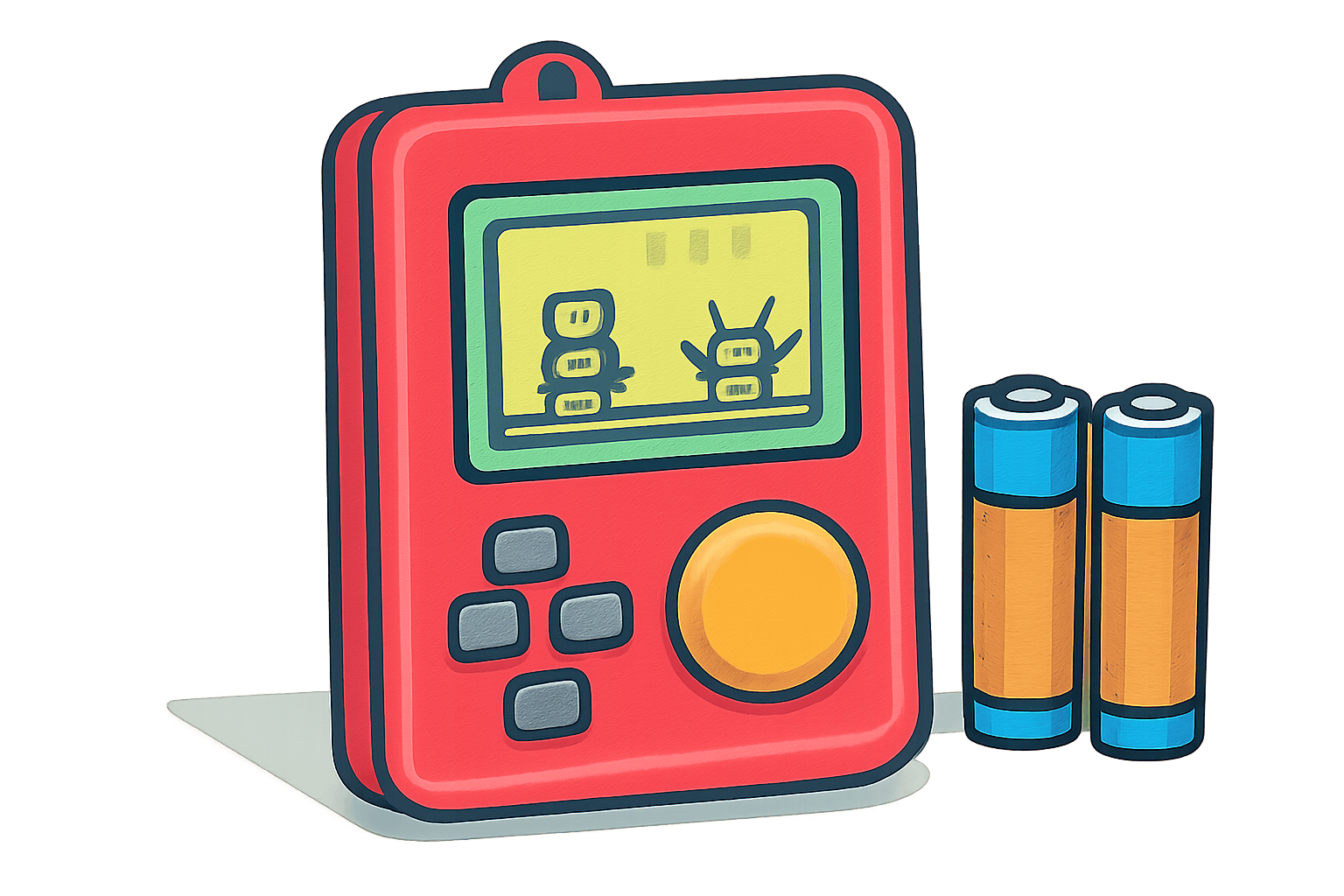
The shape was always the same. A brick of cheap plastic, about the size of a wallet folded in half, usually bright red or yellow or a shade of green that didn't exist in nature. A little loop at the top for a lanyard you never actually used. Two AA batteries in the back behind a door held shut by a single Phillips screw your dad had to open for you. A piercing speaker. Four clacky raised buttons. A gray-green LCD screen that, when you tilted it toward the light, showed you the ghosts of every single thing it was ever going to do.
That was the trick. And somehow we never noticed it was a trick.
I had the Sonic the Hedgehog one. My cousin had X-Men. Tyler Durgin - yes, same Tyler - had one of those WWF ones where Shawn Michaels looked vaguely like a brick wearing a beard. They were all the same object, really. Same chassis. Same buttons. Same mustard-colored screen. Only the sticker on the front and the tiny lit shapes inside the LCD were different. If you squinted you could convince yourself the sprite on yours was Sonic, jumping over a Crab Badnik, rather than a small angry polygon jumping over another small angry polygon.
You squinted a lot.
The LCD Confessed Everything
Here's the part that nobody talks about now. Pick up a Tiger Electronics handheld, any one of them, while it's switched off. Tilt the screen toward a lamp. You could see them. Every sprite. Every position it could ever occupy. All of them, faintly, like ghosts. The hero crouched. The hero jumped. The hero punched. The fireball at position one, and position two, and position three. The boss rising from the floor in four discrete stages. The "GAME OVER" that had been waiting there the whole time.
The LCD wasn't drawing anything. It was just choosing which of its pre-etched shapes to darken.
The game wasn't rendered. It was revealed. Every pixel had been there since the factory.
In a proper video game, the characters moved because a processor was calculating where they should be and painting them onto a screen that didn't know what they looked like. In a Tiger handheld, the characters "moved" because one shape went dim and the next shape, three centimeters over, went dark. That was the entire animation system. Teleportation, basically. We were playing a slideshow.
And once you've seen it, you can't unsee it. Crouch position. Jump position. There is no between. Your character doesn't rise into the air. He teleports to the air-slot. Then teleports back. The physics of the Tiger handheld were the physics of a flipbook someone had printed on glass.
The Box Was a Lie
The packaging was where Tiger really earned its money. The box for the Sonic handheld had full-color art of real Sonic, mid-spin, Green Hill Zone stretching behind him. It looked like a Sega game. On the back, a screenshot - and this is the crucial part - that was clearly from an actual Sega console. Not from the thing inside the box. The real game. The game this was pretending to be.
Nobody at Tiger thought we wouldn't notice. They just correctly assumed our parents wouldn't.
Our parents were looking at the price sticker. $14.99 at Kay-Bee Toys. $12.99 on sale at KB the week after Christmas. The Game Boy was eighty bucks, and a Game Boy game was another thirty. This was twelve dollars. This was what "a video game" cost when your grandma had twenty in a birthday card. Your parents wandered down the aisle at Kay-Bee and the Tiger rack was right at your eye level, a wall of licensed superheroes and wrestlers and cartoon hedgehogs, all promising a real video game for the price of a large pizza.
Of course they said yes. Of course you said yes.
Three Buttons, Two Ideas
Every Tiger game, regardless of license, was one of three games.
The first was "walk right, jump occasionally." You were Sonic, or Batman, or a minor X-Man, and a blocky enemy appeared at position four. It teleported to position three. Then position two. Then position one, which was where you were. If you pressed JUMP on approximately the right frame, you survived. If you didn't, the little heart in the corner went out and the speaker produced a sound like a dying smoke detector.
The second was "punch at the right moment." Usually a WWF or Street Fighter license. Two fighters. They took turns throwing one of two possible punches. You were supposed to press BLOCK for the high one and DUCK for the low one, or the other way around, depending on which plastic brick you had. Landing a hit reduced a health bar that was made of about six segments.
The third was the mini-game version of a pinball machine where a ball bounced around on a fixed grid and you pressed FLIPPER. This was the Tiger designers going, okay, we've done the running one and the punching one; what else is there.
That was it. Those were the games. For five or six years, from roughly 1989 to 1997, Tiger Electronics sold you those three games with forty different wrappers.
I built you the first one. It's as much of a Tiger game as any actual Tiger game was. The enemy doesn't come toward you - it teleports closer in four steps. Your hero doesn't jump - he winks out of his ground-slot and into his air-slot. If you can see the ghost of the sprite before it lights up, that's not a bug. That was the entire appeal. Every future frame was already on the screen, waiting.
The Sound of Suffering
The speaker was its own crime. There was no music, exactly. There were tones. A rising three-note chirp for the title screen. A single descending note when you got hit. A short, unholy melody - technically a melody - when you cleared a stage, usually the first five notes of the real game's theme translated into something that sounded like a microwave yelling.
You played these things with the sound off after the first day. Or with the sound on until your mom, from two rooms away, said "please."
The funny thing is your ear still filled in the music. If you had the Sonic handheld, your brain patched in the Green Hill Zone theme on top of the beeps. If it was the Jurassic Park one, you imagined the John Williams theme over the ambient screech. The Tiger handheld wasn't a video game. It was a video game prompt. It gave you ten percent of the experience and your imagination handled the other ninety.
We weren't playing Sonic. We were running a simulation of Sonic inside our own heads, using a plastic brick as a metronome.
Why We Loved Them Anyway
Here's the part where I'm supposed to argue that the Tiger handheld was secretly good. That its limitations taught us something. That the modern gaming industry, with its infinite polygons and real-time ray tracing, could learn something from a $12 brick of licensed disappointment.
I don't totally believe it.
The Tiger handheld wasn't good. It wasn't secretly good, either. It was a cheap knockoff that used its license to sell you the idea of a game you weren't going to get. The box said Sonic and you got a polygon. The box said Street Fighter and you got a polygon fighting another polygon in what could charitably be described as mime. We all knew. Some kids refused to touch them out of principle. Those kids were probably right.
And yet. The thing worked on you. You played it on the school bus. You played it under the covers after you were supposed to be asleep. You played it in the back of the minivan on the way to your aunt's, and you believed in it, because believing in it was the only way to get any value out of the twelve dollars your parents had spent. You told yourself that the angry polygon was Sonic. That the teleporting cube was a Crab Badnik. You built the rest of the game yourself and didn't notice you were doing it.
That's the weird part. Tiger Electronics figured out that kids would do most of the work. Give us a license, a sprite, a beep, and four buttons, and we'd paint an entire world on top of it with our eyes closed. Our imaginations subsidized their hardware budget.
They weren't wrong.
The Ghosts Are Still There
Somewhere in a box in your parents' basement there is, almost certainly, a Tiger handheld. The batteries are corroded. The lanyard hole is unused. The screen, when you tilt it toward the window, still shows you every sprite it was ever going to show you, faintly, like a palimpsest of a video game.
You could put two new AAs in it tomorrow. The polygon would still walk right. The enemy would still teleport at you in four fixed steps. The speaker would still make the dying-smoke-detector noise. None of it has aged, because none of it was ever modern.
And if you had the Sonic one, you'd still hear the Green Hill Zone theme in your head while you played it. Your brain wrote that music in 1994 and it never stopped.
That's the scam. That's why it worked.
The Tiger handheld was a thin plastic mirror held up to your own imagination. The game was you agreeing to pretend. For twelve dollars, that was actually a pretty good deal.