The submarine was yellow. Maybe two inches long, made of plastic so thin you could almost see through it. You dropped a pinch of baking soda into a little chamber in the bottom, sealed it up, and put it in the bathtub. Then you waited. After a minute - sometimes two, if you got the ratio wrong - the thing would bob to the surface, release a tiny bubble, and sink again. Over and over. A genuine deep-sea vessel, powered by Arm & Hammer, pulled from the bottom of a box of Lucky Charms at 6:47 on a Tuesday morning.
That was the prize. That was the whole reason you'd begged for that specific cereal in aisle seven. Not the marshmallows. Not the leprechaun. The submarine.
The Dig
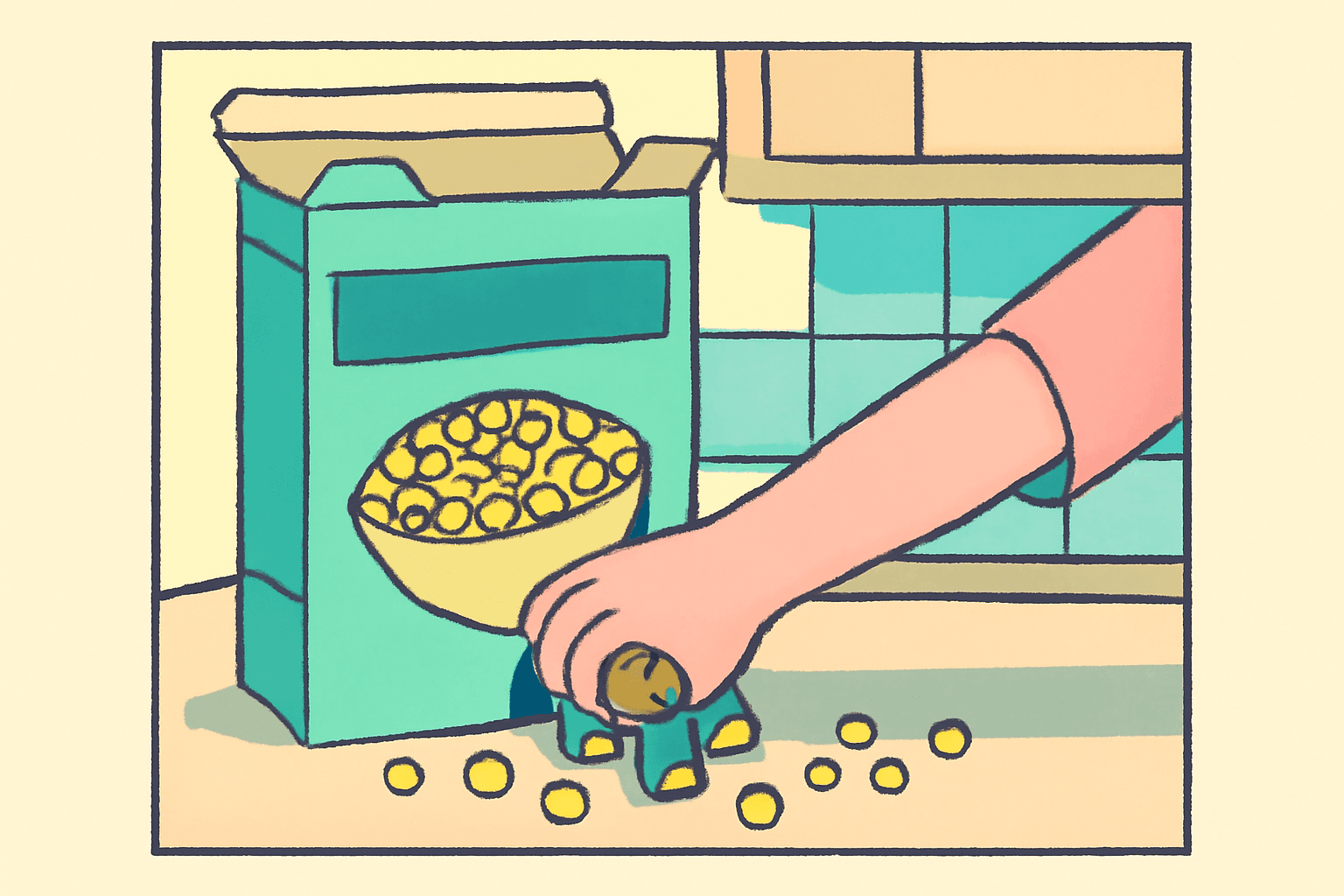
Getting the toy out was a physical act. You didn't just pour a bowl and hope it tumbled out with the cereal - though sometimes it did, and that was Christmas. More often you had to go in after it. Arm plunged into the box up to the elbow, fingers fishing through sugary rubble, trying to feel for the crinkle of a plastic bag or the hard edge of something that was definitely not a Froot Loop.
Your mom hated this. Use the bowl, don't put your whole arm in there, other people have to eat that cereal too. But the bowl method was slow and unreliable. You could eat three bowls and still not find it. The direct approach was the only serious option.
You didn't just pour a bowl and hope the toy tumbled out. You went in after it. Arm plunged into the box up to the elbow, fingers fishing through sugary rubble, searching for the crinkle of that plastic bag.
And when your fingers finally closed around it - that little sealed pouch, slightly greasy from the cereal dust - the morning changed. You tore it open right there at the counter, cereal box still gaping, your arm probably still coated in sugar. Whatever was inside, it was yours. You'd found it.
The Prizes
The range was enormous. At the low end, you had temporary tattoos and stickers - fine, acceptable, not life-changing. A sheet of Froot Loops stickers featuring Toucan Sam in various action poses. Temporary tattoos of Tony the Tiger that peeled off after one bath. These were the common pulls, the energy cards of the cereal prize world.
Then there was the mid-tier. Color-changing spoons that turned purple when they got cold, or revealed a hidden picture when you dipped them in milk. Plastic figurines of the cereal mascots. Tiny board games printed on cards you could punch out. A magnifying glass with the Trix rabbit on the handle. These were solid. You could use these. You could bring a color-changing spoon to school and blow someone's mind at lunch.
- Baking soda submarines (Lucky Charms, various)
- Color-changing spoons (Froot Loops, late 90s)
- Mini CD-ROMs (various, usually with a "game" that ran on Windows 95)
- Temporary tattoos (everyone, constantly)
- Glow-in-the-dark stickers (Count Chocula, obviously)
- Plastic figurines (too many to list)
- Lenticular cards that changed when you tilted them
- "Send away" offer forms for the really good stuff
And then, briefly, gloriously, there were the mini CD-ROMs. This was late 90s, maybe 1999 or 2000, and General Mills or Kellogg's or somebody decided to put actual computer software in the cereal box. A tiny disc in a tiny sleeve, tucked in with the Cinnamon Toast Crunch. You'd pop it into your family's Compaq Presario and it would auto-run some janky game featuring the cereal mascot. The game was never good. The game was never good. But it came from inside a cereal box, and that made it feel like the future had arrived.
The Cereal Aisle
Here's the thing nobody talks about enough: the toy determined the cereal. Not the taste. Not the nutritional content - as if that was ever a factor. The toy. You'd stand in the cereal aisle at Kroger or Safeway or Piggly Wiggly and you'd scan the boxes, looking at the front panel, where they always advertised what was inside. "FREE INSIDE: Color-Changing Bowl!" or "COLLECT ALL FOUR!" and your decision was made before you even processed what the cereal tasted like.
This drove parents insane. Your mom wanted to buy Cheerios. Cheerios didn't have a toy. Cheerios had heart health benefits. You were seven. You didn't have a heart yet, as far as you knew. But the box of Cocoa Puffs three feet to the left had a glow-in-the-dark Sonny the Cuckoo Bird, and suddenly the cereal aisle was a negotiation zone.
Your mom wanted to buy Cheerios. Cheerios didn't have a toy. Cheerios had heart health benefits. You were seven. You didn't have a heart yet, as far as you knew.
The "Collect All Four" boxes were the most dangerous. Because now it wasn't one cereal purchase - it was a campaign. You needed all four figurines, or all four color-changing spoons, or all four lenticular cards, and you had no way of knowing which one was in the box until you opened it. You could end up with three of the same Toucan Sam and zero of the one you actually needed. The completionist anxiety this created in eight-year-olds was real and lasting.
The Back of the Box
But the toy wasn't the only draw. The box itself was entertainment. The back panel was a full-page activity spread - word searches, mazes, connect-the-dots, spot-the-difference puzzles - and you stared at it every morning because there was nothing else to look at. No phone. No tablet. Just you, a bowl of Cap'n Crunch that was shredding the roof of your mouth, and a word search where you had to find MARSHMALLOW and MAGICALLY and DELICIOUS.
The back of the box was where you learned what a "proof of purchase" was. That little UPC code symbol, usually in the bottom corner, with a dotted line around it and instructions to "CUT AND SAVE." Because the really good prizes weren't in the box at all. They were mail-order. Send three proofs of purchase plus $2.99 for shipping and handling to a P.O. Box in Battle Creek, Michigan, and in six to eight weeks you'd receive a genuine Tony the Tiger wristwatch.
Nobody talked about how brutal the send-away system was. You had to eat three entire boxes of cereal, carefully cut out the UPC codes without mangling them, find an envelope, write the address by hand, convince your parents to give you a check or money order for $2.99, mail it, and then wait two months. For a plastic watch. That you would lose in a week. The commitment this required from a child was honestly unreasonable.
Six to eight weeks. Try explaining that timeline to a kid in the age of same-day delivery. You mailed the envelope and then you just - waited. Checked the mailbox every day after school for a month and a half. Forgot about it entirely. Then one afternoon a padded envelope showed up and you remembered, and it was like a gift from a past version of yourself who had planned ahead for once.
The Death of the Dig
I don't remember exactly when it changed. Sometime in the early 2000s, maybe a little before. The toy migrated from inside the box to outside the box - shrink-wrapped to the front panel, visible through a little window, or attached to the top with a strip of plastic. You could see exactly what you were getting before you bought it. No surprise. No dig. No arm disappearing into a box of Frosted Flakes at dawn.
They said it was a choking hazard thing. Maybe it was. There were probably lawyers involved, and focus groups, and someone in a conference room pointing at a chart about liability. Fine. But something disappeared when the toy moved to the outside.
The magic was never really about the prize. The submarine didn't work that well. The spoon stopped changing colors after a few weeks. The CD-ROM crashed your computer. But the moment - that blind reach into the box, the not-knowing, the possibility that this particular Tuesday morning was about to produce something wonderful from inside a box of cereal - that was the thing.
My kids eat cereal sometimes. Good cereal, honestly. Better than what I had, nutritionally speaking. The boxes are clean and informative and they don't promise anything they can't deliver. There is no prize inside. There is nothing to dig for. They pour, they eat, they look at a screen.
I don't think they know what they're missing. Which is maybe the saddest part - not that the toy is gone, but that nobody's reaching for it. Nobody's standing in the cereal aisle, heart pounding, trying to figure out which box has the glow-in-the-dark ghost inside. Nobody's going elbow-deep into anything at seven in the morning.
The cereal tastes the same. But the box is just a box now.