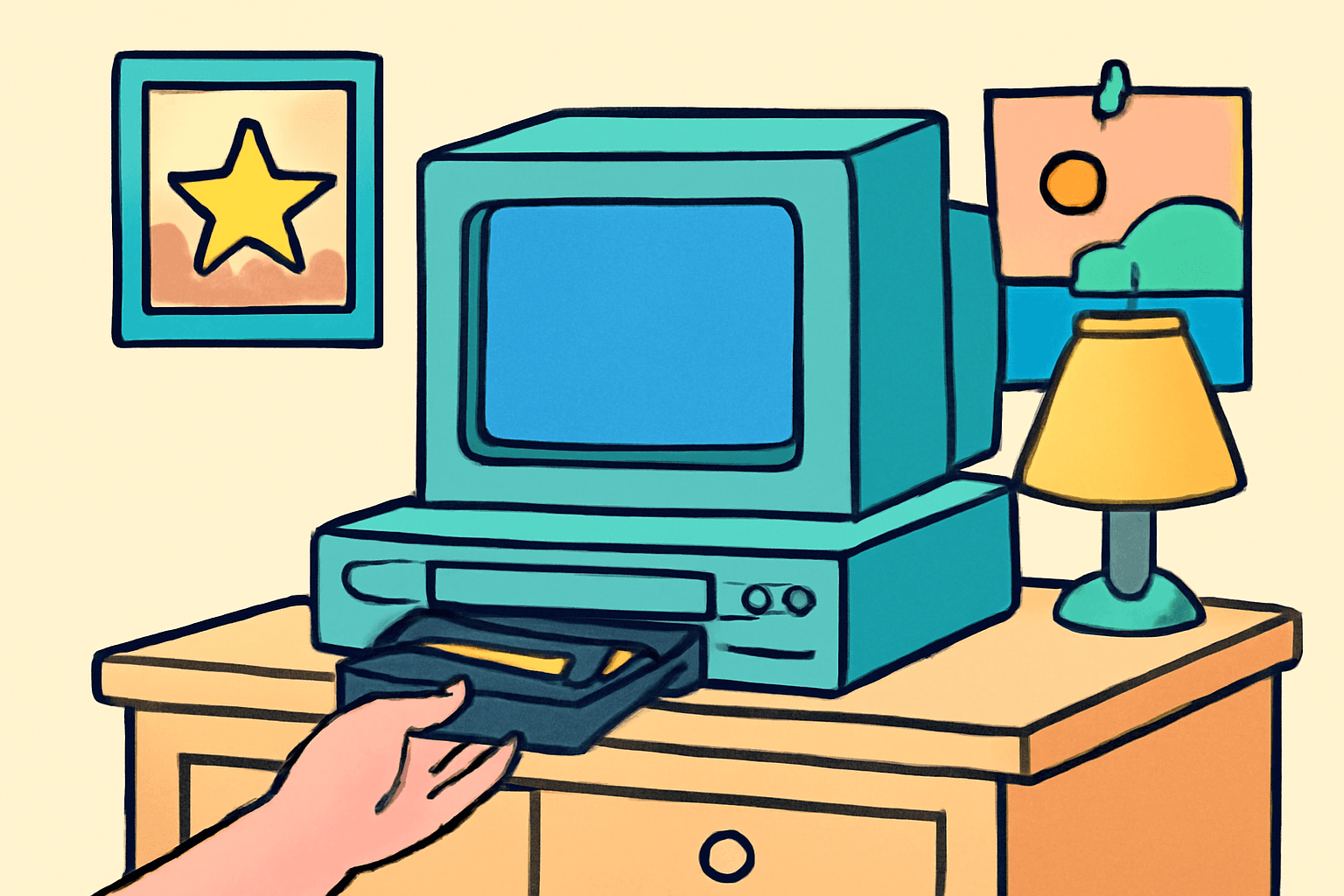
The one in my bedroom was a 13-inch Orion. Silver-gray plastic, built like a cinder block, with a VCR slot right beneath the screen that accepted tapes with a mechanical whir and a satisfying clunk. It sat on top of my dresser, slightly too heavy for the particleboard, and it was the most important object I owned. More important than my Super Nintendo. More important than my bike. That TV/VCR combo meant I could watch whatever I wanted, whenever I wanted, in the privacy of my own room, without a single negotiation.
No wires running between two separate boxes. No RF switch. No trying to figure out which input channel to use. You plugged it into the wall, attached the cable or the antenna, and you were done. One unit. One power cord. One remote that controlled everything. It was so elegant it almost felt illegal.
The Bedroom Unit
The TV/VCR combo was never the main television in the house. That was the big set in the living room - the 27-inch or the 32-inch, the one that sat in the entertainment center with the glass doors and the separate VCR underneath, connected by those red-white-yellow cables that your dad had to re-plug every time something went wrong. That was the family TV. The serious TV.
The combo unit was different. It was personal. It lived in your bedroom, or on the kitchen counter next to the microwave, or in your parents' room angled on a dresser so they could watch the news in bed. It was the second or third television in the house, the one that nobody fought over because it was yours.
The TV/VCR combo was the first real taste of media independence for an entire generation. Your room. Your tapes. Your schedule.
And it was shockingly affordable. You could pick one up at Walmart or Target for maybe $150, sometimes less if you caught a sale. For that price, you got everything in one box. No compatibility issues. No extra purchases. Just television and videotape, fused together in perfect, self-contained harmony.
The Blinking 12:00
Every TV/VCR combo in America blinked 12:00. Every single one. It blinked in bedrooms and kitchens and guest rooms and basement rec rooms, a tiny green or blue pulse that never stopped, because nobody - nobody - could figure out how to set the clock.
It wasn't that the process was impossible. It was that the process required reading the manual, and the manual was written by someone who clearly hated the English language. You had to hold down the CLOCK button while pressing CHANNEL UP to advance the hour, then switch to minutes, then confirm it, and if you accidentally let go of CLOCK at the wrong moment you'd start from scratch. So you'd try once, maybe twice, and then you'd just accept it. The 12:00 blinked. It would always blink. It was a feature now.
A 2004 study estimated that roughly 75% of VCRs in American households had never had their clocks set. The blinking 12:00 was so universal it became a punchline in sitcoms, stand-up routines, and even a shorthand for technological helplessness among older generations. It outlasted the VCR itself.
My parents' combo unit in the kitchen blinked for its entire operational life. Something like seven years. That's roughly 61,000 hours of continuous blinking. Not once did anyone in my family attempt to correct it after the initial failure. We just let it blink. It became part of the kitchen, like the fruit magnets on the fridge.
Recording While You Were Gone
The real promise of the VCR - the thing the commercials sold you on - was time-shifting. You could record a show while you were out. You could tape the season finale of ER while you were at your cousin's birthday party. You could capture The X-Files on Friday night and watch it Saturday morning. In theory.
In practice, programming a VCR to record was like filing your taxes in a foreign language. You had to set the channel. You had to set the start time. You had to set the end time. You had to make sure the tape had enough room. You had to make sure the TV was on the right input. You had to pray.
The number of times I came home to find that the VCR had faithfully recorded two hours of the wrong channel, or started fifteen minutes late, or just hadn't recorded at all because I'd missed one step in a twelve-step process - I can't count that high. The VCR Plus+ system was supposed to fix this. You'd punch in a code from the TV listings in the newspaper and it would handle the rest. It did not handle the rest. It was a different flavor of the same confusion.
The AV Cart
But the TV/VCR combo's finest hour - its true moment of glory - was the AV cart.
You'd walk into your classroom on a random Tuesday and see it. The tall metal cart on wheels, pushed into the corner or parked at the front of the room, with a TV/VCR combo strapped to the top shelf. Usually a bigger one. Maybe a 20-inch. School-issued, probably purchased in bulk from some educational supply catalog, built to survive being wheeled through hallways by custodians who did not care about your movie day.
The energy in the room shifted immediately. You'd look at your friends. They'd look at you. Nobody said anything because you didn't want to jinx it, but you all knew. Movie day. Worksheet optional. Learning suspended.
Nothing in the American educational experience generated more immediate joy than walking into a classroom and seeing the AV cart already set up.
The teacher would spend five minutes trying to get the TV to the right channel, then another three minutes adjusting the tracking because the picture was rolling, and then someone would have to get up and close the blinds because the glare washed out the screen, and by the time the movie actually started you'd lost ten minutes of class time, which was ten minutes of not doing math, which was perfect.
Bill Nye. Magic School Bus. That one PBS documentary about ancient Egypt that every social studies teacher owned a copy of. And if you were really lucky, a feature film that was only loosely connected to whatever you were studying. My eighth-grade English teacher showed us the entire 1968 Romeo and Juliet after we read the play, and let me tell you, a room full of thirteen-year-olds was not ready for that one particular scene.
The Tapes Themselves
The combo unit ate tapes. This was its one great flaw, and it was significant. Because the VCR mechanism was crammed into a smaller space than a standalone unit, the tape path was tighter, the tolerances were thinner, and every so often you'd hear a sound - a grinding, crunching, deeply wrong sound - and you'd hit EJECT and pull out your tape trailing a ribbon of crumpled film like intestines.
You'd try to fix it. Everyone tried to fix it. You'd carefully wind the tape back into the cassette with a pencil jammed into the spool, turning it slowly, smoothing the creases with your thumb. Sometimes it worked. Sometimes the tape played back with a warped, wavy section right at the good part. Sometimes the tape was just dead, and you held a funeral in your heart and moved on.
- The FBI warning you couldn't skip, threatening federal prison for piracy
- Tracking adjustment - turning a dial or pressing buttons to stop the picture from rolling
- The slow degradation of a tape watched too many times, colors bleeding, audio getting muddy
- Rewinding to the beginning when some animal returned it without rewinding
- The feel of a tape that had gotten too hot in a car, the plastic slightly warped and soft
And the wear. God, the wear. If you had a favorite movie - a real favorite, one you watched weekly - you could literally watch it deteriorate over time. The colors would fade. The tracking would get worse. The audio would develop a faint hiss. A tape watched a hundred times looked like it was being viewed through a dirty window. But you kept watching it because it was yours, and the imperfections became part of the experience. My copy of Jurassic Park by 1998 looked like it had been filmed underwater. I didn't care. I could still hear the T-Rex.
Be Kind, Rewind
There was an entire moral framework built around VHS tapes. You rewound before returning. You didn't touch the exposed film. You stored them upright, not flat. You never left them on top of the TV where they'd get warm. "Be Kind, Rewind" wasn't just a sticker on the rental tape - it was a social contract. You did it for the next person. You did it because it was right.
The dedicated rewinder was a whole product category. Little machines shaped like sports cars or plain black boxes, their only purpose in life to spin a tape backward faster than the VCR could. They cost maybe ten bucks and they lived on top of the TV stand and they were somehow always running, always whirring, like a little factory of courtesy.
The End of the Line
DVD players showed up and the combo unit didn't stand a chance. The picture was too clean, the sound too crisp, the discs too small and shiny and futuristic. Some manufacturers tried a TV/DVD combo, and it sold fine, but it was never the same. The DVD didn't need you the way the VHS tape did. It didn't need rewinding. It didn't need tracking. It didn't eat itself. It was better in every measurable way, and it had no personality whatsoever.
The combo units ended up at Goodwill, or in the garage, or just sitting in a closet for years because nobody wanted to deal with recycling a TV. Some of them are probably still out there. Still blinking 12:00.
I think about that 13-inch Orion on my dresser sometimes. The way the tape slot glowed faintly when a cassette was loaded. The static hiss when you turned it on before the signal caught. The satisfying weight of it, the way it sat there like it had important work to do.
It wasn't a great TV. It wasn't a great VCR. But it was both of those things at once, in one box, with one plug, and it gave a twelve-year-old dominion over his own viewing schedule for the first time in his life. That's not nothing. That might be everything.