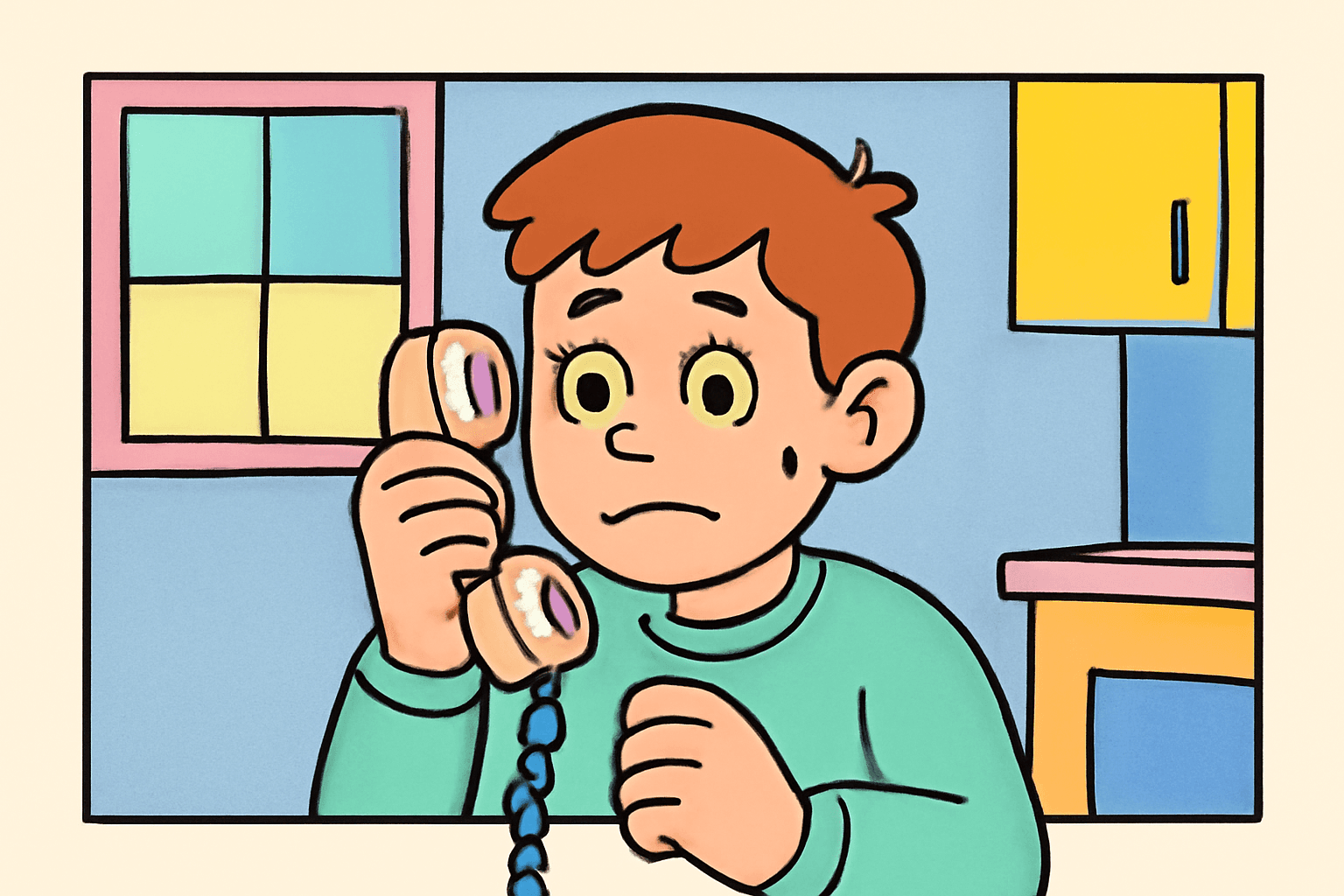
The phone was mounted on the kitchen wall, right next to the calendar from the insurance company and a pad of paper that said "WHILE YOU WERE OUT" at the top. It had a cord that reached approximately four feet, which meant every conversation in our house happened standing in the kitchen while your mom unloaded the dishwasher three feet away. There was no privacy. There was no escape. There was just you, the beige handset, and the entire family pretending not to listen.
This was the landline. The only way to reach another human being outside your house. You couldn't text. You couldn't DM. You couldn't tag someone in something. If you wanted to talk to your friend, you picked up a phone that was bolted to a wall and you called their house. Not them. Their house. Their whole family. Whatever adult happened to be closest to the receiver.
And that's where the terror began.
The Script
Every kid in America between 1988 and 2001 knew The Script. You learned it the way you learned to tie your shoes - through repetition, correction, and a healthy fear of doing it wrong. It went like this:
Ring. Ring.
"Hello?"
"Hi, Mrs. Patterson. This is Kevin. Is Brian there?"
That's it. That was the whole protocol. Fifteen words. But those fifteen words contained an entire social education. You said hello. You identified the adult by name, which meant you had to know their name, which meant you had to pay attention. You stated your own name unprompted, because anonymous callers were suspicious callers. And you asked for your friend politely, using the word "there" instead of anything that might sound demanding.
You didn't call your friend. You called their house. And their house had a gatekeeper, and that gatekeeper was someone's dad at 9 PM on a Tuesday.
If you forgot any part of The Script - if you just said "Is Brian there?" without identifying yourself - you'd hear a pause. A weighted, deliberate pause. And then: "May I ask who's calling?" Said in a tone that made it clear this was not optional and that your parents had raised you in a barn.
My mom drilled this into me. Before I was allowed to call anyone's house, she rehearsed it with me like I was preparing for a deposition. "You say your name. You say please. You say thank you when they go get him. And if they say he can't come to the phone, you say 'okay, thank you, could you let him know I called?' You do not ask why."
You did not ask why. That was the rule. If a parent said their kid couldn't come to the phone, the reason was classified information. Maybe they were grounded. Maybe they were in the bath. Maybe the family was in the middle of something. You accepted it and hung up and wondered about it for the rest of the night.
The Crush Call
Now take all of that anxiety and multiply it by a thousand, because at some point you had to call a girl. Or a boy. Someone you liked in a way that made your hands sweat, and the only path to their voice ran directly through their parents.
You'd sit on your bed with the cordless phone - if you were lucky enough to have a cordless - and stare at the number you'd written on a torn piece of notebook paper. You'd rehearse what you were going to say. You'd pick up the phone and put it down four times. You'd dial six digits and hang up. You'd get a glass of water. You'd come back. You'd tell yourself this was stupid, that calling someone on the phone was a normal human activity, and then you'd dial all seven digits and your heart would stop.
Ring.
Ring.
"Hello?"
It was her dad.
Levels of Phone Call Terror, Ranked:
- Your crush's dad answers
- Your crush's older brother answers
- Your crush's mom answers and wants to chat
- The answering machine picks up and the whole family is on the greeting
- Your crush actually answers and you forget how words work
Her dad. The man whose house you were calling at 7:45 on a Wednesday evening. The man who coached her softball team and had a mustache and once looked at you in a way that suggested he could see directly into your soul. That guy. On the other end of the phone. Waiting for you to speak.
"Hi, Mr. Caldwell. This is... Kevin. From school? Is, um, is Sarah there?"
The pause. God, the pause. You could hear him deciding whether you were worth the trip down the hallway. Then, muffled: "Sarah! Phone!" And you'd wait, listening to the distant sounds of their house - a TV, someone clanking dishes, a dog barking - until finally there was a rustle and a breath and she said "hello?" and you were alive again.
The Cord
The kitchen phone had that curly cord, a miracle of engineering that could stretch from the wall to approximately the doorway of the nearest room where you might find a shred of privacy. In our house, that was the pantry. In my friend Danny's house, it was the coat closet. You'd pull that cord taut and wedge yourself into a dark space surrounded by jackets and shoes and have a conversation in a whisper while your family ate dinner twelve feet away.
The cord always got tangled. Always. You'd finish a call and the cord would be wound into a helix so tight it looked like a DNA model. People had techniques for untangling it. You'd let the handset dangle and spin. It was a whole thing.
Privacy in the 90s was a twenty-five-foot phone cord and a closet door that didn't quite close all the way.
The cordless phone changed the game, but it came with its own problems. The range was garbage. You'd walk ten feet past the kitchen and the call would turn to static. And the battery died at the worst possible moment, always, without exception. Mid-sentence. Mid-secret. You'd hear that telltale beeping and have about four seconds to say something before the call dropped and you had to walk back to the base unit in the kitchen like a prisoner returning to their cell.
The Other Extension
Every house had at least two phones. The kitchen phone and the one in the parents' bedroom. Maybe a third in the basement. And at any moment, without warning, someone could pick up another extension and just be there.
You'd be deep into a conversation and you'd hear it. That little click. That tiny intake of breath. Your little brother. On the upstairs phone. Listening.
"MOM! Tyler's on the phone again!"
"I am not!"
"I can hear you breathing!"
"Hang UP!"
This was a nightly occurrence in most American households. Siblings treated the second phone line like a surveillance device. They'd pick up, listen for thirty seconds, gather intelligence, and then either quietly hang up or - if they were feeling particularly evil - make their presence known at the worst possible moment. "Ooooh, Kevin likes Sarah." Click.
You'd spend the next twenty minutes chasing them through the house.
The Answering Machine
If nobody picked up, you got the machine. The answering machine was a small beige box that sat next to the phone and contained a tiny cassette tape and the family's collective voice.
"Hi, you've reached the Hendersons! We can't come to the phone right now - " and then each family member would say their name in sequence like a roll call, and sometimes the youngest kid would yell theirs too loud and too close to the microphone and the whole message would clip. "Leave a message after the beep!"
Leaving a message was its own ordeal. You had to be concise, clear, and aware that the entire family was going to hear this. There was no privacy. No way to leave a message just for one person. You'd say "Hey, it's Kevin, call me back" and know that Mr. Henderson was going to hear it, and Mrs. Henderson, and Sarah's weird older brother who was in high school and already scared you.
The truly brave move was not leaving a message at all. Just hang up. Except then star-69 existed.
*69 and *67
Star-69 was callback. You picked up the phone, dialed *69, and it would automatically call back the last number that called you. This was a nightmare for prank callers and shy kids alike. You couldn't just call someone and hang up anymore. There was a record. There was accountability.
Star-67 was the countermeasure. Dial it before the number and your call showed up as "Private" or "Blocked" on their caller ID. It was the invisibility cloak of the telephone world. Of course, plenty of families had a rule: don't answer blocked calls. So you'd dial *67 to protect your identity and then just listen to it ring forever because Mr. Caldwell wasn't picking up a call from "Unknown."
An arms race, right there on the telephone network. Fought entirely by thirteen-year-olds.
Phone Hours
There were rules about when you could call someone's house, and nobody wrote them down, but everybody knew them. You didn't call before 9 AM on a weekend. You didn't call during dinner, which was roughly 5:30 to 7 depending on the family. You didn't call after 9 PM unless you were very close friends, and even then you were pushing it.
The sweet spot was 7 to 9 PM. Phone hours. The dishes were done, the news was on, the parents had settled in. This was your window. Two hours to make every call you needed to make - homework questions, plans for the weekend, the conversation with your best friend about what happened at lunch that somehow lasted forty-five minutes.
If you violated phone hours, the parent who answered would let you know. Not rudely. Just with a tone. "Kevin, it's nine-thirty." That was it. No further explanation needed. You apologized, you hung up, and you never did it again.
The Phone Book
Before you could call anyone, you had to find their number. And the way you found someone's number was a physical book that arrived on your doorstep once a year, roughly the size and weight of a cinder block.
The White Pages. Every listed household in your area code, arranged alphabetically. You'd flip to the right letter, run your finger down the column, and pray that your friend's last name wasn't something common like Johnson, because then you were scanning through forty Johnsons trying to remember if their dad's name was Robert or Richard.
Some families were unlisted. This was the 90s equivalent of a private Instagram. It meant you had to actually ask someone for their number, in person, which required a level of social bravery that cannot be overstated.
I had a list of numbers taped to the wall next to the kitchen phone. My mom's handwriting at the top, mine at the bottom. It was the original contacts app. If you lost that piece of paper, you lost your entire social network.
The phone book was a cinder block of everyone's personal information, delivered annually to every doorstep in America, and we all just thought that was normal.
What It Actually Taught Us
Here's the thing nobody says about the home phone. It taught you how to talk to adults. Not in a classroom, not in a structured way, but in the trenches. You learned to introduce yourself. You learned to be polite under pressure. You learned that the path to the person you wanted to reach ran through people you had to respect first.
You learned to read a voice. Was this a good time? Was Mr. Caldwell in a fine mood or a bad one? Was Mrs. Patterson going to chat with you for three minutes before getting Brian, or was she going to hand off the phone immediately? You got good at this. You had to.
Every kid who grew up with a landline had a minor in diplomacy by age twelve.
I still remember Sarah Caldwell's phone number. Seven digits I dialed so many times they wore a groove in my brain. I couldn't tell you what I had for lunch on Thursday, but I can rattle off that number without thinking. It's disconnected now, probably. The kitchen phone is gone. The cord is gone. Mr. Caldwell and his pause are gone. But the number is still in there, living rent-free in whatever part of your memory holds the things that used to make your heart pound.