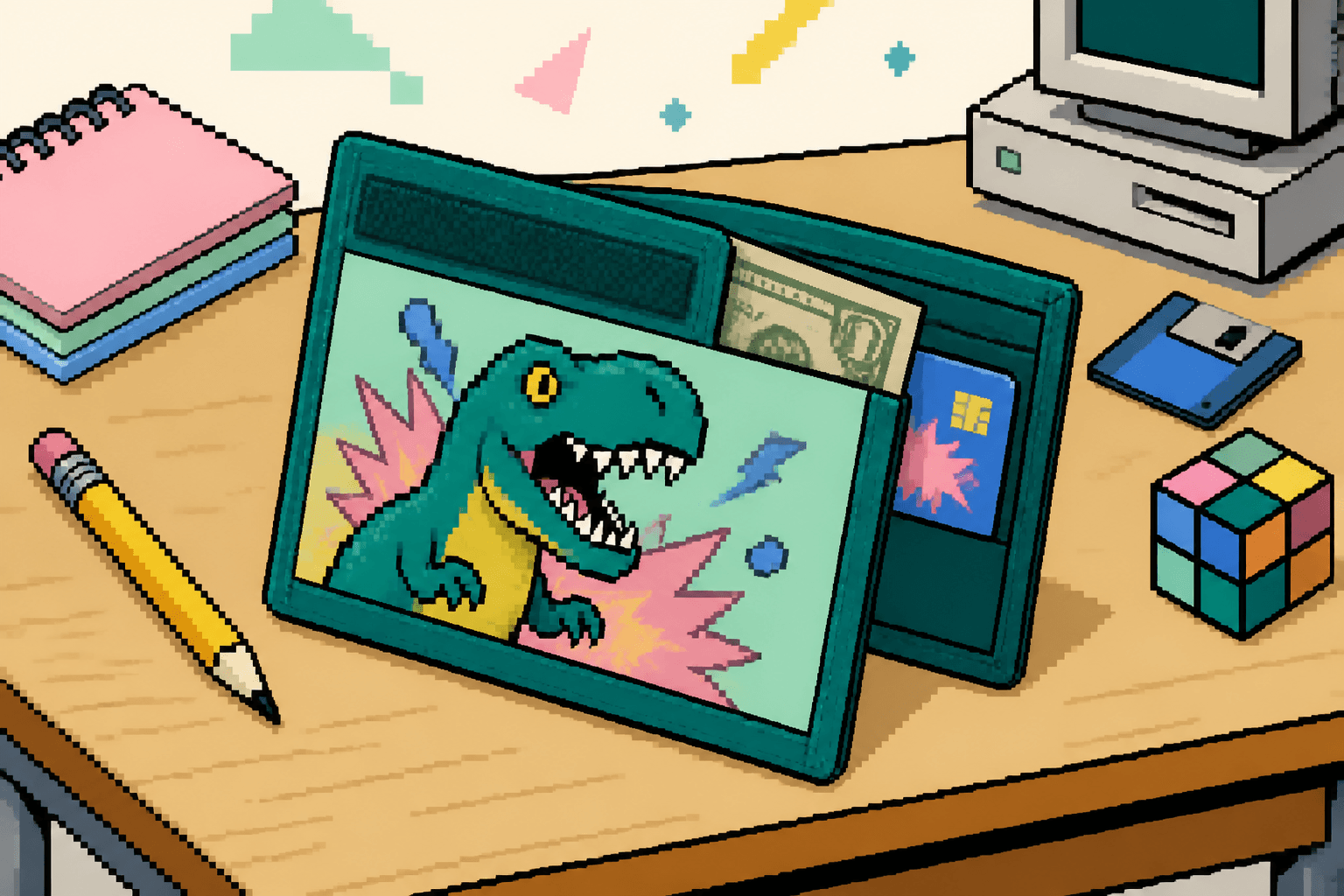
You got it from the gift shop at a mini-golf place, or from the back-to-school bin at Kmart, or in a birthday goody bag at a party where somebody's mom had overcommitted. It was nylon. It was trifold. It had a cartoon printed on the outside - a T-rex, a Power Ranger, a Looney Tune, the Space Jam Tune Squad logo, a Lion King stamp that had already started to peel at the corner. The inside was lined in a pink or neon-green nylon that felt, if you were honest about it, like a windbreaker.
It closed with a strip of velcro that ran the full width of the top flap. One hooky side. One fuzzy side. Pressed together: a bond so strong you had to use two hands to break it. Breaking it: the loudest sound a child could produce in a library without being asked to leave.
The Design
The wallet had three panels, which is why it was a trifold, which is what everybody called it because that is what the packaging called it.
Panel one was the money panel. It was a single long pouch running the width of the wallet, and you folded bills in half the long way and slid them in. Everybody kept two bills in there, max. One dollar, sometimes a five, almost never a ten. Any time you had more than that, it was an event, and the event ended with the money being spent within an hour.
Panel two was the card panel. There were four or five slots for cards, stitched in at angles so the cards fanned out when you opened the wallet. You did not have cards. You did not have a driver's license. You did not have a credit card. You did not have a library card for about a year after you got the wallet, and when you did finally have one, you were so proud of it that you slid it into the first slot and left it there, and every time anybody opened the wallet for any reason you would say that's my library card, and they would nod, and you would feel seen.
Panel three was the clear window. This was for your ID. You did not have an ID. What you had was a picture of yourself - a school picture, usually, trimmed badly with kitchen scissors so the white edge was uneven - pressed behind the plastic. Sometimes a Pokemon card. Sometimes a Beanie Baby tush tag, which you had decided was valuable. Sometimes a photo of a dog you had met at your cousin's.
You did not have a driver's license. You did not have a credit card. You did not have a library card for about a year. What you had were slots.
The whole thing folded down to about the size of a Pop-Tart. It bulged slightly because of the velcro. It fit in your back pocket and then did not fit, because you had also stuffed in a folded receipt from Blockbuster and a ticket stub from the movies and a fortune from a Panda Express.
The Sound
This is the part everyone remembers.
Velcro, when you pull it apart, does not open quietly. There is no stealth velcro. Velcro was engineered in 1948 by a Swiss man named George de Mestral, after he noticed how burrs stuck to his dog's fur on a walk. He took a burr apart and figured out that it was tiny hooks catching tiny loops, and he made a synthetic version, and he spent a decade perfecting it, and the result - the thing he gave the world - was a fastener that could hold a parachute harness under eight Gs of load and could also be heard, clearly, from across a gymnasium.
The sound is specifically a riiiiiiiip. It is not a click. It is not a snap. It is a slow unzipping tear, about half a second long, in a frequency range that a human ear is specifically tuned to notice. If you have ever been in a library at eight years old and realized, halfway through opening your wallet to show a friend a Pokemon card, that you were about to make this sound, you know exactly what I mean. There is no takeback. Once you have started pulling the flap, you are committed. The strip releases hook by hook, and every hook is a tiny amplifier.
Try It
Pull the flap. Listen for it. Fold it open and look at what is in there. It is, if you are being honest, mostly nothing. A punch card from a pizza place. A phone number written on a corner of notebook paper. A dollar.
That was the whole inventory. That was the whole wallet.
The Graphic On The Front
Every wallet had a graphic. The graphic was the entire reason you picked the wallet. Your parents would have bought you a plain black one for three dollars at the drugstore. You would not accept this. You needed the one with the thing on it.
The things, in rough order of social clout, were:
- Jurassic Park. The T-rex logo, red on black. Timeless. You could carry this to high school.
- Space Jam. The Tune Squad basketball. Peaked in 1997. Still fine in 1998. Weird by 2000.
- Power Rangers. Only one color of Ranger. You picked your favorite. You defended it.
- Looney Tunes. Usually Taz with his tongue out. The adult choice at eight years old.
- Rugrats. The one you had if you were nine and did not understand yet that you were nine.
- Lion King. Simba on Pride Rock, ca. 1994. The first wallet. The one that peeled first.
- Mighty Ducks. Specifically the hockey team logo, not the cartoon. Nobody asked why.
- Nickelodeon splat. Just the logo. Just the slime. A statement.
- Hot Wheels flames. For the kid who had already decided he was a car person.
- Plain nylon with a brand label. Reserved for the kid whose mom shopped at TJ Maxx.
The graphic was heat-transferred onto the nylon with the same technology used to print iron-on T-shirt decals at the mall. This meant that within about four months, specifically at the fold creases, the graphic would start to flake. The T-rex would lose an eyeball. Simba would lose his face. Taz, mercifully, mostly held together, because Taz was just a brown-and-black blob to begin with and had less to lose.
Within four months, specifically at the fold creases, the graphic would flake. The T-rex would lose an eyeball. Simba would lose his face. Taz, mercifully, mostly held together.
The Inventory
What did you actually have in there.
The bill. A single dollar, folded the wrong way, soft at the corners from being folded and refolded. Sometimes a five. On your birthday, a crisp twenty you were going to spend by sundown.
The library card. Laminated. With your home phone number printed on the back in Sharpie by your mom, because what if you lost it.
The Toys R Us Kids Club card. Which did absolutely nothing. You got one because at Toys R Us, at the cash register, there was a little stack of them, and you took one, and your mom signed you up on a form, and they mailed you a card with your name on it. It unlocked nothing. There was no discount. It was a membership in a club whose entire function was that you had a card for it. You kept it in the first slot.
The Blockbuster card. Technically your parents' card. You were allowed to carry it. It had a little keychain version too. You did not have the keychain. You had the card. You slid it out at the counter like a man of the world.
The photo. Behind the clear window. Your school picture, trimmed badly. Or a wallet-size of your grandma, because your grandma had sent you a stack of her own wallet-sizes with a note that said in case you forget what i look like, and you had found that funny but also you had put one in.
The arcade token. A loose arcade token, picked up from the floor at Discovery Zone three months ago, saved for a future arcade visit that never happened. It would still be there when you outgrew the wallet.
A receipt. For something. You did not remember buying it. It was folded four times.
A piece of lint. Always. Velcro grabs lint the way a magnet grabs iron filings. It is in the physics of the fastener. You could clean it. It would come back. There is a small museum of your laundry in every velcro wallet ever made.
The Opening In Church
You could not open a velcro wallet in church.
You tried once. You were seven. Your mom had handed you a dollar on the way in and said for the offering, and you had put it in your wallet, and now the collection basket was coming down the pew, and you had to get the dollar out. You thought, briefly, about the sound. You weighed the options. You decided it would probably be okay.
It was not okay.
The riiiiip went across the church like somebody had unzipped a tent in a cathedral. Three rows ahead of you, a man turned around. Your mom closed her eyes. Your dad made the face that means we will talk about this in the car. The offering basket arrived. You put the dollar in. You did not look up.
You did not open the wallet in church again, ever, and neither did anybody else who had been there.
The Argument With Itself
I want to be fair about this.
It was not a serious wallet. It was a child's wallet, printed with a dinosaur, held shut with hook-and-loop, containing one dollar and the certificate of a club that did not exist. The adult version of a wallet - a leather bifold, a folded rectangle of actual utility - would come later and would feel, when you got it, like a demotion. The adult wallet closed silently. The adult wallet had slots for things you actually carried. The adult wallet could not be identified from the back pocket of your jeans as Jurassic Park branded.
I agree with that. A leather bifold is better in every measurable way.
I would also note, out loud, that the velcro wallet did something a leather wallet has never done, which is make the act of opening it public. When you opened your velcro wallet, everyone within thirty feet knew. When you opened your velcro wallet, you were announcing. You were saying: I have a wallet. I am here. I am about to buy something, or show you something, or produce my library card. You could not open the wallet quietly. You could not open the wallet casually. You could not open the wallet without a tiny ceremony.
That is, I think, a kind of honesty a leather wallet refuses to give you. Money moves silently in adult life. The adult wallet is designed to let you spend without announcing that you are spending. The velcro wallet was designed by a fastener engineer who did not know he was teaching eight-year-olds a lesson about the acoustic signature of commerce.
Money moves silently in adult life. The velcro wallet was designed by a fastener engineer who did not know he was teaching eight-year-olds a lesson about the acoustic signature of commerce.
I am being slightly grand about this. The wallet was four dollars at Kmart. But the point stands.
The End Of The Wallet
The wallet ended in one of three ways.
The velcro wore out. After about eighteen months of daily use, the loops on the fuzzy side started to lie flat, and the hooks on the hooky side started to lose their hook-ness, and the flap would stay closed if you pressed it but would pop open on its own in your pocket, and you would reach back and find your dollar missing. You tried pressing the velcro harder. You tried a rubber band. Eventually you gave up.
The graphic peeled. The T-rex lost his lower jaw. Simba's face flaked into a Rorschach. You tried to carry the wallet anyway, graphic-side-in, but your friends saw, and your friends said your wallet is dying, and that was that.
Or you got a new wallet. For Christmas, usually. Your uncle gave you one, a leather bifold that smelled like a store. It was black and it was quiet and it was adult, and you held it in your hands and said thank you so much, and that night you transferred the Toys R Us Kids Club card and the dollar and the loose arcade token out of the old wallet and into the new one. You did not transfer the photo. The new wallet did not have a window. You could not keep your grandma in it.
The old wallet went into a drawer. It stayed there, flattened, the velcro still pretending to work, the graphic still flaking, for about eleven years. Then your mom cleaned out your bedroom to make it a guest room. She did not throw it away. She put it in a box. The box is in the attic of the house your parents sold. The wallet is still in the box.
The dollar is almost certainly still inside. The Toys R Us Kids Club card is almost certainly still inside. There is probably also a piece of lint.
The library card is not. You carried that one into your real wallet. You still have it. You will not throw it away, even though the library it was issued by was torn down and rebuilt in 2014, and the number on it stopped being a valid library account at some point in the Bush administration.
The lint moved too. It moved into the leather bifold. It moved into the wallet after that. It is in every wallet you have ever owned.
You cannot clean lint out of a velcro-adjacent life. You can only carry it with you.