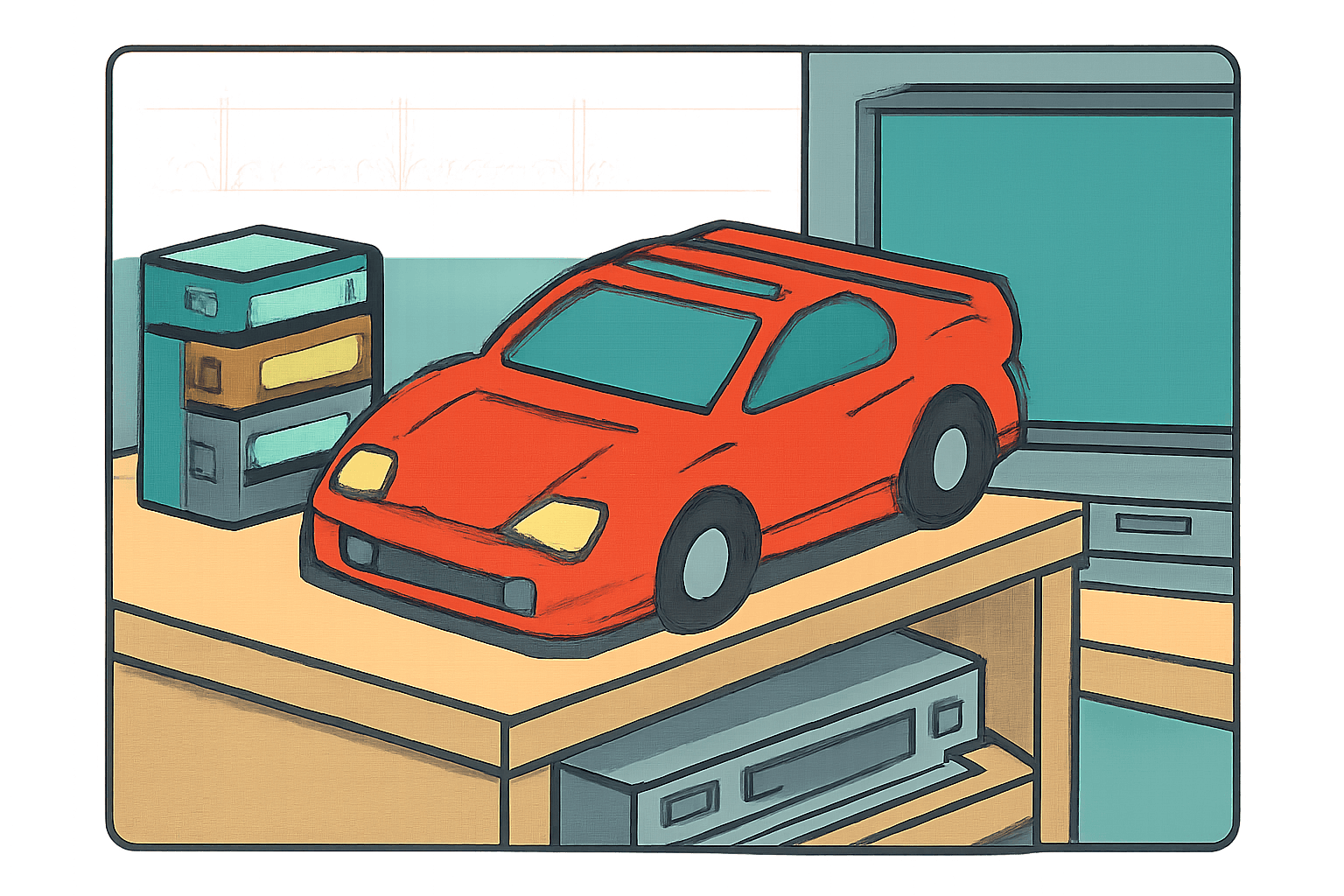
It sat on top of the VCR, or next to it, or on the shelf below the TV between a stack of rental tapes and a dusty TV Guide. It was bright red, or sometimes black, or sometimes a deep metallic blue that nobody asked for. It was shaped like a 1987 Lamborghini Countach if the Lamborghini Countach had been designed by someone who had never seen a car but had one described to them over the phone. It had a slot in the top where the tape went in. It had one button. It did one thing.
It rewound your tapes. That's it. That was the whole machine.
And somehow, this was a product that millions of American households owned. Voluntarily. With money.
The Problem It Solved
Here's the thing - the VHS rewinder wasn't stupid. It was actually solving a real problem, and the problem was this: rewinding a tape in your VCR was slow, it wore out the VCR heads, and it meant your VCR was occupied doing nothing useful for two to four minutes while you sat there waiting to either watch something else or return the tape to Blockbuster.
The standalone rewinder was faster. Way faster. The good ones could rewind a full T-120 tape in about forty-five seconds. The VCR took three or four minutes to do the same job, because the VCR was threading the tape past the heads and doing all kinds of careful mechanical work that wasn't necessary for a simple rewind. The standalone unit just spun. No heads, no threading, no delicacy. Just a motor and two spools and raw torque.
The standalone rewinder had one job, and it performed that job with the urgency of a machine that understood you had a 6 PM return deadline and it was 5:47.
So the logic was sound. Use the rewinder. Save the VCR. Rewind faster. Get the tape back to the video store on time and avoid the dollar surcharge that Blockbuster absolutely would charge you, the sticker on the cassette reminding you in passive-aggressive blue text: BE KIND, REWIND.
The logic was sound. What was not sound was making the thing look like a Ferrari.
The Design Choices
Nobody knows who decided first. Some product designer at a factory in Shenzhen or maybe Taipei looked at a small plastic box whose only purpose was to spin magnetic tape backward and thought: what if this was also a car?
And not just a car. A race car. A sleek, aerodynamic, vaguely Italian supercar with molded headlights and a spoiler and sometimes - sometimes - little wheels on the bottom that didn't roll. The tape slot was where the windshield would be. The power cord came out the back like an exhaust pipe. Some of them had LED taillights that actually lit up red while rewinding. Some of them made engine sounds. Not kidding. Actual engine sounds, a tiny speaker inside playing a whirring revving noise while the tape spun, as if the act of rewinding a copy of Mrs. Doubtfire required the audio atmosphere of the Daytona 500.
- The classic red race car (every flea market, always)
- A black stealth fighter jet
- A purple sports car with flip-up headlights
- A plain black rectangle (for serious adults)
- One shaped like a VHS tape itself (recursive and unsettling)
- A gold-colored luxury car model (for the discerning rewinder)
The car shape had no engineering justification. The tape didn't rewind faster because the housing looked aerodynamic. The motor didn't perform better because there was a spoiler. It was pure, uncut, 1990s product design instinct: kids will want this. And kids did want it. I wanted it. I wanted the red one with the LED headlights that blinked when you pressed the button, and I got it for Christmas in 1995 or maybe 1996, and I put it on my dresser next to my 13-inch TV and I thought it was the coolest thing in my room.
It was not the coolest thing in my room. My Super Nintendo was in my room. But the rewinder was up there.
The Sound
You remember the sound. You absolutely remember the sound.
A high-pitched whine that started the instant you dropped the tape in and hit the button. Not a gentle hum. A whine. Mechanical, aggressive, rising in pitch as the spool picked up speed, then holding at a steady scream for thirty or forty seconds, then slowing - the pitch dropping, the whine becoming a whir becoming a groan becoming a click.
Done.
The rewinder announced itself like a kitchen appliance with something to prove. You could hear it from the next room. You could hear it from the next floor.
The whole house knew you were rewinding a tape. It was louder than it needed to be, because it was faster than it needed to be, because the motor was overpowered for the task. This was a machine with no governor, no subtlety, no interest in being quiet about its work. It rewound tapes the way a Vitamix makes smoothies - with disproportionate violence.
And when it finished, you'd pop the tape out and it would be warm. Noticeably warm. The friction of high-speed rewinding generated enough heat that the cassette felt like it had just come out of a clothes dryer. You'd pick it up and think, briefly, should this be warm? And then you'd put it in the case and drive to Blockbuster because it was 5:52 and you had eight minutes.
The Ritual
The rewinder fit into a very specific sequence of events that no longer exists.
You finished watching the movie. You hit EJECT on the VCR. The tape slid out with that mechanical clunk. You pulled it from the VCR and walked it over to the rewinder - three feet, maybe four, but it was a journey with purpose. You placed the tape into the slot. You pressed the button. You waited, standing there or walking away, while the machine screamed through its forty-five seconds of work. The click. The eject. The warm tape in your hand.
Then you put the tape in its case, and the case went into a plastic bag if you were organized, or just loose on the passenger seat if you were my family, and someone drove to the video store.
This was a ritual. A genuine, repeated, weekly ritual in millions of homes. It had steps and an order and a specific machine dedicated to one of those steps. We had a purpose-built appliance for one phase of the movie-returning process. That's like having a separate machine whose only job is to close the pizza box after you take the last slice. It's absurd. And it was completely normal.
The Mortality Rate
VHS rewinders died. They died constantly. They died the way cheap electronics from the 90s always died - suddenly, dramatically, and with a smell.
One day you'd drop the tape in, hit the button, and instead of the familiar whine you'd get a grinding noise, a burning smell, and nothing. The motor burned out. Or the belt snapped. Or something inside just gave up, because the machine cost $12.99 at Kmart and was engineered to survive approximately eighteen months of regular use before converting itself into landfill.
And here's the thing: you'd buy another one. Immediately. Without hesitation. Because the VHS rewinder was cheap enough to be disposable and necessary enough to replace. It was the Bic lighter of home electronics. You didn't mourn it. You didn't repair it. You just bought a new one, probably a different color this time, probably still shaped like a car.
- A two-liter of Pepsi and a large pizza from Domino's
- Three rentals at Blockbuster (two-night)
- A cassette single of the Macarena
- The rewinder that replaced your last rewinder
I went through at least three in the life of our VCR. The red race car, then a plain black box my mom bought because she said the car was "tacky" - she was right but I was offended - then another red race car because the black box died and they were out of black boxes.
What It Really Was
The VHS rewinder shaped like a race car was, when you strip away the nostalgia, a monument to a very specific moment in consumer technology. A moment when physical media required physical maintenance, when returning a rental was a real errand with a real deadline, when the solution to a minor inconvenience was an entire additional appliance.
It was a product that could only exist in the gap between analog and digital. Too late for a world without home video. Too early for a world with streaming. It lived in that narrow window when we had VCRs in every room and Blockbusters on every corner and the concept of "rewinding" was a verb people used multiple times a week.
The VHS rewinder was a product that could only exist in the gap between analog and digital - a weird little machine from a weird little window of time.
And someone, at some point in the design process, looked at this brief, disposable, fundamentally boring machine and thought: let's make it fun. Let's give it headlights. Let's give it a spoiler. Let's make it look like something a kid would put on a shelf and feel proud of, even though all it does is spin tape backward.
That impulse - to make the mundane delightful, to put a race car body on a forgettable appliance, to treat even the smallest household task as an opportunity for a little joy - that's the most 90s thing I can think of.
The last one I owned is probably still in a box somewhere in my parents' garage. Red. Dusty. One of the LED headlights burned out years before the motor did. If I found it and plugged it in, I don't think it would work. But I also don't have any tapes to rewind, so it doesn't matter.
It doesn't matter and I still don't want to throw it away.