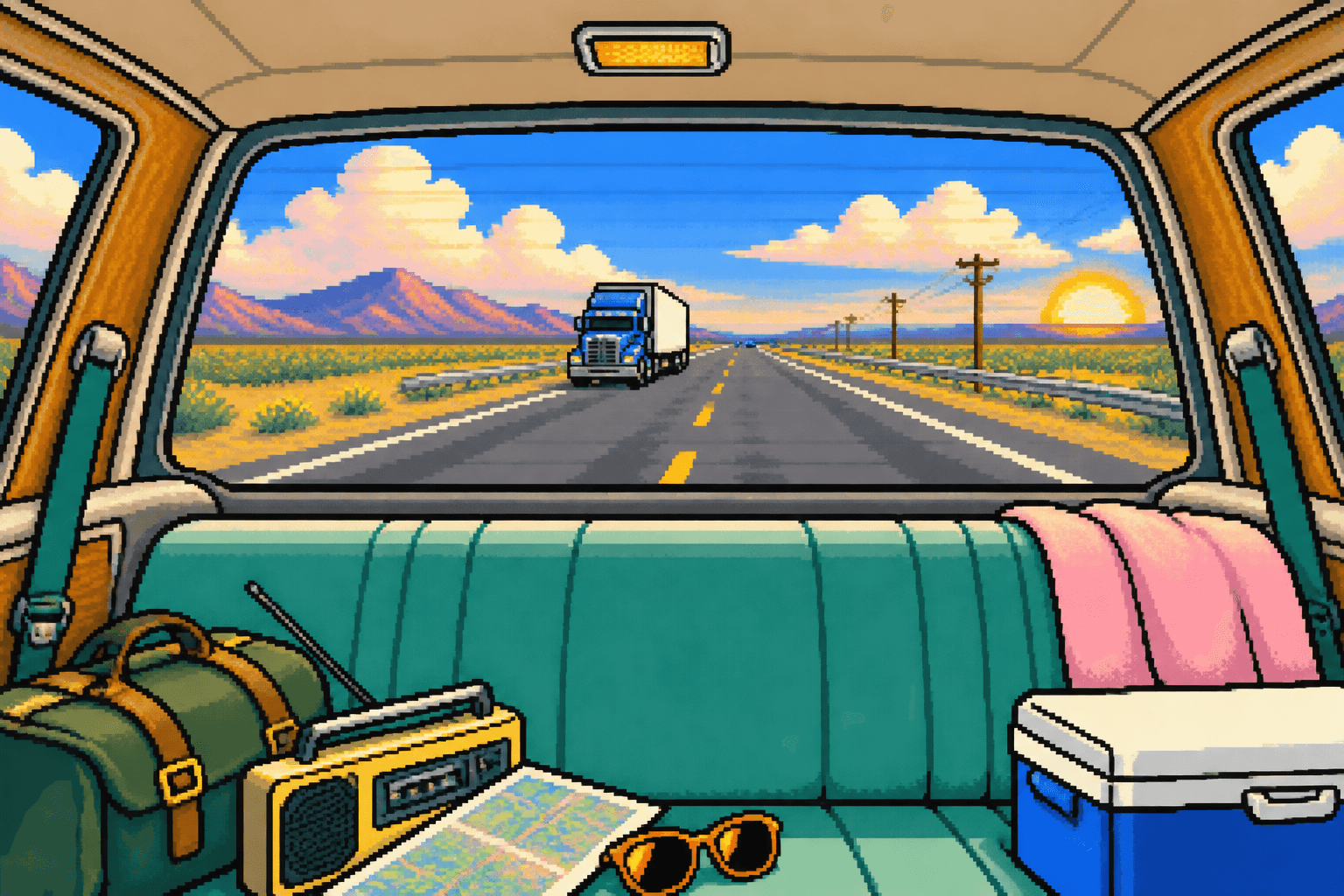
The rear hatch of the station wagon was a two-step process. Your mom pulled the outside handle, which lifted the whole glass panel up like the mouth of a whale. Then she reached in and folded down the third-row bench, which was carpeted on its underside and revealed, at last, the seat. It faced the wrong direction. That was the point.
You climbed in. The floor was two inches lower than the middle row and you had to step down into it, and the seat was upholstered in the same beige-brown-plaid-thing as the rest of the car, and it was warm from the sun coming through the rear window, and there was a fossilized french fry between the cushions from a McDonald's trip in June. You sat down. You buckled the lap belt. Or you did not buckle the lap belt, because the lap belt was somewhere down in the seat cushion, and you were seven, and nobody was looking.
Your mom closed the hatch. The car started. The driveway rolled away in front of you.
You Faced the Cars Behind You
The way-back was a room facing the wrong direction.
Everybody else in the car was looking at the road ahead. Your parents, in the front. Your siblings, in the middle bench. They saw what was coming. Green signs. Exits. The gas station where you were about to stop. The car in front of you slowing down for a light.
You saw none of it. You saw the road you had already driven. You saw the cars behind you. You saw the driver of the Buick two cars back, hunched over the wheel, mouthing something to himself. You saw the woman in the minivan eating a granola bar. You saw a Corolla with a bumper sticker for a college in Ohio. You saw a semi come up over a hill, small at first, and get bigger for the next forty seconds until it filled the entire back window.
You did not know what was in front of you. You knew, in a very specific way, what was behind you. This was the whole geography of the way-back. You were a small child in a rear-facing chair on Interstate 80, curating an in-depth report on the drivers of eastern Pennsylvania.
You were a small child in a rear-facing chair on Interstate 80, curating an in-depth report on the drivers of eastern Pennsylvania.
The Semi
The semi was the event.
You would see it come over a hill, four hundred yards back, and you would sit up. The semi was catching you. You could tell because it was slowly getting bigger. The car was doing sixty-five and the semi was doing seventy, which meant the semi was gaining a car-length every ten seconds, which meant in about three minutes the semi was going to be right on top of you, and you were going to be looking directly at the front grille of a Peterbilt through the back window of a Ford Country Squire, and the driver was going to be sitting up there in the cab, and you were going to be sitting down here in a rear-facing seat with a fossilized fry, and you were going to make eye contact.
You knew what to do. Everybody knew what to do. You did not have to be told. You made a fist and you pumped it up and down like you were pulling a chain. It was the gesture for honk the air horn. You had never been in a truck. You did not know there was a chain. You did not know the horn was a rope on the ceiling. You had inherited the pump-arm from an older cousin, or from a movie, or from the ambient culture of a country full of freeways, and you did it, silently, from a car seat with a lap belt you had not buckled, and you hoped.
Half the time the trucker did nothing. He had seen this move nine hundred times that day. He was thinking about his back, or his dispatcher, or the miles he had left before the next weigh station. He looked at you. He looked away.
But some of the time - one in three, on a good stretch of highway, in daylight, if the trucker was under fifty and did not have a headache - some of the time the trucker would grin, and reach up, and pull the chain, and the horn would come through the back window of your parents' station wagon like a foghorn a hundred feet away, and your entire body would light up, and you would spin around in the seat and yell at the front of the car HE HONKED, and your mom would say okay honey, and you would spin back to face the truck, and the trucker would already be passing you and lifting a hand and moving on.
You did not know there was a chain. You did not know the horn was a rope on the ceiling. You had inherited the pump-arm from an older cousin, and you did it, silently, from a car seat with a lap belt you had not buckled, and you hoped.
Try It
Wait for a truck to catch up. Pump the arm when it's close. Miss the window and it just passes.
The Other Kids in the Other Cars
The other event was the other kid.
Sometimes, in the middle distance behind you, another station wagon would come up. And another station wagon meant, statistically, another kid in a way-back. And another kid in a way-back meant a small face in a small window in a car about fifteen car-lengths behind you, and you would see them see you, and you would wave.
They would wave back.
Now you had a friend. Not a friend you had met. A friend you were sharing a highway with, sixty-five miles per hour apart, for as long as your two cars stayed on the same road at the same speed. You would make faces. They would make faces. You would put your hands up against the glass. They would put their hands up against the glass. You would hold up how many fingers you were. They would hold up how many fingers they were. You had communicated the ages of two children in different cars in different states going to different places. This was, at seven, worth doing.
It would end when one of the cars took an exit. You did not know which exit. You would just look up, sometime later, and their car would be gone. Some off-ramp forty miles back had ended a friendship. You would go back to watching the semi.
- The wave (open palm, high, at the window)
- The pump-arm (fist, vertical, requesting honk)
- The peace sign (two fingers, low, meaning nothing)
- The finger-count (age, or grade, or number of siblings)
- The tongue on the glass (regrettable, occurred at least once)
- The face against the glass (nose flattened, cheeks in, only if the driver behind seemed like a good sport)
The Seat Was Not a Seat
Let's be honest about the seat.
The way-back bench in a 1988 Ford Country Squire, or a Buick Roadmaster, or an Oldsmobile Custom Cruiser, was not what a modern person would call a seat. It was a padded plank. It sat directly against the rear crumple zone of the vehicle, which is to say, no crumple zone at all. Behind you, through the back window, was six inches of paneled tailgate and then the road. If somebody rear-ended the station wagon at highway speed, the physics were not complicated. You knew this in the abstract. Nobody said it. The seat existed. You sat in it. That was the deal.
The lap belt was there but was often stuck under the cushion, and the cushion had to be pried up with both hands to get to it, and by the time you had the belt out you were already ten miles down the road and your mom was on a call in the front seat with the cordless phone that plugged into the cigarette lighter, and it seemed like a lot of trouble for a belt.
Sometimes there were two lap belts, side by side, so a friend could ride back there with you. Sometimes there was a stack of towels and a cooler and a boxed fan, and you rode with your feet up on the cooler. Sometimes your dad had put the third row down flat so you could lie on it, and you would lie on your back on the folded bench with a book, and you would read for exactly nine pages before you got carsick and had to sit up and look out the back window and take deep breaths.
Every kid in a way-back knew about the sit-up-and-look-forward-out-a-back-window nausea cure. Your inner ear was doing calculus about a horizon it could not see. Facing backwards meant the horizon was rolling away from you at all times, and if you looked down at a book, the horizon was rolling away invisibly, and after ninety minutes your stomach filed a complaint. Sit up. Look at the road going away behind you. It was steadier that way. It was your own private motion sickness diet.
The Rear Wiper
Every rear-window station wagon had a rear wiper. It lived at the bottom of the back window and it swept the exact area you were looking through. When it rained, your mom would flip a switch somewhere in the front, and the wiper would come alive, and it would swipe a semicircle of clean glass right in front of your face. You were the only one who could actually watch the rear wiper work. Everybody else just knew it was on because they could hear it.
The wiper was a small, dedicated, mechanical friend. It swept once every eight seconds. It cleared the same rectangle of glass. When it hit the end of its arc, it went thunk into the rubber stop, and then it swept back, and it went thunk into the other rubber stop, and this continued for as long as it was raining. You could time it. You could count with it. You could match your breathing to it, if you were the kind of kid who did that, which, in the way-back, alone, staring at the state of Pennsylvania, you sometimes were.
The wiper was a small, dedicated, mechanical friend. It swept once every eight seconds and went thunk into the rubber stop, and this continued for as long as it was raining. You could match your breathing to it.
The Way-Back Was a Different Room
Here is what I want to actually say about it.
The way-back was, functionally, a different room of the house than the front of the car. Everybody in the front seat was doing the drive. They were watching mile markers. They were looking for exit 41. They were arguing about whether to stop for gas now or in an hour. They were listening to NPR. They were in the forward mode - the getting-there mode, the goal-oriented mode, the parent mode.
You were in the behind mode. There was no goal. There was no exit. There was no getting there. There was only the road unrolling away from you, and the drivers behind you, and the trucks catching up, and the rain hitting the rear window. You were not part of the trip. You were part of the aftermath. You were watching the trip end, in real time, for two hundred miles.
This was a legitimate mode of being. You could tell because time behaved differently back there. An hour in the way-back was not the same as an hour in the middle row. In the middle row, an hour was your sister's elbow and a dropped Gameboy and the exact same five songs on a cassette. In the way-back, an hour was a whole moving painting of the country you had already crossed, plus a semi honking at you, plus a wave from a kid in a Volvo who lived in a state you would never see. It was not boring. It was, in a specific way, meditative. You did not have the word. You just came out of it at the rest stop with a very still expression on your face and your mom said are you okay honey, and you said, yeah, and you went and used the bathroom.
The Argument
I want to give the counter-argument, because it's not small.
The counter-argument is that the way-back was a deathtrap. The rear-facing seat in a station wagon had, in the event of a rear-end collision, no meaningful crumple zone, no side impact protection, no proper three-point restraint, no headrest, and often no functional seatbelt. The kids riding in it were sitting inches from the rear glass. In a serious rear-end at highway speed, the physics of what happened next were not survivable. Cars with rear-facing jump seats were phased out in the 90s not because Americans got sentimental, but because the death and injury numbers on those seats were bad and everybody who worked on car safety knew it. The lap belt alone, without a shoulder strap, in the event of a frontal collision, folded a small body forward at the waist in a way that had a name in pediatric emergency medicine.
I am not going to pretend I did not know this. I am going to be honest: my parents did not know this. Or they knew it and let me ride there anyway because it was 1993 and the car had a way-back and the way-back had a seat and that was where kids went. The car seat conversation, as we have it now, was not the car seat conversation we had then. It got better. It got much better. The kids in the way-back grew up and looked at the numbers and put their own kids in a five-point harness in the middle row of a minivan with side curtain airbags and a backup camera, and none of those kids will ever wave at a trucker through a rear window because there isn't one.
The kids in the way-back grew up and looked at the numbers and put their own kids in a five-point harness with side airbags and a backup camera, and none of those kids will ever wave at a trucker through a rear window because there isn't one.
The Other Side
But here is the thing I want to hold onto.
The way-back was the first time a lot of us had a view. It was the first room in our lives with a window that did not look at the neighbor's garage. The window looked at the country. The window changed every hour. The window contained trucks and other kids and a rear wiper and rain and, once, on a stretch of I-80 in western Nebraska, a hot air balloon parallel to the road for eight minutes. You did not choose the view. The view was assigned to you by geography and interstate signage and whatever your dad had decided about the route. You just sat there and it went by.
The way-back was also, I think, the first place a lot of us practiced being alone in public. You were in a car with your family. But you were facing the other way, in a different room, with your own view and your own semi and your own thoughts about the driver of a distant Corolla. Nobody was talking to you. Nobody was checking on you. You had, for two hundred miles at a stretch, a small quiet room that happened to be moving at sixty-five miles per hour, and you could think about whatever you wanted, and the country went past, and every so often a trucker honked. It's not nothing to have that at seven.
The Way-Back Is Gone
The station wagon with a rear-facing jump seat basically does not exist anymore. Ford stopped making the Country Squire in 1991. The last Buick Roadmaster wagon rolled off the line in 1996. The Volvo 240 wagon, which had two jump seats facing each other in the back, ended in 1993. The rear-facing seat was designed out of American car interiors by the end of the 90s, and it did not come back. The minivan, then the SUV, then the crossover, ate the family wagon. Kids now sit in the third row facing forward, or they sit in the middle row facing forward, or they sit in a captain's chair facing forward, and every seat has a headrest, and every belt is a three-point.
This is better. This is real progress. I am not going to be that guy about it. My kid, when I have a kid, will not ride in a rear-facing bench with a stuck lap belt six inches from the back window of a wagon, and I will be glad about that.
But something is gone. The pump-arm gesture is gone. The wave to the kid in the other station wagon is gone. The two-hour meditation on the road you had already driven is gone. The rear wiper going thunk into the rubber stop, for you and you alone, is gone. It was replaced by an iPad in a seat-back holder playing Moana for the third time that week, which is fine, which is safe, which is what a good parent does, and which is also, in a specific way, not the same.
The last time I rode in a way-back was 1998. We were driving to a wedding in Cleveland. It was raining. The rear wiper was on. A semi came up behind us on I-71 for a long time and then it started to catch us. I pumped my arm. The trucker looked at me. He looked at me for a long time, actually, because he was passing us for what felt like a full minute, and I kept pumping. Right when he was about to be past us and I had given up, he pulled the chain. The horn came through the rear window like a wave. My mom, in the front, jumped and said Jesus. I did not spin around and tell her. I just sat there. He was already gone. I watched his taillights get smaller for the next ten minutes until he crested a hill and I never saw him again.