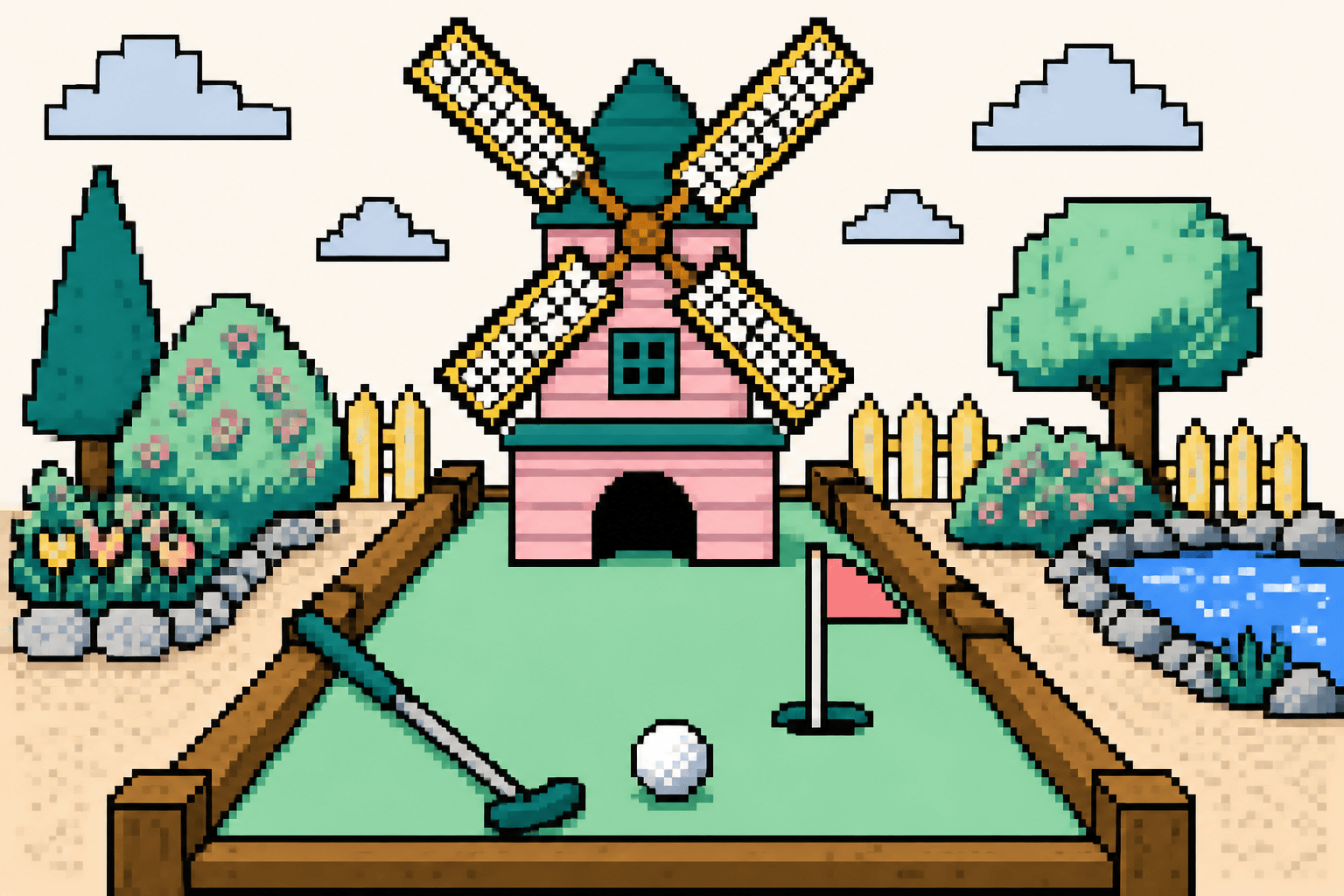
There was a windmill. There was always a windmill.
It sat somewhere in the middle of the course, hole eight or nine, far enough in that you'd already lost track of the score and committed to a fight with your brother about whether his ball had really gone in or just hung on the lip. The windmill was made of plywood painted to look like a Dutch postcard, with four blades that turned on a motor you could hear if you stood close. They never stopped. They never sped up. They turned at one fixed, maddening speed, and your entire job - the only thing the hole asked of you - was to roll a ball through the gap at the bottom while the blades weren't covering it.
This was harder than it sounds. It was also rigged. And we loved it.
The Course
Mini golf in the 90s was a specific kind of place. Not the glow-in-the-dark blacklight version that came later, with the airbrushed sharks and the techno. The older kind. Daylight. A strip of land next to a go-kart track or a Dairy Queen, eighteen holes of green outdoor carpet stapled over plywood, surrounded by railroad-tie borders that the ball bounced off with a hollow tonk.
The carpet was the thing. That bright, artificial, slightly abrasive green - Astroturf before Astroturf meant anything - worn smooth in the middle of every hole where ten thousand balls had rolled the same line. You could read the course like a deer trail. Everyone aimed for the same worn patch because the carpet had already told you where the ball wanted to go.
You could read the course like a deer trail. Everyone aimed for the same worn patch because the carpet had already told you where the ball wanted to go.
You got your putter from a rack by the little hut. The putters came in heights that did not correspond to any actual human. There was a kid-sized one that was too short and an adult one that was too long and nothing in between, so you spent the whole round hunched over or choked up on the grip like a tiny nervous golfer. The ball came out of a chute when the teenager working the counter pressed something. Red, yellow, blue, that one orange that was really more of a traffic cone. You did not get to choose. You got the ball you got.
And the scorecard. A folded paper card with eighteen tiny boxes and a pencil the length of your thumb, no eraser, sharpened on one end by a machine that clearly resented its job. You wrote your strokes in the boxes. Mostly honestly.
The Obstacles
Each hole had a gimmick, and the gimmicks were a fixed national vocabulary. Every course in America was assembled from the same parts catalog.
The loop-the-loop that never worked. The little wishing-well you had to putt around. The ramp up to a second level where the ball either made it or rolled back down into your shoes. The "bank shot" hole with the angled wall that the sign promised was the smart play and that nobody ever actually used. The hole with the water hazard that was really just a painted-blue trough of standing rainwater with a dead leaf in it.
Every course had some subset of: a windmill, a lighthouse, a castle with a drawbridge, a loop, a giant clown or whale or dinosaur with a mouth, a fake creek, a tilted "funnel" green, and at least one hole that was just a long straight rectangle that everyone parred without thinking and secretly loved.
But the windmill was the boss. The windmill was the one your whole group bottlenecked at, the one where the foursome behind you started sighing, the one your dad lined up with the seriousness of a man defusing a bomb. You had to read the rhythm. Wait for the blade to clear, putt clean and straight and now, and watch the ball disappear into the dark gap under the house and - if the timing held - reappear on the other side, rolling toward the cup like a small white miracle.
Most of the time it hit a blade. Thwack. Back it came.
Here. The windmill's spinning. Wait for the gap.
The trick they never tell you is that the windmill isn't really a skill hole. It's a patience hole. The gap is open more than half the time. You just have to be willing to stand there, putter back, and not putt until it's actually clear - which, when you're nine, and your brother already went, and the people behind you are watching, feels physically impossible. So you putt early. And the blade gets you. And that, somehow, is the point.
The Math Was a Lie
Here is what nobody admitted about mini golf: the scores were fiction.
Officially there was a six-stroke maximum. You hit it six times, you wrote down six, you moved on, dignity intact. This rule existed so that families would not get divorced on hole twelve. In practice the rule was applied unevenly, generously, and entirely according to who was winning.
Somebody was always cheating. The little kid got "do-overs" that didn't count. Somebody nudged a ball with the toe of their sneaker when they thought no one was looking. Somebody wrote a 3 that was clearly a 5. And it didn't matter, because the score was never the actual game. The actual game was the windmill, and the clown's mouth, and the one hole where the ball went down a pipe and you had to run around to see where it came out, and the specific joy of a putt that banked off two walls and dropped in while you stood there pretending you'd meant to do that.
The six-stroke maximum existed so that families would not get divorced on hole twelve.
You added it all up at the end on the tiny pencil and someone won by a stroke and it meant nothing and everyone was a little sunburned and wanted ice cream.
The Eighteenth Hole Kept Your Ball
And then there was the last hole.
The eighteenth was different. The eighteenth was a trap. It looked like a normal hole, maybe a little downhill, with a cup that seemed slightly too eager. You putted, the ball rolled in, and instead of fishing it back out like every other hole, the ball disappeared. It dropped through the cup into some hidden tube and rattled away down into the hut, gone forever, swallowed by the course itself.
This was by design. The eighteenth hole ate your ball so you couldn't just keep playing for free. You had to go back to the counter to get another one. The course took its ball back at the exact moment of your final triumph, which is a genuinely diabolical piece of psychology to spring on a ten-year-old.
But there was a rumor. There was always a rumor.
If you got a hole-in-one on the eighteenth - if you dropped it in the trick cup in a single shot - a bell rang, or a light flashed, or the teenager at the counter looked up with mild surprise, and you won a free game. A whole free round. The holy grail. The thing you lined up that final putt for with your tongue between your teeth, knowing the odds were terrible, knowing the hole was rigged against exactly this, and trying anyway.
I never won the free game. I knew exactly one kid who claimed he did, and I never believed him, and I still don't, and I think about it more than I should.
I drove past one of these courses a few years ago. Same plywood windmill, repainted. Same railroad ties. The carpet was new but already wearing through in the middle of every hole, the deer trails forming again, one ball at a time. There were kids on hole nine, bottlenecked, one of them lining up a putt with that bomb-defusing seriousness while the blades went around at the same speed they have always gone around, the speed of a child's patience running out.
He putted early. The blade got him. Thwack.
He laughed. He set up to try again.
The windmill was rigged. It was always rigged. That was never the part that mattered.