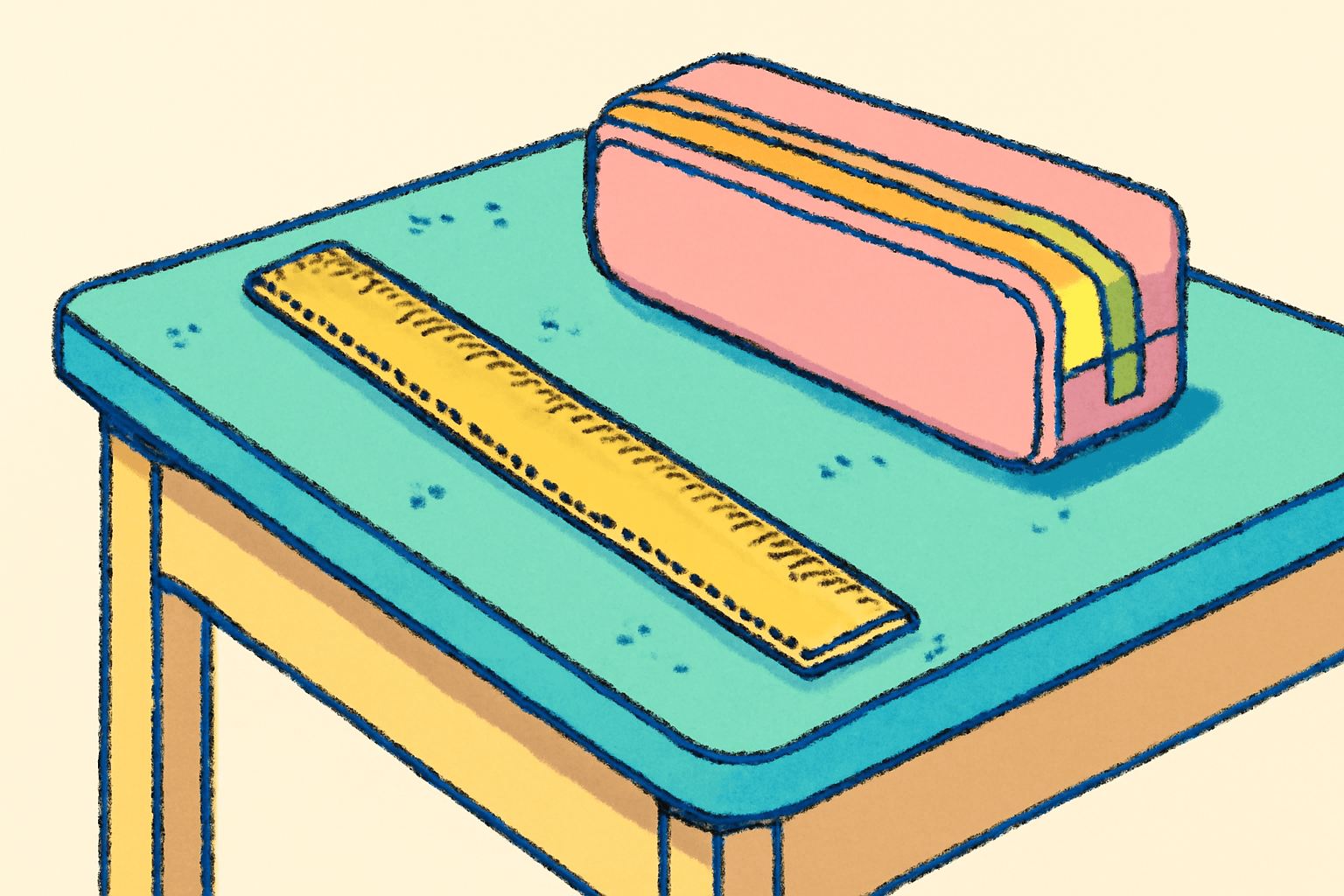
Kevin Brower hit me in the knuckles with a wooden ruler in third grade and I can still feel it. Not a memory of pain - actual residual nerve anger, like my hand has been holding a grudge for thirty years. It was one of those twelve-inch rulers that every classroom had in a plastic bin by the window. Light-colored wood, slightly warped, printed with inches on one side and centimeters on the other. And running along one edge, a thin strip of metal that turned an innocent measuring tool into something that belonged in a medieval armory.
That metal edge. I don't know who made the design decision. I don't know what meeting happened at the ruler factory where someone said, "You know what children's school supplies need? A blade." But someone did, and it shipped, and for decades American kids sat in classrooms with what amounted to a flat wooden sword with a sharpened spine.
The Purposes
Here is an incomplete list of things the wooden ruler was used for in every classroom I ever sat in: desk drumming, sword fighting, seeing how far you could bend it before it snapped, launching erasers like a catapult, flicking the end so it made a thwack against the desk surface, scratching your back, poking the kid in front of you, sliding it between the desk and the chair to make a lever, and pretending it was a guitar during any moment of unsupervised downtime.
Here is a complete list of things the wooden ruler was used for in terms of its actual intended purpose: nothing. Not once. Not ever.
Nobody in the history of American public education used a wooden ruler to measure anything. It was a percussion instrument, a weapon, and a toy - in that order.
Okay, maybe that's not entirely fair. Maybe somewhere, in some classroom, a kid lined up a ruler along the edge of a worksheet and drew a straight line. But I never saw it. What I saw was thirty kids with wooden sticks figuring out every possible use case except measurement. The ruler was the most repurposed object in the supply chain. It was open-source hardware before the concept existed.
The Drum Kit
The desk drumming alone could fill an essay. Every kid figured out independently that a ruler hanging halfway off the desk edge, pressed down with one hand and released with the other, produced a sound. A deeply satisfying bwaaanng that changed pitch depending on how much ruler was hanging over the side. More overhang, lower pitch. Less overhang, higher pitch. You could play a whole scale if the teacher wasn't looking, and she was always looking, but you did it anyway.
The advanced technique was the two-handed method. Ruler flat on the desk, both palms drumming on the ends, alternating like you were playing a tiny marimba for ants. This was less about pitch and more about rhythm, and if you had a friend with another ruler at the desk next to you, suddenly you had a band. A terrible band. A band that existed for forty-five seconds before Mrs. Patterson said your names in that voice that meant the next time she'd use your full names.
The Bend Test
Every wooden ruler got bend-tested. This was not optional. The moment a ruler entered your hands, you grabbed both ends and applied pressure toward the middle. Slowly. Carefully. Watching the wood flex, listening for that first creak, feeling the tension build. The question was never if you would snap it. The question was when. How far could it go? What was the breaking point?
Some kids had patience. They'd bend gradually, scientifically, like they were conducting a materials stress test. Other kids - and I was this kid - just went for it. Both hands, full force, snap. Two pieces. And then you had two short rulers, which were less useful as rulers but twice as useful as drumsticks.
The teacher would look up at the sound. The snap of a ruler was distinctive - dry and sudden, like a branch breaking underfoot. She'd see you holding two halves and just sigh. Not surprise. Not anger. Just the bone-deep resignation of a person who had budgeted for ruler attrition and was already running low for the year.
The Flexible One
The plastic ruler was a different animal entirely. The clear, bendy one that you could curl into a full U shape without breaking. This was the ruler that could survive anything. You could roll it up, twist it, sit on it. It was indestructible in a way that almost felt like cheating.
But its real talent was the snap. You'd bend it back and release it against someone's arm or leg - just a quick, sharp flick that left a red mark and a sting that faded in seconds but felt, in the moment, like you'd been branded. The flexible ruler was less a weapon and more an instrument of casual, low-grade harassment that existed in every classroom in America and was somehow never addressed in any student handbook.
It also couldn't draw a straight line to save its life, which was the one thing you'd think a ruler should do.
The Yardstick
And then there was the teacher's yardstick. Three feet long. Wooden. Usually stored leaning against the wall behind her desk or lying across the top of the chalkboard ledge. The yardstick was not a student tool. The yardstick was authority.
The yardstick was not a measuring device. It was a scepter. The teacher who held it held the room.
A teacher pointing at the board with a yardstick was making a statement. A teacher tapping a yardstick against her palm while waiting for the class to quiet down was making a threat. And a teacher slapping a yardstick flat against a desk to get attention - that crack echoing off cinderblock walls - was deploying a weapon of psychological warfare that would absolutely not fly today and probably shouldn't have flown then, but here we are.
Some teachers used the yardstick as a pointer during map lessons, tapping on countries like they were selecting targets. Some used it to reach things on high shelves. One teacher I had - Mr. Almeida, fifth grade - used his to gently tap the desks of kids who were falling asleep, like a shepherd nudging a sheep, and honestly it was the most benign use of a yardstick I ever witnessed.
The Broader Arsenal
The ruler wasn't alone, of course. It existed within a larger ecosystem of school supplies that were designed for one purpose and universally repurposed for another. The compass - the one with the sharp metal point for drawing circles in math class - was a weapon so obvious it's a wonder they let kids have them at all. You could stab things with it. You did stab things with it. Desk surfaces across America still bear the tiny puncture wounds of a million compasses used as miniature spears.
The protractor was a frisbee. I don't make the rules. It was semicircular, flat, and aerodynamic enough that if you gave it a flick of the wrist it would sail across a classroom with real accuracy. The fact that it was made of hard plastic and had sharp corners just made the stakes higher. Protractor frisbee was an extreme sport.
- Compass: Stabbing tool. Desk engraver. Occasional circle-drawer.
- Protractor: Frisbee. Scooping device. Thing you pretended was a steering wheel.
- Safety scissors: Could not cut anything. Not paper. Not string. Not tape. Existed only to teach frustration.
- Hole puncher: Confetti machine. You'd punch holes in scrap paper for five minutes straight just to fill the little tray, then dump it like New Year's Eve.
- Glue stick: Dried out by October. Applied to skin. Peeled off in a sheet. Repeated forever.
The safety scissors deserve a special mention because they were a lie. They were called safety scissors because they couldn't hurt you, but they also couldn't cut anything, which made them not scissors. They were two dull blades connected by a rivet, performing a pantomime of cutting while the paper just folded and tore. Every kid learned to hate safety scissors. Every kid celebrated the day they graduated to the real ones, the ones with the actual metal blades, which felt like being handed car keys.
And the hole puncher. The three-hole punch that sat on the teacher's desk like a small industrial machine. The satisfying chunk of punching through a stack of papers. But more importantly - the confetti. Those little circles that collected in the bottom tray. Some kids would empty them into their hands and throw them. Some kids would stuff them into other kids' backpacks like paper ticks. One kid in my class - and every class had this kid - would eat them, which was disgusting but also kind of impressive in its commitment to chaos.
I don't know what classrooms look like now. I assume the supplies are safer, more intentional, less likely to double as weaponry. Maybe kids still get wooden rulers, though I doubt they have the metal edge anymore. Somebody probably got sued. Somebody probably should have.
But there was something about that era of school supplies - the sharp compasses and the snapping rulers and the scissors that couldn't cut and the hole puncher confetti. It was a little ecosystem of misuse, every object repurposed by small hands that were bored and creative and absolutely not interested in using anything the way it was designed. We took measuring tools and turned them into instruments and weapons and toys. We took safety scissors and learned that safety and uselessness were sometimes the same thing.
Somewhere in a landfill there's a broken wooden ruler with a metal edge, snapped clean in half by a kid who just wanted to know how far it would bend. I hope that kid remembers the sound it made. I do.