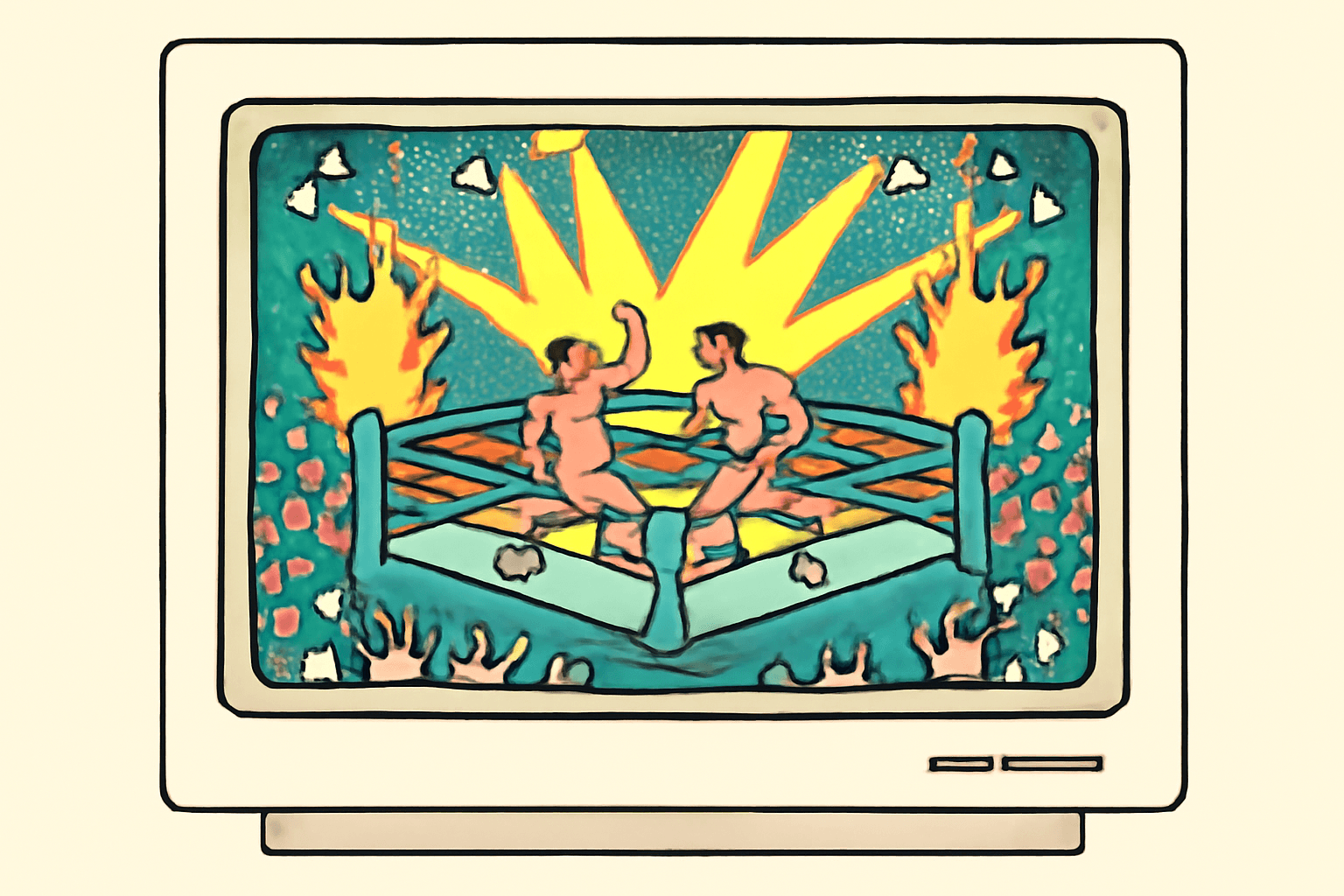
The glass shattered and you knew. You didn't need to see the screen. You didn't need the announcer. That sound - that specific, unmistakable sound of breaking glass - meant Stone Cold Steve Austin was walking down that ramp, and whatever was happening on Monday Night Raw was about to get significantly louder. My brother and I would be sitting on the carpet, too close to the television, and the moment those first notes hit we'd lose our minds. Every single time. Never got old.
It was 1998. Maybe 1999. The years blur together now, but the feeling doesn't. Monday night was sacred. You came home, you did your homework - or you didn't, and you lied about it - and at 9 PM you planted yourself in front of the TV for two hours of the most ridiculous, most electrifying, most genuinely unhinged television programming ever produced for a mass audience. And you loved every second of it.
The War
You had to pick a side. Raw or Nitro. WWF or WCW. This was not optional.
The Monday Night Wars were real to us in a way that's hard to explain to anyone who wasn't there. Two wrestling promotions, head to head, same time slot, every Monday, for years. You had a remote in your hand and you were flipping back and forth during commercials like some kind of cable television intelligence operative. Raw goes to break, flip to Nitro. Nitro goes to break, flip back. You were a ten-year-old managing a content portfolio before that phrase existed.
- If Stone Cold was scheduled: Raw. No question.
- If the nWo was doing something: Check Nitro first, then flip.
- If Goldberg's streak was on the line: Nitro until the spear, then back to Raw.
- If your parents wanted to watch something else: Negotiate. Beg. Offer to do dishes for a week.
WCW had the nWo, and for a while that was enough. Hollywood Hogan, Scott Hall, Kevin Nash - they spray-painted everything, they ran roughshod over the entire roster, and it was genuinely cool in a way wrestling hadn't been since Hulkamania. The nWo felt dangerous. They felt like the bad guys had actually won and nobody could stop them. The black-and-white shirts were everywhere. Every kid in my school had one, or wanted one.
But then the WWF figured something out. They figured out that if you let Stone Cold be Stone Cold and let The Rock be The Rock and just got out of the way, you could make television that felt like it was happening in real time, like anything could go wrong, like the whole thing might fall apart at any second. And that energy was addictive.
Austin 3:16
Stone Cold Steve Austin was not a role model. This was understood. This was, in fact, the entire point.
He drank beer in the ring. He flipped people off. He stunned his own boss on live television, repeatedly, and it never stopped being the most satisfying thing you'd ever seen. Vince McMahon would be standing there in his expensive suit, doing his evil boss routine, and Austin would just - stunner. Crowd goes nuclear. Beer cans everywhere. Absolute chaos.
Every kid in America wanted to be Stone Cold at recess. Every kid. You'd grab your friend by the shoulder, kick him in the gut, and deliver the worst Stone Cold Stunner ever performed on a blacktop. Your friend would sell it like he'd been shot. You'd stand over him and do the arm thing. A teacher would see you and you'd both get a talking-to about roughhousing, and the next day you'd do it again. Because what were they going to do. Suspend you for delivering the most electrifying finishing move in - wait, that's the other guy.
Stone Cold Steve Austin stunned his boss on national television every week, and an entire generation of kids thought: yeah, that tracks.
The Most Electrifying Man in Sports Entertainment
The Rock was a different thing entirely. Where Austin was chaos, The Rock was performance. The eyebrow. The catchphrases. The way he could hold twenty thousand people in his hand just by pausing before he said something. "If you smellll - what The Rock - is cookin'." That pause. That delivery. The man could cut a promo the way Miles Davis played trumpet - half of it was the notes he didn't play.
The People's Elbow was objectively absurd. He'd run the ropes, stop, dramatically remove an elbow pad, throw it into the fifteenth row, run the ropes again, do that weird shimmy, and drop an elbow. It should not have worked. It worked every single time. And we did it at recess too, obviously. You'd take off an imaginary elbow pad, whip it at nobody, and drop an elbow on your friend who was lying in the grass. It was theater. We were all theater kids. We just didn't know it.
Mankind and the Match
Then there was Mick Foley.
I need to talk about Mick Foley, because if Austin was the rebel and Rock was the showman, Foley was the guy who made you believe. He came out as Mankind with that leather mask and that screeching voice, and he looked like someone who should not be on television, which made it impossible to look away. He wasn't chiseled. He wasn't polished. He was missing teeth and chunks of his ear and he'd wrestle in a dress shirt and tie like he'd just walked out of an office job and decided to put someone through a table.
The Hell in a Cell match. King of the Ring 1998. Foley versus the Undertaker. If you know, you know, and if you were watching live, you will never forget it. Foley went off the top of that cage - sixteen feet, onto the announce table - and Jim Ross screamed "Good God almighty! They've killed him!" and for a moment, sitting in your living room, you genuinely weren't sure if you'd just watched someone die on USA Network. Then he got back up. Then he went through the cage roof. Then he finished the match. With a tooth sticking out of his nostril.
That match got talked about at school for weeks. It was our Zapruder film. Everyone had seen it. Everyone had an opinion. Everyone described it to the one kid who'd missed it with the breathless urgency of an eyewitness account.
The PPV Economy
Here was the thing about pay-per-view: it cost money. Like, real money. Forty or fifty dollars in late-90s currency, which might as well have been a thousand. Your parents were not ordering WrestleMania. Your parents had strong opinions about the cable bill already. So you had to find the kid whose parents would order it.
Every friend group had one. The PPV Kid. His parents either had money, or they had a particular fondness for wrestling, or they simply could not say no to their child. Whatever the reason, that house became command central on the night of a pay-per-view. Royal Rumble, WrestleMania, SummerSlam, Survivor Series - these were events. You'd show up at 6 PM with a sleeping bag you didn't need and snacks nobody asked you to bring, and you'd sit on that couch like you were at church. Sacred. Reverent. Loud.
- A friend with cable and permissive parents
- At least four kids on one couch
- Pizza ordered by 7
- Complete silence during main events (enforced by group pressure)
- Replaying the finishing move on each other immediately after
If you didn't have the PPV Kid in your circle, you scrambled the signal. Everyone knew someone who claimed they could get the scrambled pay-per-view to come in just clear enough to sort of see what was happening. You'd watch Royal Rumble through wavy lines and static, the picture occasionally resolving into something recognizable for three seconds before dissolving again, and you'd cheer based on crowd noise alone. It was miserable. It was the best.
The Backyard
We wrestled in the backyard. I need to say this plainly because it's true and because I have no excuse for it. We pulled a mattress off someone's bed - usually the kid whose parents were least likely to notice - and we dragged it into the yard and we wrestled on it. On a mattress. In the grass. Like animals.
We had entrance music. Someone would hold a boombox and press play at the right moment. We had finishing moves. We had storylines. I was part of a backyard stable called - and I am not making this up - The Wolfpack, named after the nWo Wolfpack because we thought the red-and-black color scheme was cooler than the original black-and-white.
Nobody got seriously hurt, which is a miracle. A few bruised ribs. A sprained ankle once. One kid got the wind knocked out of him doing a splash off a picnic table and we all stood around him in silent terror until he gasped back to life and said "I'm fine" in a voice that suggested he was not fine. We didn't do the picnic table spot again. We had some sense.
The Merch
D-Generation X told you to suck it and you wore the T-shirt to school. The Austin 3:16 shirt was the most popular piece of clothing at my middle school for roughly eighteen months. The nWo shirt - the classic black one with just the letters - was a close second. You wore these like gang colors. You were declaring an allegiance.
And the WWF ice cream bars. If you had an ice cream truck in your neighborhood, you know. Cookie face on a stick. You'd bite into The Undertaker's forehead without a second thought. There was something deeply funny about eating a frozen dessert shaped like a man who pretended to be a dead mortician, but we didn't question it. You just ate the wrestling man and went back to playing.
What It Actually Was
Here's what I think about when I think about the Attitude Era: I think about sitting next to my brother. I think about the carpet under my knees because I kept inching closer to the screen. I think about the way the crowd sounded through our crappy TV speakers, that roar that started low and built and built until it crested and you could feel it in your chest even through the glass.
I think about calling my friend during commercials on the cordless phone. "Did you SEE that? Did you see what just happened?" We always had. We were always watching.
Monday Night Raw wasn't appointment television. It was closer to religion. You didn't decide to watch it. You just showed up, because that's what you did on Mondays.
People want you to be embarrassed about this. They want you to admit it was dumb, it was fake, it was lowbrow. And sure. It was all of those things. It was also the most invested I've ever been in serialized storytelling, and that includes every prestige drama that came after. Those characters were real to me in a way that mattered. The betrayals stung. The comebacks gave me chills. When Mankind won the WWF Championship on Raw - when Tony Schiavone on Nitro smugly spoiled it, thinking it would send viewers to WCW, and instead half a million people changed the channel to Raw to see it happen - that was narrative on a scale that no writers' room could engineer. That was just Monday night.
I won't apologize for it. For the stunners at recess or the People's Elbows on the lawn. For the ice cream bars or the T-shirts or the pay-per-view scramble. For sitting too close to the screen on a Monday night in 1998, believing completely.
The glass shatters. The crowd roars. And if you listen, you can still feel it.