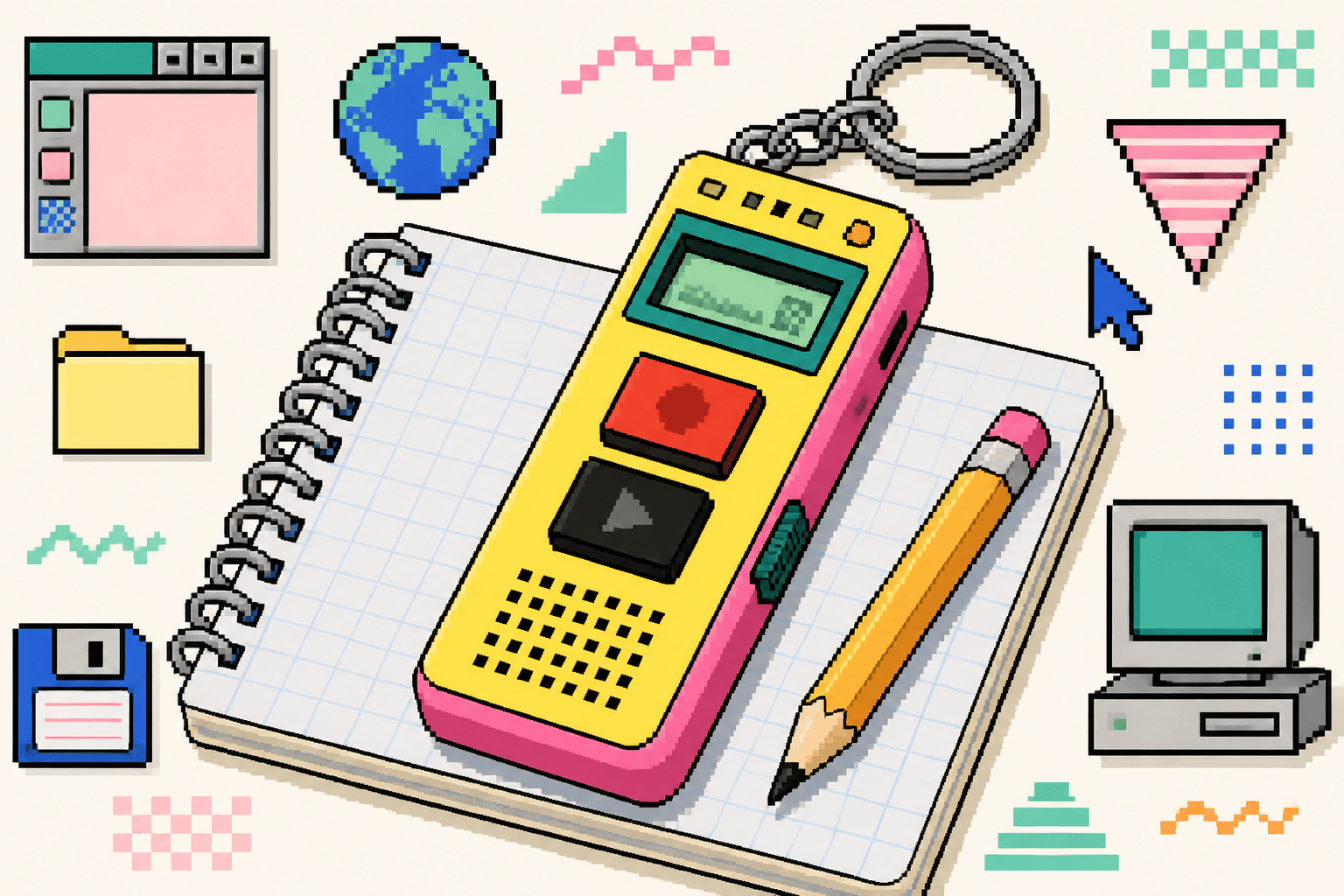
It was hot pink. It was neon yellow. It was slightly smaller than a deck of cards.
It had two buttons. One was a red circle. One was a black triangle. There was a speaker on the front made of a grid of tiny black dots, and a keychain ring at the top that nobody ever attached to keys. The plastic was the specific bright grade of plastic that Yes! Entertainment was buying in bulk in 1994, the kind that scratched if you looked at it wrong and squeaked against your palm when you held it.
You held down the red one. You said the word butt. You let go. You pressed the black one.
Somewhere inside the toy, a tiny speaker screamed the word butt back at you in a voice that was almost yours, but higher, and thinner, and structurally rushed, like a version of you that had had too much sugar and was late for something.
That was the whole thing. That was the Yak Bak.
The Four Seconds
The recording limit was four seconds.
Not five. Not three. Four. Somebody at Yes! Entertainment had sat in a conference room in Emeryville in 1993 and decided that four seconds was the exact amount of time a nine-year-old should be trusted with. Any less and you couldn't get a full sentence in. Any more and you'd start doing bits. Four was the sweet spot. Four was the fart. Four was shut up. Four was nice pants, dude. Four was your sister's voice reading something out of context that you would then walk around the house playing at your father while he was trying to make dinner.
The four-second limit was not a suggestion. It was a wall. You would hold the red button, you would say your sentence, and at the exact moment you got to the interesting part - the punchline, the burp, the impression of Mr. Fisher pronouncing particularly - the tape would run out. The Yak Bak would stop listening. The rest of your sentence went into the air and stayed there. Only the setup made it in.
Somebody at Yes! Entertainment had sat in a conference room in 1993 and decided four seconds was the exact amount of time a nine-year-old could be trusted with. They were right.
You learned this the hard way, twice, and then you started planning. You would rehearse the sentence under your breath. You would count one, two, three, four against the beat. You would leave off the parts you didn't need. You became, at nine, a producer. You were editing before you had ever heard the word edit. The Yak Bak was teaching you compression.
The Pitch
The playback was not a faithful recording.
It was faithful in the way a photocopy of a photocopy is faithful. The Yak Bak used a very small, very cheap solid-state memory chip that stored your voice at a sample rate that was, charitably, an insult to sound. When you pressed PLAY, the chip played it back at a slightly different rate than it had recorded at, so your voice came out pitched up and sped up, thin and metallic and permanently in a hurry.
This was not a bug. This was the point. Your own voice was boring. Your own voice sounded like you, which you heard all day. The Yak Bak turned your voice into somebody else's voice. Somebody smaller. Somebody meaner. Somebody who could get away with things you couldn't. If you said I hate my sister into the black recorder in your voice, that was a confession. If you said I hate my sister and then held up the Yak Bak and let it repeat I hate my sister in the chipmunk voice, that was a comedy bit. Nobody could get mad at you. It wasn't you. It was the Yak Bak.
You could hide behind the pitch shift. That was the actual product.
The Bus
The Yak Bak's natural habitat was the school bus.
Not the classroom - the teacher would confiscate it inside forty seconds. Not the house - your mom would take away the batteries. The bus. On the bus, at 7:14 AM in the fall of 1995, in the third row on the right side, next to the kid who ate his cereal dry out of a ziploc bag, the Yak Bak had its full run.
The bus was loud. The bus was already vibrating with forty simultaneous conversations, three older kids trying to open a window, and the specific low grinding of a school bus doing thirty on a residential street. Into this sonic soup you would introduce a small yellow keychain that played the words SHUT UP in a chipmunk voice at a volume that a six-inch cone speaker in a fifteen-dollar toy could produce, which was: not much, but plenty. The kids around you would hear it. They would laugh. You would press REC again. You would capture the driver saying SIT DOWN. You would press PLAY. The driver would hear his own voice at a slightly higher pitch coming from the third row. He would say sit down again, less patiently. You would record that too.
- Yak Bak (1994). The original. One record button. One play button. Four seconds. Chipmunk pitch.
- Yak Bak 2 (1994). Two-button remix version. Play forwards. Play backwards. Two different pitches.
- Yak Bak SFX (1995). Preset sounds. Fart, burp, siren, crash. Kids preferred the fart.
- Yak Bak Traxx (1996). Rhythm loop. Add-on beats. An attempt to make it musical. It was not musical.
- Yak Bak Rex (1996). Talking dinosaur shell. Recording came out of a plastic T-Rex mouth. Same chip. Same four seconds.
The Cousin
The other toy in this category was the Talkboy.
The Talkboy was from Home Alone 2. Macaulay Culkin used it in the movie to record adult voices and prank the hotel staff, which was the entire plot device, and Tiger Electronics turned the movie prop into a real product for Christmas 1993 and sold roughly a million of them. The Talkboy was different. The Talkboy was big. It was a real handheld cassette recorder with a variable-speed slider and a headphone jack, and it was aimed at the kid who wanted to do a bit - to plan the prank, to construct the fake voice, to play the tape back at half-speed and turn a normal adult sentence into a slow-motion demon growl.
The Talkboy took itself seriously. The Talkboy came in a box that said for kids who want to be their own producers. The Talkboy cost thirty dollars.
The Yak Bak cost seven.
The Talkboy was for kids who wanted to be producers. The Yak Bak was for kids who wanted to say butt in the wrong voice on the bus.
The Yak Bak was not, and did not want to be, a Talkboy. The Yak Bak did not respect you. The Yak Bak knew what you were going to record. It had preloaded the four seconds and it had already put quotation marks around whatever fart noise was about to arrive. The Talkboy invited you to make a piece of work. The Yak Bak invited you to yell at your brother in a squirrel voice. They were solving completely different problems.
I owned a Yak Bak. My friend Andrew owned a Talkboy. We used mine more.
The Death
The Yak Bak died the way most 1994 electronics died, which is: the batteries.
It ran on three button-cell batteries, the small silver kind that came in a strip that you were not supposed to open with your teeth. The three batteries lived under a small plastic panel on the back that was held on by a screw so small that your dad had to do it. When the batteries died, you would press REC and nothing would happen, and you would press PLAY and your recording would come out very slowly, dragged down into a low, sludgy voice, like the tape was running underwater. The chipmunk was gone. What was left was a large, sad, tired man saying butt very carefully, in slow motion, as if he had finally understood what a life of yelling butt had cost him.
Then it stopped. The button-cells died fully, and my dad did not want to buy more, and the Yak Bak went into a drawer. It stayed in the drawer for a decade. I found it once, at fourteen, and pressed PLAY out of curiosity. Silence. I found it again at twenty-two, moving out of my parents' house, and pressed PLAY. Silence. The chip had lost the recording somewhere along the way - I don't know when, and I don't know what was on it, but I have thought about this often. I did not, at nine, keep a running list of what was on my Yak Bak. It could have been anything. It was probably a fart.
The Argument
Here is the part where I am supposed to say the Yak Bak was actually a genius product that taught kids about editing and self-authorship and the plasticity of identity, and I could make that argument, and I sort of believe it, but I am not going to make it, because it would be dishonest to say we bought Yak Baks for anything other than the fact that they said butt in a squirrel voice.
That was the value proposition. That was the pitch. Nobody at Yes! Entertainment was under any illusion about who was buying this. The packaging did not say record important thoughts. The packaging said WHAT YOU SAY IS WHAT YOU HEAR! in exclamation-point font, over a picture of a kid with his mouth open, and there was a small disclaimer at the bottom that said ages 5 and up which was, in retrospect, extremely optimistic on the up side.
The Yak Bak was a fart amplifier. It was a farming implement for embarrassing your family. It was a way to say SHUT UP to your sister a second time, in a different voice, at a higher pitch, so that she couldn't reasonably retaliate because technically it wasn't you who had said it. This was, at nine, a piece of surprisingly sophisticated legal footwork. I am not going to pretend it was profound. It was funny. It stayed funny for about a month. Then it went in the drawer.
The Rehearsal
The thing I actually remember, and the thing I did not know I would remember, is the rehearsal.
Before you pressed REC, you had to figure out what you were going to say. You had four seconds. You had one shot. You could always tape over it - the Yak Bak had exactly one recording slot, and every new recording erased the last one, which was itself a fairly profound idea to hand to a nine-year-old - but each new recording used the last of your battery, and your dad was not going to change the button-cells again, and you knew it. So you rehearsed. You rehearsed SHUT UP under your breath at a whisper. You rehearsed I'm telling three different ways. You picked the one where your voice cracked in a funny place. You held down the red button and you said your line and you let go and you pressed the black one.
Sometimes the chipmunk voice made it better than the original. Sometimes it made it worse. You could not know in advance. That was the game. That was the four seconds.
My kid is nine.
She has an iPad. On her iPad there is an app that lets her record a video of herself and add filters that change her voice, and there are approximately thirty voice filters, and one of them is chipmunk pitch, and one of them is deep robot, and one of them is called ghost, and she can make videos that are ninety seconds long, or two minutes, or however long she wants, and she can save them, and share them, and delete them, and re-record them, and the whole thing runs on a device that also does her homework and calls her grandmother in the same afternoon.
The videos are longer. The pitches are cleaner. The recording is actually good.
I do not know that she rehearses. I do not know that she compresses. I do not know that she says butt into the mic and then holds her breath waiting to hear whether the chip picked it up. She has ninety seconds. She has thirty filters. She has all the room in the world.
I keep the Yak Bak in a drawer in my office. I don't know why. It doesn't work. It hasn't worked in twenty-eight years. But I know where it is. And every once in a while, when I open the drawer for tape, I see it - hot pink, neon yellow, four seconds of somebody's mostly-forgotten butt joke sealed forever inside a plastic keychain in Emeryville plastic - and I think about the third row on the right side of a school bus in 1995, and about how loud we thought the speaker was, and about how brief the joke had to be to fit.
Four seconds was enough.