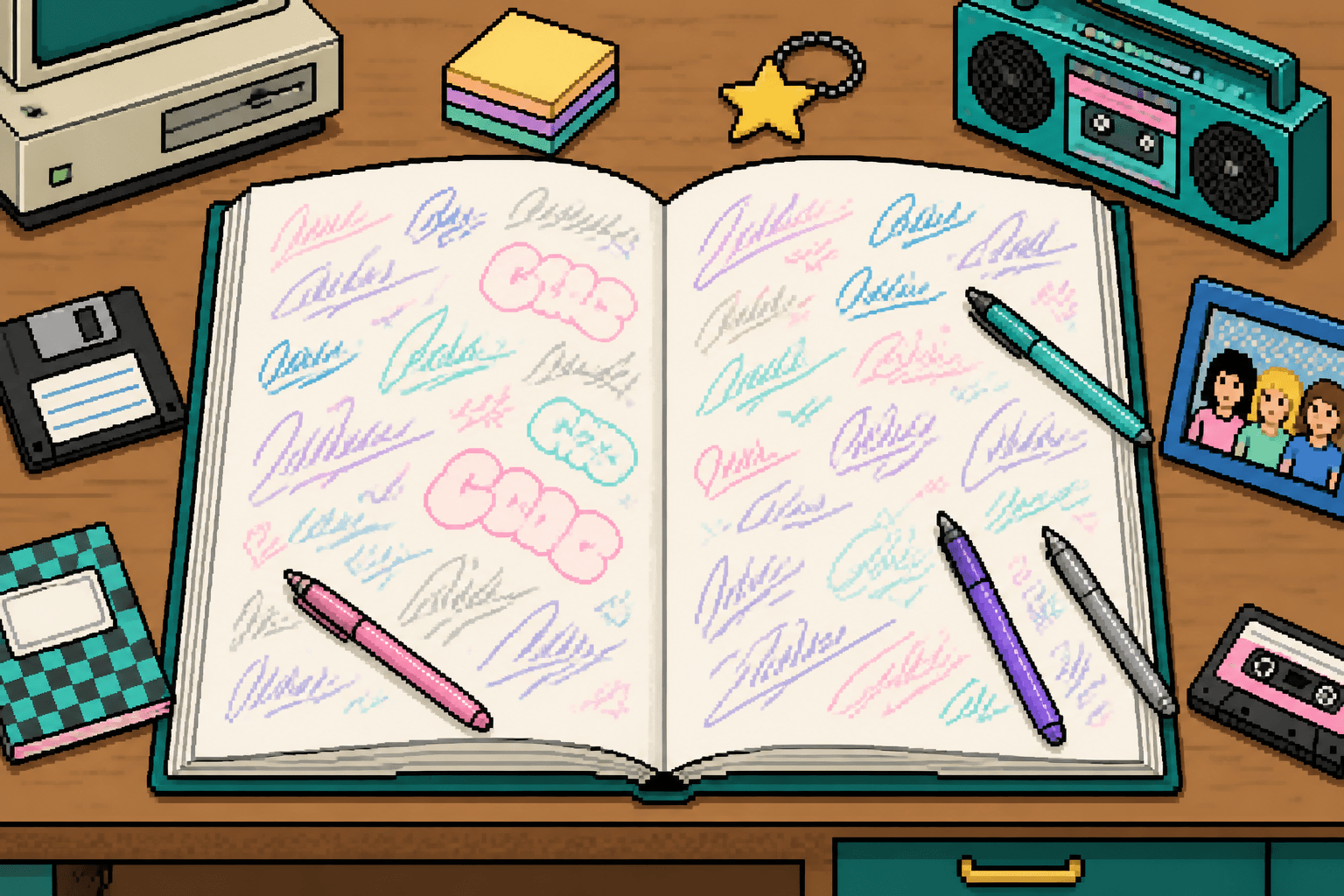
The last week of school was a book.
It was hardcover, glossy, about the size of a phone book but heavier, and the school had handed it to you on a Monday in June for reasons that were partly ceremonial and partly commercial. You paid twenty-two dollars for it in the fall. You had forgotten. Your parents had not. The book had your picture in it, printed at the size of a Chiclet, and if the photographer had caught you blinking, that was the version that would exist forever, and you would not know until you opened the book on Monday.
You opened it. You flipped to your page. You blinked in the photo. It didn't matter. The photo wasn't the point. The point was the rest of the pages, which were blank on the front and back covers and on the endpapers and in a small ruled section at the very back called AUTOGRAPHS, and those pages were about to be filled in with the handwriting of every person you had ever sat near.
You had four days.
The Handoff
You handed your book to a stranger.
Not a total stranger. Someone you had algebra with. Someone whose name you knew but who you had never actually had a conversation with, because your seats were assigned and their assigned seat was the one behind you, and you had spent nine months looking at the back of their head, and now school was ending, and you would probably never see them again, and this was your one chance to have them acknowledge that you had existed.
You said sign my yearbook?
They said yeah, sign mine.
You traded books. You each opened to a random blank spot - front endpaper if you were being polite, next to your own photo if you wanted to be found later. You clicked open a gel pen. You wrote something. You wrote HAGS.
HAGS stood for Have A Great Summer. Nobody said it out loud. Nobody wrote out Have A Great Summer. You wrote HAGS because writing Have A Great Summer would have taken longer and been less cool.
You handed the book back. They handed yours back. You did not read what they had written yet. You would read it in the car on the way home, or in your room that night, or two weeks into summer when you were bored, and you would learn who you had been to a person who had sat behind you for nine months. Usually the answer was 2 good + 2 be = 4 gotten. Usually the answer was six words long.
The Ten Phrases
Every yearbook signature was one of ten phrases.
There were variations. There were embellishments. There were kids who wrote paragraphs, kids who wrote poems, kids who tried to be funny about it. But if you took a random middle-school yearbook from 1996 and did a content audit of the autographs page, ninety percent of them would be some version of these ten:
- HAGS - Have A Great Summer
- KIT - Keep In Touch
- LYLAS - Love Ya Like A Sister
- Don't ever change
- Stay sweet
- 2 good + 2 be = 4 gotten
- U R 2 cute 2 B 4 gotten
- BFF!!!
- See ya next year!
- P.S. sorry my writing sucks
These were not phrases anyone had invented. These were phrases that had been handed down from older siblings, from babysitters, from cousins who were in high school and therefore had access to the true forms. If you were nine you didn't know what LYLAS meant and you did not ask, because asking would reveal that you didn't know, and you were supposed to know. You wrote LYLAS in your best friend's yearbook because Meagan had written LYLAS in yours the year before, and Meagan was fifteen and Meagan knew things.
The phrases were interchangeable. They meant, roughly, I acknowledge that we existed near each other for a year. They meant this is a signature and I have signed it. If a kid you barely knew wrote don't ever change in your book, they were not making a request. They were writing a signature. Change was not on the table.
The exception was P.S. sorry my writing sucks, which was universal, and which was always written in the neatest, most careful handwriting in the entire book, because writing an apology for your handwriting was the one part of yearbook signing where you actually tried.
The Pen
The pen mattered.
There were six pens in your pencil case that week. There was the black ballpoint you used for math. There was the mechanical pencil with the eraser worn down to the metal. And then there were the four gel pens - hot pink, purple, teal, and silver - which you had bought in a four-pack at Staples for the express purpose of yearbook week, and which you had guarded all year like a rare currency.
Gel pens on white yearbook paper glowed. That was the thing. Ballpoint on white paper looked exactly like ballpoint. Gel pen on white paper looked like your signature had been personally endorsed by the future. Purple ink laid down thick and slightly wet, drying into a soft glossy line that caught the fluorescent lights of the classroom. Silver was legible if you tilted the book to the light. Silver was mostly ceremonial. Silver signatures happened once per book, in the biggest empty white space, from the kid who wanted to be remembered.
You handed your pen to the person signing your book. You did not let them use their own pen. If they were signing your book, they were using your pen, because the ink had to match, and because the pens were yours, and because a yearbook signed in six different pens was not a yearbook, it was a document. It had to look like a document.
The Real Estate
Where a person signed you told you what they thought of you.
The inside front cover was the top tier. The inside front cover was where your closest friends signed, in the biggest handwriting, in the fanciest gel pen, sometimes over the course of the entire page. If your best friend took up the whole front endpaper, filling it with a paragraph about your friendship and a doodle of a heart with your initials in it, you had reached the top of the social ladder for that year, and the physical evidence was in ink, and it was permanent.
The next tier was next to your own photo. That was the deliberate spot. A person who wrote HAGS in tiny letters next to your Chiclet-sized photo was saying I want you to find me later. They were annotating your record. They were signing your permanent file.
Then there was the AUTOGRAPHS page at the back, which was where the strangers went. The kid from algebra. The kid whose locker was near yours. The kid you had shared a table with in art in October and never spoken to again. They all signed the back page, in whatever color pen they had, in whatever mood they were in, and the back page filled up over four days like a small parking lot.
The worst spot was the back endpaper. The back endpaper meant I ran out of room, and I did not care enough to find a better spot.
The One Weird One
There was always one weird one.
There was always one signature in the book that you did not fully understand. A kid you barely knew had written a whole paragraph. A kid you thought you were friends with had written just their name and nothing else. A kid whose name you didn't recognize had written don't ever change - you know why. You did not know why. You would think about it for years.
The weird ones were often from the boys. The boys did not, as a rule, do gel pens. The boys used a blue Bic ballpoint from their teacher's cup and wrote, in a hand that could barely be described as handwriting, some version of cool or later or their whole first and last name and no message at all, which was somehow the most romantic signature a boy could produce in the seventh grade, and you would look at their signature that summer and try to determine, from the loop of their L, whether they had liked you.
There was also always at least one kid who wrote SEE PAGE 47. You would flip to page 47. On page 47, wedged between the boys' basketball team photo and the ad for the local flower shop, they had written NOW SEE PAGE 112. You would flip to page 112. This would continue for six pages. The last page would say GOTCHA. You loved this. You hated this. You wrote GOTCHA in someone else's book the next day.
The Signature You Cannot Read
I keep going back to one of them.
There is a signature in my seventh-grade yearbook, in purple gel pen, on the inside front cover, that takes up about a third of the page. It is signed by a girl I remember only in outline. She had glasses. She played the flute. We had one class together, English, and I do not remember her ever speaking directly to me, and I would swear on my life that we never had a full conversation. But she wrote me a paragraph.
The paragraph is illegible. Not because her handwriting is bad. The handwriting is beautiful, actually, tiny and careful and looped, in that specific middle-school-girl cursive that seemed to happen to everyone at once around age twelve. It's illegible because purple gel ink on glossy paper, twenty-eight years later, has faded into a lavender ghost, and the loops have blurred, and I can make out about every fourth word. The words I can make out are funny, always, never, and my name. That's it. Four words, and my name.
I do not know what she said. I do not know if she liked me. I do not know if we had a moment I have forgotten, or if she was signing everyone's yearbook that way that week, and I was one of thirty stops on her tour. I have thought about this signature more, in my adult life, than I have thought about most of the people I actually spoke to that year.
The paragraph is fading further every year. Purple gel pen is not archival. Purple gel pen was designed for one class period on one afternoon in June 1996, and it delivered exactly that, and it was never meant to last thirty years, and I did not know that at the time. I thought the yearbook was permanent. I thought ink was ink. I thought a book made of paper and hardcover binding, sitting in a bookshelf in a house I would not live in forever, was going to hold the shape of a year for me until I needed it.
The paragraph is fading further every year. Purple gel pen is not archival.
The Argument With Myself
Here is the honest part. Nine tenths of the yearbook is meaningless.
Most of the signatures are HAGS. Most of the signatures are from kids I no longer remember. Most of the messages are stock phrases that were interchangeable at the time and are more interchangeable now, and if I lost the yearbook tomorrow I would recover approximately zero information about the year I spent in that school. HAGS is not data. HAGS is a stamp. HAGS is a checkbox saying this book has been signed.
And yet.
And yet somewhere in there, on the inside front cover, in purple gel pen, in a paragraph I cannot read, there is a small piece of information about a person who saw me, in the seventh grade, in a way I no longer have access to. She saw something. She wrote it down. The medium she used to write it down was engineered to be pretty for six weeks, and it was pretty for six weeks, and then it started to fade, and now I get one more year of it and then another year and then I don't know how many years after that.
The kids' yearbook this year is signed on an iPad. My kid told me this. They passed around a shared album at the end-of-year assembly and everyone dropped a video into it and the videos are on the school's server and will be there until the school changes vendors. Then the videos will be gone. Not faded. Not smudged. Gone. The kids do not know this yet. I have not told them.
I don't miss much about middle school. I miss purple gel pen. I miss the specific act of handing a paper book to another human being and asking them, essentially, would you please put a piece of yourself on my record. And I miss the fact that they always said yes, and they always used my pen, and they always wrote HAGS.
Have a great summer. Never change. See you next year.
I don't remember her name. She signed her whole name. I just can't read it anymore.