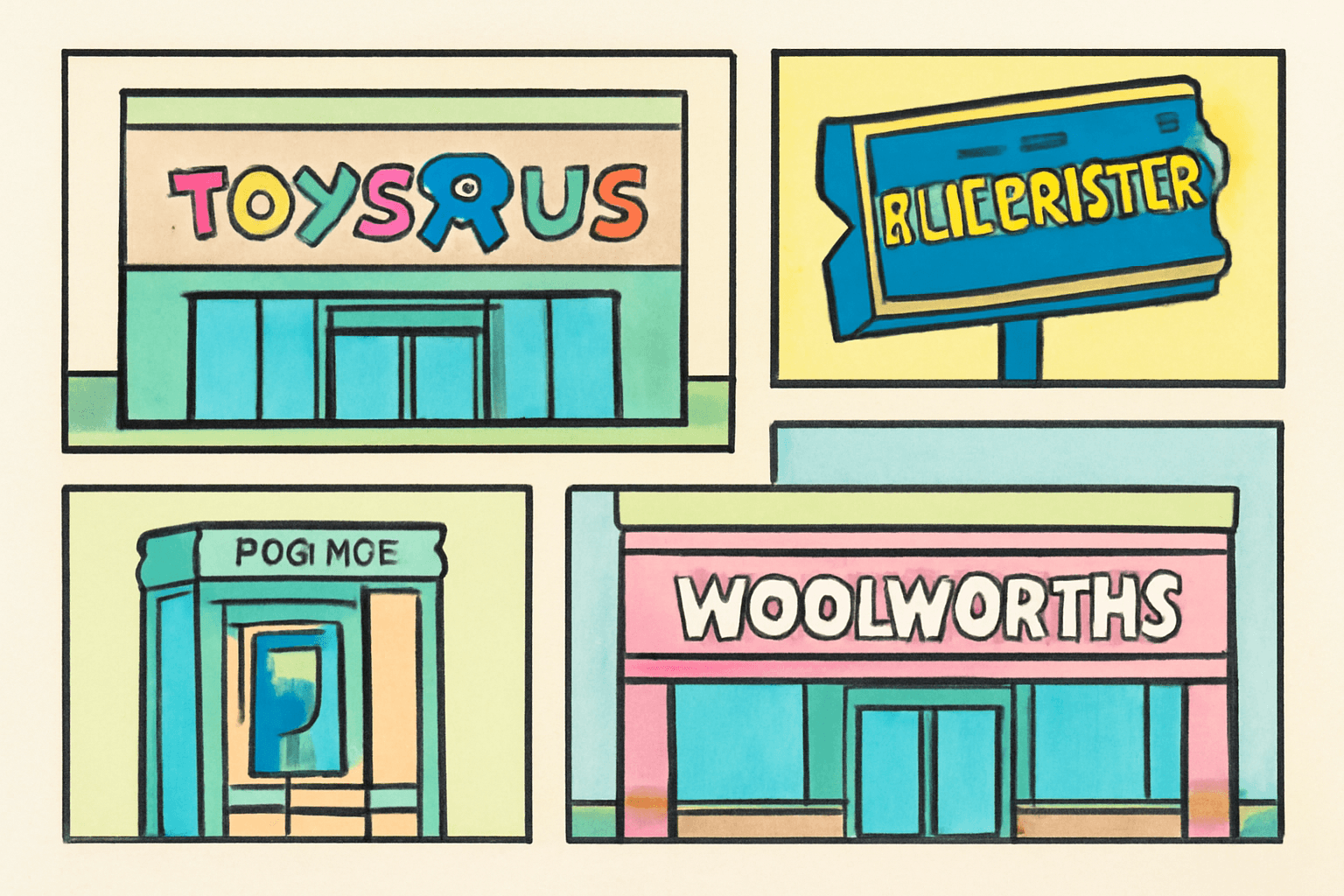
The Toys R Us on Route 17 had a Ferris wheel inside it. Not every Toys R Us did. But the one near us in New Jersey had this massive, creaking thing right in the middle of the store, and when you were seven years old, that felt like proof. Proof that the world was solid. That certain things were just there, the way trees were there, the way the sun came up. You didn't think about a Ferris wheel inside a toy store closing. That wasn't a category your brain had invented yet.
A lot of things felt like that.
The Stores
Woolworths had a lunch counter. I know that sounds like something from a movie about the 1950s, but in the early 90s there were still Woolworths around, and some of them still had lunch counters, and your grandmother could take you there and buy you a grilled cheese sandwich in a store that also sold goldfish and discount shampoo. It was a place that didn't make sense and didn't need to.
Then it was gone. Not dramatically. It just sort of wasn't there one day, and something else was, and you didn't think about it much because you were ten.
RadioShack. Where your dad went to buy batteries and cables and things you didn't understand. The guy behind the counter always knew exactly which adapter you needed for whatever incompatible piece of electronics had entered your life. That store smelled like solder and cardboard. It was never exciting. It was just necessary. Like a library, but for plugs.
Nobody warned us that "going out of business" would become the defining phrase of every strip mall in America.
Tower Records. Blockbuster. KB Toys. Service Merchandise, with that weird conveyor belt system where your purchase appeared from behind a wall like it had been manufactured on the spot. Circuit City, with the red logo and the commissioned salespeople who followed you around like friendly vultures. They're all gone now. Every one. Not relocated. Not rebranded. Gone.
And the mall. God, the mall.
The Mall Was a City
I don't mean the mall was a building where you bought things. I mean the mall was a civilization. It had its own economy, its own social hierarchy, its own food court that served Orange Julius and Sbarro and that Chinese place where everything came in a styrofoam container the size of a shoebox.
You went to the mall to exist. To walk around. To see who was there. To sit on a bench near the fountain and pretend you weren't looking at whoever you had a crush on that week. The mall was the public square of suburban America, and nobody voted to close it. It just slowly emptied, store by store, until what was left was a Spirit Halloween in October and silence the rest of the year.
The fact that dead malls now have their own YouTube subgenre tells you something about how we process grief in this country. We turn it into content.
The Things We Watched
Saturday morning cartoons started at six if you were ambitious, seven if you were normal, and by noon they were over. That was it. You had this window, this sacred six-hour block, and then the local news came on and the spell was broken and you had to go outside. Nobody scheduled them. Nobody curated a playlist. You just showed up and watched whatever was on, in order, commercials and all.
MTV played music videos. I know. I know everyone says this, and I know it's become a cliche, but it was real. You would turn on MTV and a song would be playing, and if you didn't like it you'd wait, because the next one might be the one you'd been hoping to see all week. There was no search bar. There was no algorithm. Just patience and luck.
The newspaper landed on the doorstep every morning with a thud. My dad read it at the kitchen table with coffee. He did the crossword in pen, which I now understand was either confidence or insanity. That newspaper felt like the ground itself - always there, always waiting. The idea that news would become something you'd scroll through on a glowing rectangle in bed at 1 AM, anxious and unable to stop - that would have sounded like dystopian fiction.
The Personal Stuff
Here's where it gets harder to write about.
Your childhood home. The one with the specific creak on the third stair and the dent in the hallway wall from when your brother threw a baseball inside. The kitchen where the light came in a certain way on winter mornings. You thought you'd always be able to go back there. Not to live, but just to see it. To stand in the driveway and feel something.
Then your parents sold it. Or lost it. Or it just stopped being yours in one of the thousand quiet ways that things stop being yours.
We didn't know that "forever" had an expiration date. We were kids. That was the whole point of being kids.
Your parents' marriage, for a lot of us. Not everyone. But enough of us that it became a thing you just understood about your friend group - whose parents were together, whose weren't, and who was in the terrible middle part where nobody was saying anything but the house felt different. One day the world had two pillars and the next day it had one and a half, and you were supposed to just keep going to school and doing your homework and being fine.
Friendships. The ones that felt like blood oaths. Your best friend from fourth grade, the one you swore you'd know forever, the one you built forts with and shared secrets with and called every single night until your mom yelled at you to get off the phone. Where are they now? Do you even know their last name anymore? Not because anything went wrong. Just because time is a river and people are leaves and that metaphor is as depressing as it is accurate.
The neighborhood. The specific arrangement of families and dogs and yards. Mrs. Patterson watering her garden. The Hendersons' basketball hoop that everyone used. The creek behind the Millers' house where you found a turtle once. All of it felt permanent as geography. But people move. People die. People just change, and one day you drive through and it's all the same houses but none of the same people and it's like visiting a museum of your own life.
The Big Things
Remember the ozone layer? That was going to kill us all. There was a hole in it, they told us, and the sun was going to cook us alive, and we all needed to stop using aerosol cans. I remember being genuinely afraid of this in a way that felt enormous and personal, like the sky itself had betrayed us. We actually kind of fixed that one, which would be inspiring if we could apply the lesson to anything else.
But bigger than the ozone layer, bigger than any single fear, was this: we believed the future would be better. Not in a political way. In an ambient, unexamined, bone-deep way. The future had flying cars and moon bases and a cure for everything. The future was where the good stuff was. You just had to get there.
I don't know exactly when that stopped being the default assumption. It wasn't one moment. It was a slow leak, like air out of a tire you don't check often enough. At some point the future stopped being a destination and started being a threat, something to prepare for rather than look forward to, and that shift - that quiet, enormous shift - might be the biggest thing that turned out not to be permanent.
The Toys R Us closed in 2018. All of them, all at once, like a magic trick in reverse. I drove past the one on Route 17 a few years after. The building was still there. The parking lot was still there. But the sign was gone, and the windows were dark, and the Ferris wheel - I don't know what happened to the Ferris wheel.
Probably it's in a warehouse somewhere. Probably it got scrapped. Probably it doesn't matter.
But I think about a seven-year-old standing inside that store, looking up at that wheel turning slowly under the fluorescent lights, believing with every cell in his body that this moment, this place, this feeling - that it would all just keep going.
It's the most natural thing in the world, to believe that. And the most wrong.