The DJ was talking. He was always talking.
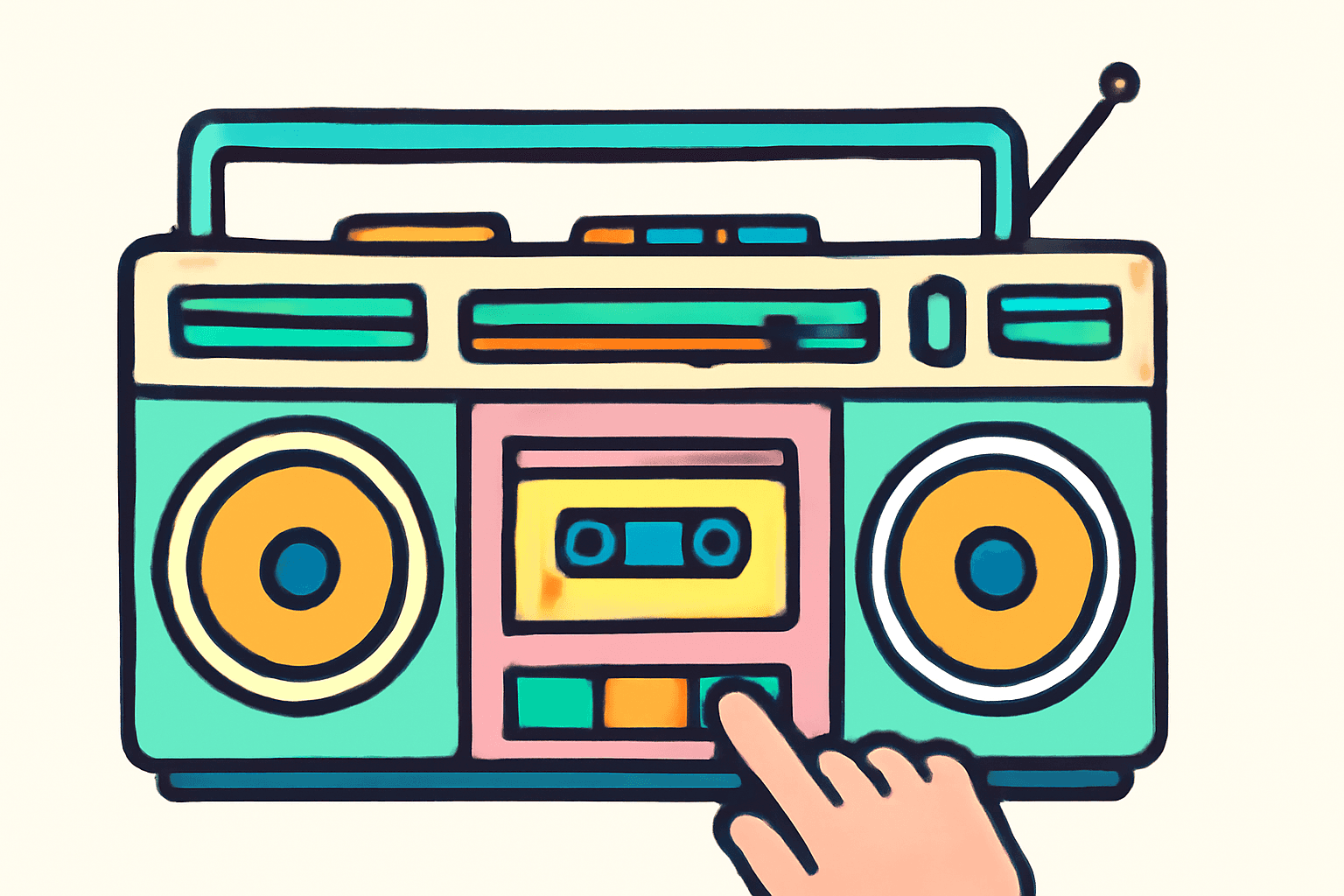
You'd been sitting on the edge of your bed for forty-five minutes with your index finger resting on the record button of a Panasonic boombox, waiting for Z100 to play "No Diggity" for the third time that afternoon. You had the blank side of a Maxell XLII cued up. You had the volume set. You were ready. And then the song started - you could hear those first few notes sliding in under the DJ's voice - and he just kept going. Talking about a concert this weekend. Giving out a phone number. Saying "Z one hundred, New York's number one hit music station" right over the intro, stretching every syllable like he was getting paid by the word.
You hit record anyway. You always hit record anyway. Because the intro was already half gone and if you waited any longer you'd miss the whole thing, and who knew when they'd play it again? Maybe in an hour. Maybe in three. You didn't have that kind of time. You had homework. You had dinner. You had a finite window of unsupervised access to the boombox before your brother wanted to play his Korn CD.
So you got the song. Most of it. Starting about eight seconds in, with a local car dealership jingle fading underneath, and the DJ's voice trailing off like a ghost that refused to leave the building.
That was the recording. That was the best case scenario.
The Waiting Game
Kids today will never understand what it meant to want a specific song and not be able to just have it. You couldn't search for it. You couldn't click on it. You couldn't ask a little speaker on your kitchen counter to play it. You had to sit there, next to the radio, and wait. Like a hunter in a blind. Like a fisherman watching a bobber. The song would come to you on its own schedule, or it wouldn't come at all.
You didn't find the song. The song found you. All you could do was be ready.
You'd listen to fifteen songs you didn't care about. You'd sit through traffic reports and weather updates and commercials for mattress stores that were always going out of business but never actually closed. You'd hear the opening notes of something and your heart would jump and then it would turn out to be a different song entirely - something that started the same way, some bait-and-switch from the universe. And then your mom would yell that dinner was ready and you'd have to leave your post and the song would probably play while you were eating meatloaf and you'd never know.
The radio was a river. You stood on the bank and waited for your fish to swim by. Sometimes it took all day.
The Art of the Imperfect Recording
Every tape I made off the radio had the same artifacts. The same beautiful, infuriating imperfections.
- The last three seconds of whatever song played before yours
- A DJ talking over the intro (guaranteed)
- Your mom yelling something in the background on at least one track
- A slight volume dip where you bumped the boombox reaching for the button
- The sound of you pressing stop a half-second too late, catching the opening of a Subway commercial
- Blank tape hiss between songs where you forgot to pause
There was no editing. There was no "let me just trim that." Whatever the tape captured, that was it. That was the version of the song you owned now. And after a while, those imperfections became part of the song itself. To this day, I can't hear "Waterfalls" by TLC without expecting a guy to start talking about Kiss FM's weekend countdown right at the beginning. My brain filled in the artifact. The clean studio version sounds wrong to me - like something's missing.
And the transitions between songs were chaos. You'd have the end of "Creep" by TLC bleeding into the first two seconds of a Taco Bell commercial bleeding into silence bleeding into the opening of "Gangsta's Paradise" with the DJ saying "and we're back" underneath it. Every mix tape was an accidental sound collage, a little time capsule of what the airwaves sounded like at 3:47 PM on a Tuesday in 1996.
Saturday Mornings with Casey
The best time to record was during the countdown shows. Casey Kasem's American Top 40. You knew the songs were coming. You knew roughly which songs were coming. It was a scheduled event, like a TV show but for your ears, and Casey would count them down and tell you little stories between tracks - who wrote the song, who requested it, some letter from a kid in Iowa who dedicated it to his girlfriend.
Casey Kasem made you feel like every song had a story behind it, and every story mattered to somebody.
Casey talked over the intros too, of course. They all did. It was some kind of radio law - thou shalt never allow a song to begin in silence. But Casey's voice was warm enough that you didn't mind as much. It felt like he was introducing the song to you personally. "Coming in at number seven this week..." and then the music would swell underneath him and you'd be ready with your finger on the button and you'd catch it - maybe not the first note, but close enough. Close enough was the whole game.
The dedication shows were even better. Friday nights, late. Love songs and slow jams requested by people who called in with their voices shaking. "This is for my boyfriend Marcus, I love you baby." And then Boyz II Men would start playing and you'd record it not because you needed a copy of "I'll Make Love to You" but because the whole moment felt like something you should keep. The dedication. The song. The static. All of it.
The Dual-Cassette Deck
If you were lucky - if your family had invested in a proper stereo system, one of those big shelf units from JCPenney with the glass door and the fake wood paneling - you had a dual-cassette deck. Two tape slots. Side by side. This changed everything.
Because now you could dub.
Your friend had a tape with "Slam" by Onyx on it? You could copy it. Your cousin brought a tape back from California with songs you'd never heard on your local stations? Dubbed. A kid at school had a tape his older sister made? You could borrow it for one night and duplicate the whole thing, both sides, in real time, sitting there for ninety minutes while the machine quietly transferred music from one plastic rectangle to another.
- Always rewind both tapes before starting
- Never dub over someone's tape without asking (a violation punishable by social exile)
- Accept that the copy would sound slightly worse than the original
- Accept that a copy of a copy would sound significantly worse
- Third-generation dubs were basically AM radio with a pillow over it
- This was fine. You were grateful.
The quality degraded with each generation. The original recording off the radio was already imperfect - the DJ talking, the jingle, the slight hiss. The dub of that recording lost a little more. The dub of the dub lost more still. By the time a song had passed through three or four tape decks, it sounded like it was being played at the bottom of a swimming pool. But it was yours. You had it. You could listen to it in your Walkman on the bus, and that mattered more than fidelity ever could.
What Scarcity Did
Here is the thing that's hardest to explain to anyone who grew up with Spotify: not being able to hear a song whenever you wanted made you love it more. Not less. More.
When you finally captured a clean - well, clean-ish - recording of a song you'd been chasing for weeks, you listened to it differently. You didn't skip it. You didn't let it play in the background while you did something else. You sat with it. You listened to every second, because every second had cost you something. Time. Patience. Vigilance. The willingness to sit next to a boombox on a Saturday afternoon when you could've been outside.
Scarcity made you pay attention. And paying attention is just another word for love.
You learned the songs completely. Not just the chorus, not just the hook - the verses, the bridge, the little instrumental break two-thirds of the way through. You knew when the drums came in. You knew the exact breath the singer took before the last chorus. Because you'd listened to your imperfect recording dozens of times, rewinding and playing, rewinding and playing, wearing the tape thin with your attention.
The Tape is Gone
I don't know where those tapes are now. Probably in a landfill somewhere, or in a box in my parents' basement, the magnetic coating slowly degrading, the sound getting muddier year by year even without anyone pressing play. The songs are all still available, of course. Every single one. I could hear any of them right now in perfect digital clarity with no DJ, no jingles, no Taco Bell commercials, no hiss.
But I don't think I'd hear them the same way. Not without the waiting. Not without the finger on the button. Not without that half-second of panic when the intro started and you had to decide - now, hit it now - knowing you'd probably be a beat too late, knowing the DJ would probably talk over it, knowing the recording would be imperfect in all the ways recordings were imperfect back then.
You hit record anyway.
You always hit record anyway.