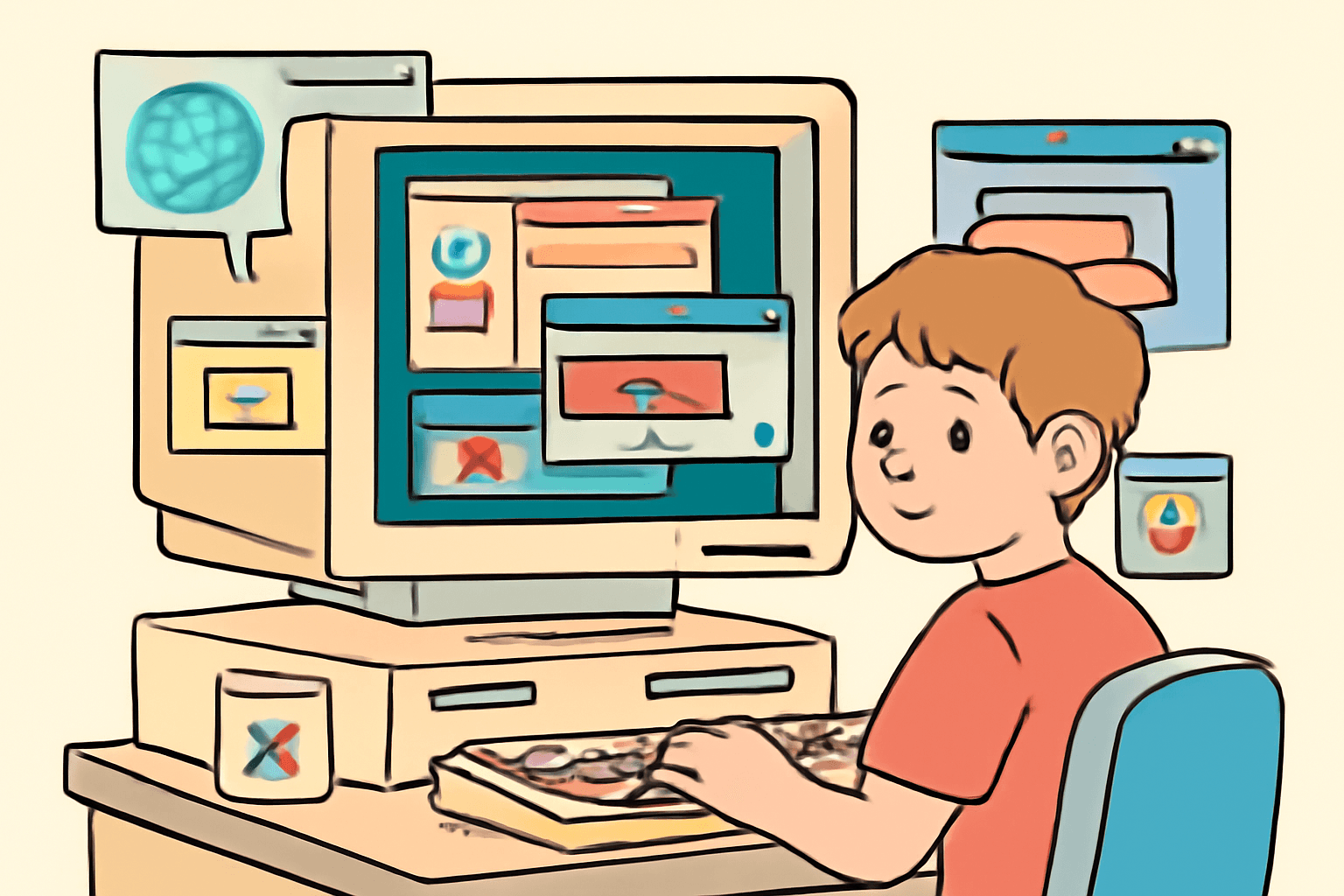
The first email I ever sent was to nobody. I just wanted to see if it worked. I typed something like "hello this is a test" into my Juno account, sent it to myself, and then waited. When it showed up in my inbox thirty seconds later, I felt like a scientist who'd just split the atom. I was twelve.
Nobody told me that moment was the beginning of something. Nobody could have.
Terms of Service: Unread
We were the guinea pigs. The beta testers. The first kids in human history to come home from school, log on, and become someone else in a chat room. We picked screen names like they were superhero identities. SkatePunk97. XxAngelBabyxX. We didn't know we were building the first draft of online identity. We thought we were just goofing around.
There were no tutorials. No "digital literacy" classes. No parent who could sit us down and explain what we were walking into, because they didn't know either. Your mom was still figuring out how to set the clock on the VCR. She was not going to help you navigate AIM drama.
We were the first generation to learn that words on a screen could make you cry just as hard as words said to your face.
And that's the thing people forget. Every single norm, every unwritten rule, every piece of "netiquette" that governs online life today - we wrote it. In real time. With no safety net. While we were children.
The Chat Room Was the Town Square
Before Facebook. Before Twitter. Before any of it. There were chat rooms.
Yahoo Chat. AOL Chat. Random IRC channels with names that probably should have tipped off our parents. We wandered into these places the way kids in the '70s wandered into the woods - unsupervised, curious, and completely unprepared for what we'd find.
We learned fast. Don't type in all caps. That's yelling. Don't ask "a/s/l" right away - wait at least two messages. If someone's being weird, just leave the room. If someone's being really weird, block them. We figured out moderation before platforms did. We were the moderation.
Things we learned the hard way, so you didn't have to:
- Don't give out your real name
- Don't give out your address
- Don't believe anyone who says they're also 14
- "LOL" means the conversation is going fine
- Silence means it's not
- Away messages are an art form
And the bullying. God, the bullying. It didn't have a name yet. There was no "cyberbullying" awareness campaign, no school assembly, no after-school special. There was just you, sitting in your room at 11 p.m., watching someone you thought was your friend post something awful about you in a chat room full of people from your school. And you couldn't tell your parents because they'd take away the computer. And you couldn't tell your teacher because they'd look at you like you were speaking Klingon.
So you just dealt with it. You learned to log off. Or you learned not to care. Or you didn't learn either of those things and it messed you up for a while. There was no playbook.
MySpace Taught Us to Build. Facebook Taught Us to Perform.
MySpace was the Wild West and we were all homesteaders. You could customize your entire page. Pick your Top 8. Autoplay a song that announced your personality to anyone who dared to visit your profile. Mine was "Ocean Avenue" by Yellowcard for an embarrassingly long time.
We learned HTML to make our pages look cool. Actual code. We'd copy-paste from sites with names like PimpMySpace and then tweak the colors until three in the morning. We were twelve-year-old web developers and we didn't even know it. We just wanted a background that tiled correctly.
Then Facebook showed up. And Facebook was different.
Facebook didn't let you customize anything. Facebook gave you a box and said, "Put yourself in here." Real name. Real school. Real photo. It was the first platform that demanded authenticity, and we handed it over without blinking. We'd spent years being anonymous online and then one site said "give us everything" and we said "sure."
We were the first people to Google ourselves and find results.
Nobody warned us because nobody knew. The adults in our lives were still amazed that you could buy books on the internet. They were not thinking about the long-term psychological effects of curating a public identity at age fifteen. They were trying to figure out why the printer wasn't working.
YouTube and the End of Forgetting
Early YouTube was chaos. Beautiful, dumb, unfiltered chaos. People uploaded anything. Skate videos shot on handicams. Lip syncs in bedrooms. Rants about nothing. The "Broadcast Yourself" slogan wasn't ironic yet - it was an invitation, and we RSVP'd immediately.
We were the first people to learn that the internet never forgets. Some kid at your school did something embarrassing at a party, someone recorded it on a Motorola RAZR, and by Monday it was on YouTube with 400 views. That was a lot of views in 2006. That kid's life was different now.
We watched the concept of "going viral" get invented in real time. We didn't call it that at first. We just said "dude, have you seen this?" and sent a link over AIM.
No One Was Driving
Here's what I keep coming back to. Every generation has its version of "we had it rough." And I'm not trying to win that contest. But there's something specific about being the test case. The prototype users. The ones who showed up before the safety features.
Every platform that launched in the late '90s and 2000s - AIM, LiveJournal, Xanga, MySpace, Facebook, YouTube, early Twitter - launched on us. Teenagers. Kids. We were the target demo and the crash test dummies at the same time. They built the cars while we were driving them.
There were no content warnings. No algorithmic controls. No "are you sure you want to post this?" prompts. No privacy settings because the concept of "privacy settings" hadn't been invented yet. We posted our full names, our schools, our phone numbers, our deepest journal entries, and nobody stopped us because nobody was paying attention.
The adults weren't negligent. They were just as lost as we were. The whole thing was new for everyone. But we were the ones in the deep end. We were the ones who had to figure out, at thirteen, that a person could be completely different online than they were in real life. That someone could pretend to be your friend and screenshot your conversations. That a photo could travel further than you ever intended.
We didn't just adopt the internet. We domesticated it. We taught it tricks. And it bit us sometimes, and we learned from that too.
What We Left Behind
The norms we built - don't feed the trolls, think before you post, curate your online presence, protect your personal information - those aren't just suggestions now. They're the foundation of digital life. They teach them in schools. They write books about them. There are entire university departments dedicated to studying the things we figured out by trial and error in our parents' basements.
We didn't get credit for it. We didn't get an instruction manual either. We got a dial-up connection, a screen name, and a world that nobody understood yet.
And we walked right in.
Sometimes I think about that first email I sent to myself. "Hello this is a test." I didn't know how right I was. The whole thing was a test. All of it. Every login, every profile, every late-night conversation with a stranger in a chat room, every time we posted something and immediately regretted it.
We were the test. And somehow, mostly, we passed.