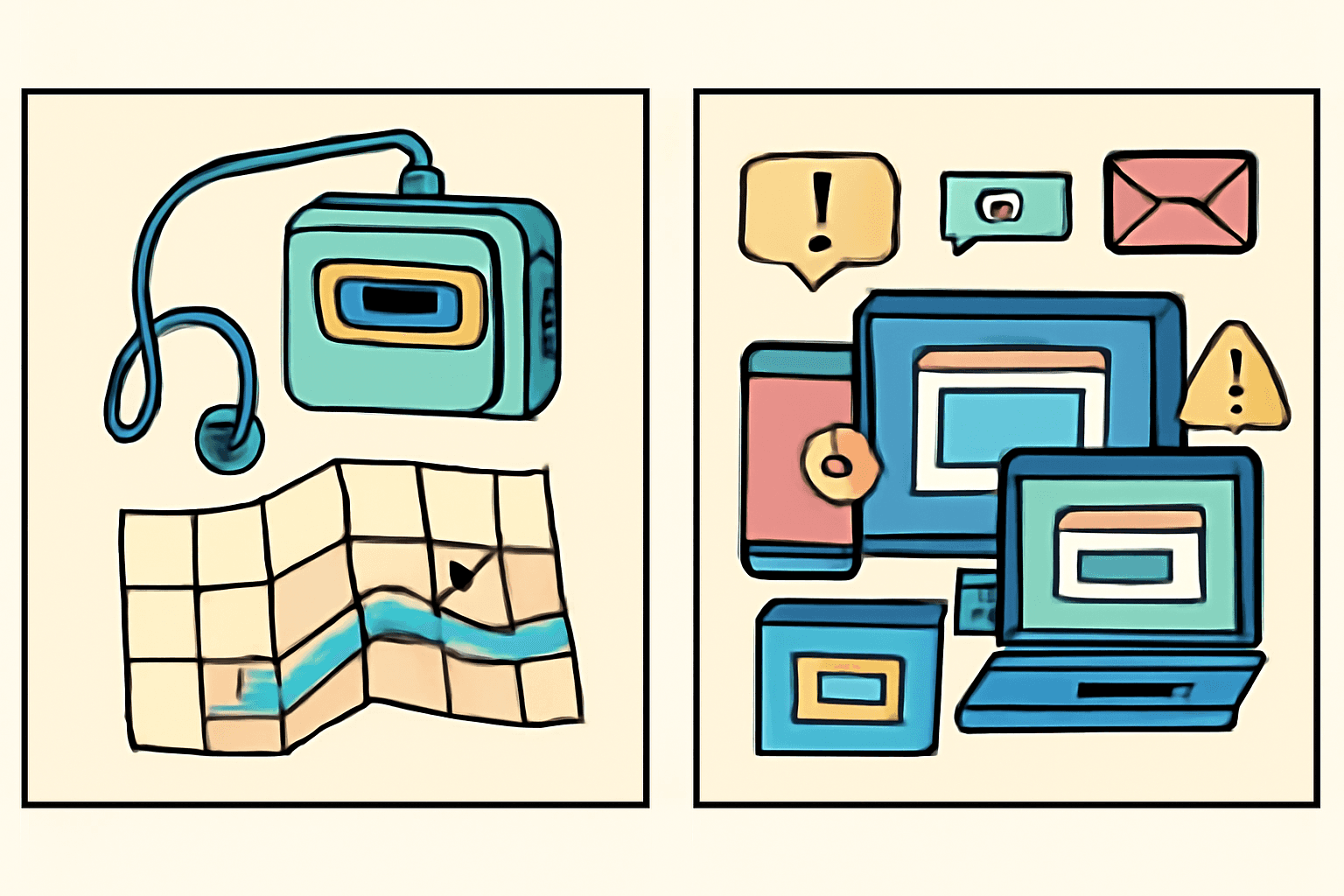
The last time I was truly lost was 1998. Somewhere outside Tallahassee, in a rented Pontiac Grand Am, with a gas station map folded wrong on the passenger seat. No GPS. No phone with a blue dot telling me where I was. Just me, the wrong exit, and the growing suspicion that I'd been driving south when I should have been driving north.
I figured it out. Eventually. And the relief of finding the right road felt like something I'd earned.
You can't get lost anymore. Not really.
The Deal We Didn't Know We Were Making
Somewhere around 2007, give or take, we made a trade. Nobody voted on it. Nobody read the terms. We just collectively handed over a set of experiences we didn't know had value, and in return we got everything. All of it. All the time. In our pockets.
Every song ever recorded. Every movie ever made. Every fact, every map, every recipe, every answer to every question you could think of at 2 AM. Infinite. Instant. Bottomless.
We got everything. And everything, it turns out, has a weight to it.
I'm not here to tell you the deal was bad. I use Google Maps every day. I stream music while I cook dinner. I am not building a cabin in Montana. But I do think we should be honest about what the other side of the ledger looks like. Because we lost things. Real things. Things that were so ordinary we didn't think to miss them until they were gone.
The Blockbuster Problem
Friday night, 1995. You drive to Blockbuster. This is not a metaphor. This is a literal errand that took actual time in your actual car.
You walk in. The new releases wall is half empty because it's Friday and everyone else had the same idea. The movie you wanted - that one your friend told you about - is gone. All five copies, gone. So you wander. You pick up boxes and read the backs. You judge cover art. You argue with whoever you came with. You settle on something you've never heard of, based on nothing more than a paragraph of plot summary and the fact that Bill Pullman is in it.
And sometimes that random pick was great. Sometimes it changed what you thought you liked.
Now open Netflix. Scroll. Scroll more. Read a logline. Watch a trailer. Add it to your list. Keep scrolling. Twenty minutes later you've chosen nothing and you're vaguely irritated. You put on The Office again.
Blockbuster at its peak had over 9,000 stores in the US. The last one stands in Bend, Oregon, operating as something between a rental shop and a museum. Which tells you everything.
The scarcity was the point. When you couldn't have everything, the thing you did get felt like it mattered. The movie you brought home on Friday was your movie for the weekend. You watched it. You committed.
Infinite choice turns out to be a very specific kind of paralysis.
Forty-Five Minutes of Silence
I bought Weezer's Blue Album on cassette in 1994 from a Sam Goody at the mall. It cost me like twelve bucks, which, when you're fifteen, is not nothing. I listened to that tape until the ribbon warped. I knew every song. Not just the singles - every song. The deep cuts. The weird ones. I had opinions about track five versus track eight.
That's what happens when you own twelve albums. You live inside them.
Now I have access to a hundred million songs. I have playlists curated by algorithms that know my taste better than I do. And I skip tracks fifteen seconds in. I let entire albums wash over me like background noise while I do something else. I hear more music in a week than I heard in a year in 1994.
But I don't know any of it. Not the way I knew the Blue Album. Not the way I knew every breath and pause and weird little guitar squeal on Say It Ain't So.
Scarcity made us pay attention. Abundance let us stop.
Having twelve bucks on the line meant you listened. You gave the album a second chance, a third chance, because you had to. You'd already spent the money. And on that third listen, something would click. A song you thought you didn't like would suddenly open up. That almost never happens on Spotify, because why would it? There's always another song. There's always another playlist. There's always more.
The Joy of Not Knowing
Here's one that sounds small but isn't.
You're at a barbecue. Someone says, "Hey, what was the name of that guy - the actor - he was in that movie with the helicopter?" And what follows is twenty minutes of six people guessing, arguing, snapping their fingers, saying "It's on the tip of my tongue." Someone thinks it's Jeff Daniels. Someone else is sure it's Jeff Daniels but in a different movie. The conversation spirals. It becomes its own thing. You talk about other movies. You tell stories. You laugh.
Now someone just pulls out their phone. "It was Nicolas Cage." Conversation over.
We killed the tip-of-the-tongue moment. We killed the beautiful, rambling, twenty-minute detour that happened when nobody could remember a thing. We gained the answer. We lost the conversation that happened in its absence.
Boredom Was a Feature
Kids today - and I hear myself saying that, I hear it - don't experience boredom the way we did. And I know how that sounds. Like a cranky uncle. But hear me out.
Boredom in the 90s was long. It was oppressively long on summer afternoons when your friends weren't home and there was nothing on TV except soap operas and Judge Judy. So you did things. Weird things. You built stuff out of cardboard boxes. You invented games with rules that made no sense. You rode your bike to nowhere in particular. You lay in the grass and watched clouds and genuinely, sincerely, without any irony, thought about stuff.
Boredom was where creativity went to get started. It was the empty space where ideas showed up because there was nothing else competing for the room.
Now that empty space is filled. Always. Immediately. A six-second video. A notification. A scroll through something. The boredom never builds long enough to push you toward making anything.
I'm not romanticizing being bored. Being bored sucked in the moment. But something grew in that emptiness. Something that doesn't grow when the emptiness is never allowed to exist.
The Last Shared Experience
Super Bowl XXVII. February 1993. Cowboys versus Bills. My entire extended family crammed into my uncle's living room in suburban Ohio, watching on a 27-inch Zenith. Not because we all loved football. Because there were four channels and this is what was on and this is what everyone was watching.
Monday morning at school, everybody had seen the same thing. The same commercials. The same halftime show. You could reference it and every single person knew what you were talking about.
That was the monoculture. And it had problems - real ones, about whose stories got told and whose didn't. I'm not pretending it was all good. But there was something in the shared experience that we haven't replaced. When everyone watches something different, on different schedules, on different screens, you lose the connective tissue. You lose the "Did you SEE that last night?" moment. You lose the water cooler.
We went from three channels with nothing on to five hundred apps with everything on, and somehow we ended up more alone with our screens.
Now we have a thousand tiny rooms instead of one big one. And each room is fine. But the hallway between them is quiet.
Not a Eulogy
I want to be clear. I don't want to go back. I don't want to refold that gas station map. I don't want to wonder what actor was in that helicopter movie for three days because nobody I know can remember.
But I think it's worth noticing what happened. Worth naming it. We optimized for access and speed and convenience, and those are real goods. But the things we traded away - boredom, scarcity, patience, getting lost, not knowing, the shared fumbling of collective experience - those were doing work we didn't see. Quiet work. They were making us pay attention. Making us commit. Making us talk to each other in a different way.
We gained everything.
I just wonder sometimes if everything was more than we needed.