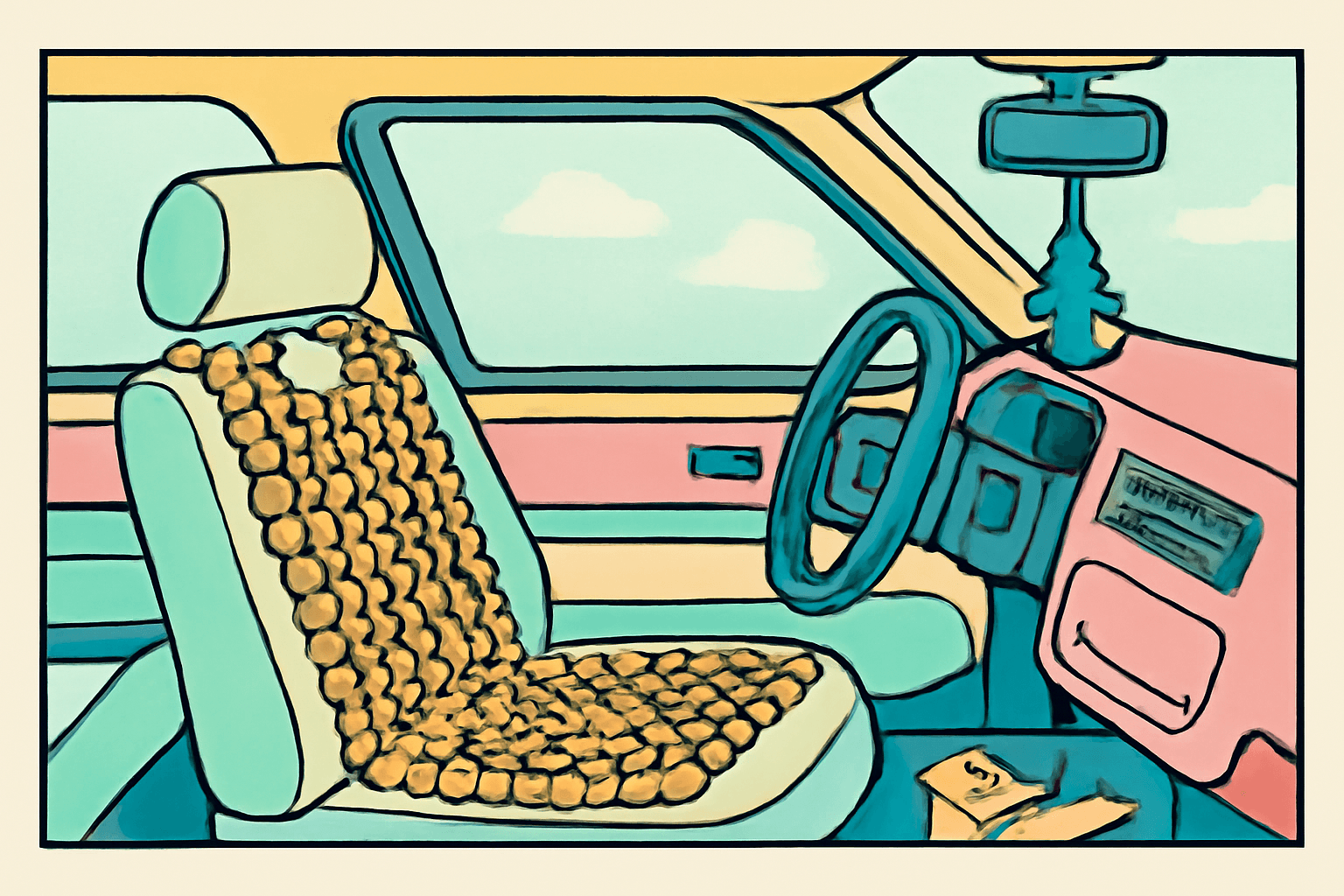
You knew you were getting into your aunt's car before you opened the door. Maybe it was the color - some shade of maroon or teal that Detroit stopped making in 2001. Maybe it was the pine tree air freshener hanging from the mirror, faded to a color that no longer existed in nature. But mostly it was the seats. You could see them through the window. Row after row of wooden beads, strung together on wire, draped over the driver's seat like chain mail for a Buick.
You'd climb into the back and hear it. That sound. Part rattle, part click, a full-body percussion event triggered by the simple act of your aunt sitting down. Every shift of her weight produced a tiny wooden symphony. Turn signal on? Click-clack. Checking the blind spot? Clatter. Hard brake at a yellow light? A full avalanche of maple-colored noise.
Nobody Bought These for Themselves
Here's the thing. You never saw bead seat covers at the store. You never watched someone install them. They simply existed on your aunt's car seat the way barnacles exist on the hull of a ship - permanently, mysteriously, without origin story. They were always already there.
No one ever witnessed the installation of a wooden bead seat cover. They arrived the way myths do - fully formed and impossible to trace.
And it was always an aunt. Not your mom. Your mom had cloth seats with a coffee stain she'd covered with a towel from a Holiday Inn. Not your dad. Your dad's truck seat was held together with duct tape and optimism. But your aunt - the one who drove a Pontiac Grand Am or a Chevy Cavalier or, if she was doing well, a Camry - she had the beads. Always the beads.
The Ergonomic Lie
The stated purpose, if anyone ever stated it, was back support. The beads were supposed to provide some kind of massage effect during long drives. They were supposed to promote circulation, reduce fatigue, prevent the kind of lower-back stiffness that came from commuting forty-five minutes to a job at the county courthouse.
Did they work? Absolutely not. What they actually did was imprint a grid pattern into your skin that lasted for forty minutes after you stood up. You'd get out of the car at the grocery store looking like you'd fallen asleep on a waffle iron. Your thighs had texture. Your back looked like a topographical map.
- A tissue box on the rear dash, slid fully to one side
- Werther's Originals in the center console, some unwrapped and fused to the plastic
- A visor clip holding insurance cards from three years ago
- An AM radio preset she hadn't changed since the first Bush administration
- A steering wheel cover made of the same leather-adjacent material as a Bible cover
But comfort wasn't really the point, was it? The beads were a choice. A deliberate aesthetic decision in a decade when your car's interior was one of the few spaces you could customize without a landlord's permission. You couldn't paint the walls of your apartment, but you could absolutely drape your Corolla in wooden orbs and call it self-expression.
The Taxonomy
They weren't all the same, either. There were tiers.
The basic model was natural wood - pale, unfinished, the color of a tongue depressor. This was the Honda Civic of bead seat covers. Functional. Unambitious. Fine.
Then there was the stained version. Honey-colored or dark walnut, like someone had applied the same finish they'd use on a deck. These said I have preferences. These said I browsed.
And then, at the top - the painted ones. Alternating stripes of color. Red, black, natural. Or blue, white, natural. These were the ones that committed. These were the ones that made the car smell faintly of lacquer on hot days, when the sun turned the interior into a kiln and every bead became a tiny brand waiting to contact bare skin.
Sitting on heated wooden beads in July wearing shorts was a formative pain experience. You learned things about yourself in that moment.
The Summer Problem
We need to talk about summer. Because in winter, the beads were fine. Cool, maybe. A little clinical. Like sitting in a doctor's waiting room that happened to be moving at sixty miles per hour. But in summer - in real summer, in the back seat of a car that had been parked in a Kmart lot for two hours - the beads became instruments of war.
They absorbed heat like they'd been engineered for it. Each individual bead became a tiny sun, and there were roughly four hundred of them between you and the seat. You'd sit down and gasp. Your aunt would say it'll cool off in a minute and turn the AC to a setting that produced a sound but not a temperature. You'd press your bare legs into the beads and feel each one individually, like being acupunctured by a tree.
The backs of your thighs. The small of your back where your shirt rode up. That one spot on your shoulder blade. Every point of contact was a separate negotiation with pain.
The Sound of Arriving
But here's what stays with me. The sound.
Not just the clacking when your aunt sat down. The whole acoustic landscape of that car. The beads shifting when she turned corners. The faint wooden rattle over bumps, like a rain stick laid on its side. The way the whole seat seemed to breathe with tiny percussive exhales every time the car changed speed.
It was the sound of being driven somewhere by someone who wasn't your parent. Which meant different rules. Which meant the window could be all the way down. Which meant stopping for ice cream was a real possibility and not a negotiation. The bead seat covers were the soundtrack to a slightly unsupervised afternoon, and they sounded like freedom filtered through maple.
Where Did They Go?
You can still buy them. I checked. They're on the internet, sold by companies with names that suggest they've been in business since 1974. But you never see them anymore. Not in parking lots, not at stoplights, not through the window of a Grand Am at the Winn-Dixie.
They vanished the way a lot of small, weird, specific things vanished - not with an announcement, but with a slow fade. One day your aunt got a new car and just didn't put them on. The beads went into the garage, then into a box, then into the particular dimension where all 90s artifacts go when they've finished being ordinary.
But you remember the pattern on your legs. You remember the clacking. You remember the heat and the Werther's Original and the faint smell of Virginia Slims that had soaked so deep into the headliner it had become part of the car's molecular structure. You remember your aunt adjusting the rearview mirror, the beads shifting under her like a slow applause, and pulling out of the driveway toward anywhere. The seats clicked. The world opened up.