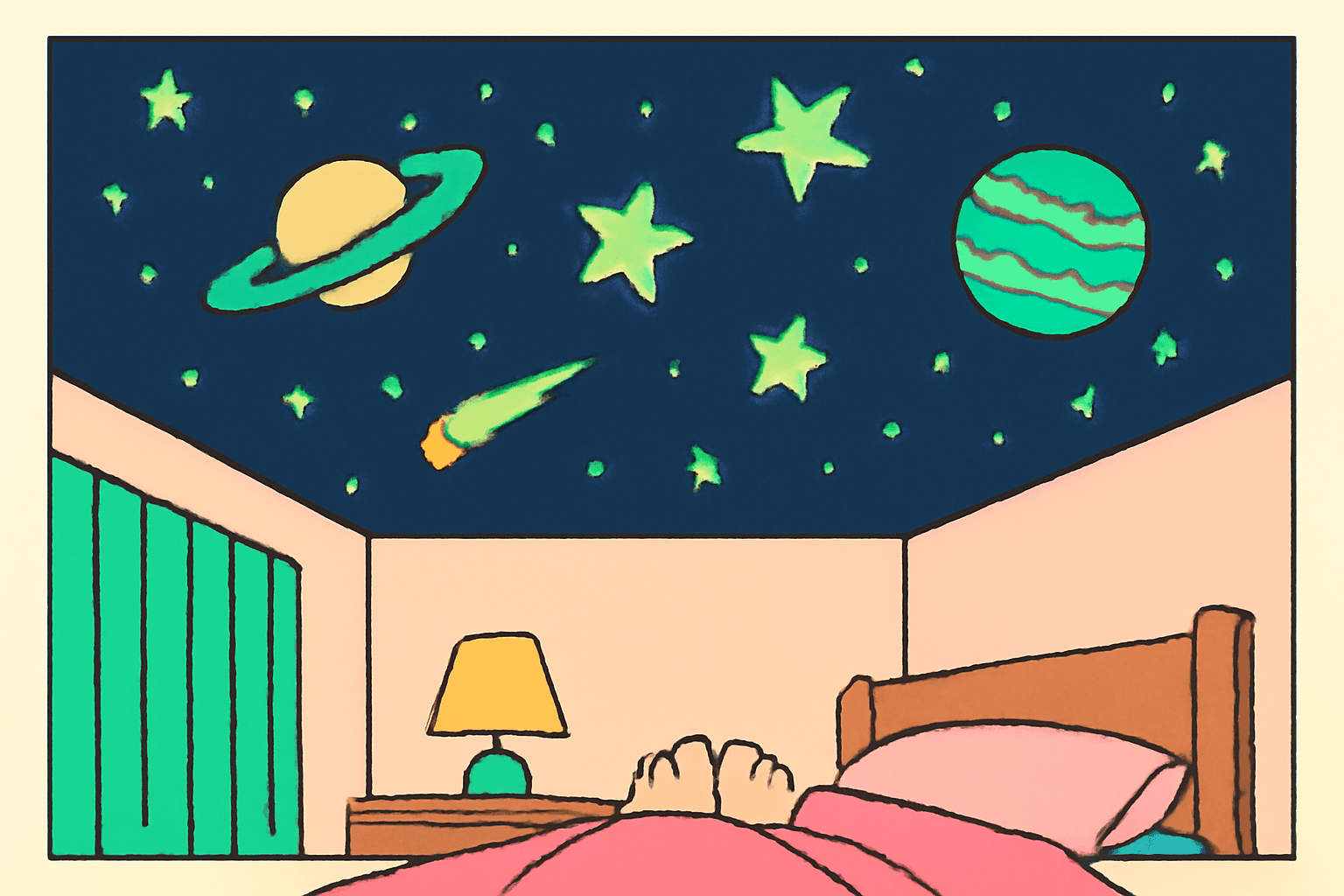
The pack came from a drugstore. CVS, maybe Rite Aid, maybe the space aisle at Toys "R" Us if you were lucky. It was a flat plastic bag with a cardboard header, and through the packaging you could see them - dozens of pale green plastic stars, each about the size of a quarter, with a little circle of adhesive putty on the back. They cost maybe three dollars. They were the most important purchase of your entire childhood.
You brought them home and immediately went to your room and closed the door, because this was serious work. This was interior design. You stood on your bed in your socks, reaching up toward the ceiling with the confidence of someone who had absolutely no plan.
The idea, at first, was to make real constellations. You'd seen a star chart somewhere - maybe in a library book, maybe on a placemat at a diner, maybe in one of those Scholastic books about space that you'd ordered off the flyer. You were going to recreate the night sky. Orion. Cassiopeia. The Big Dipper, at minimum. You were going to make your bedroom ceiling astronomically accurate.
That lasted about four stars.
The Big Dipper That Wasn't
Here's the thing about constellations. They look simple in the book. Seven stars, connect the dots, there's your Big Dipper. But when you're standing on a twin mattress with your arm fully extended and one foot on your pillow, spatial reasoning breaks down fast. Your first star went up fine. Your second star went up fine. By the third star you'd already lost track of the scale and the angle, and by the fourth you were just kind of eyeballing it.
The result was a Big Dipper that looked more like a lowercase h. Or maybe a shopping cart. It was not a shape that any astronomer would recognize. You knew it was wrong. You pressed on anyway.
You weren't making the night sky. You were making your night sky, which was better because it didn't have to answer to science.
After the Big Dipper disaster, you abandoned the constellation project entirely and just started putting stars wherever they looked cool. Clusters in the corners. A spiral near the light fixture. A big one right above your pillow so it would be the last thing you saw. This was the right call. Accuracy was overrated. Coverage was the goal.
The Planets Were a Flex
The basic pack was just stars. But the deluxe pack - the one that cost maybe five or six dollars - came with planets. Saturn with its ring. Jupiter with painted bands. A big yellow sun. A crescent moon that was nearly the size of your palm. If you had the planets, you had range. Your ceiling wasn't just a sky. It was a solar system.
The planets went in prime locations. Saturn above the bed, obviously. The moon near the window where it felt like it belonged. The sun usually ended up on the wall instead of the ceiling because you were running out of reachable space and your mom said you could not stand on the dresser again.
Some kids had glow-in-the-dark solar systems and those fiber optic lamps and a lava lamp. Those bedrooms were basically planetariums. You'd walk in for a sleepover and it was like entering a rave designed by a fourth grader.
Charging Them Up
This was the nightly ritual. Lights out didn't mean you just rolled over and closed your eyes. First, you had to charge the stars.
You'd grab the flashlight from your nightstand - every 90s kid had a flashlight in their room, usually one of those chunky plastic ones that took D batteries - and you'd hold it up toward the ceiling, moving it slowly across the stars like you were blessing them. Ten seconds per star. Maybe more for the big moon. You were loading them with light, and you took this seriously.
Sometimes you'd use the overhead light instead, flipping it on for thirty seconds and then killing it to get the full effect. The reveal was everything. That moment when the room went dark and the ceiling came alive in pale green - it hit every single time.
Ten minutes. That's how long they actually glowed. But those ten minutes were a cathedral.
They'd start bright. That first minute or two, they were vivid - electric green, almost alien, like something was happening up there that shouldn't be possible. You could see the texture of the ceiling around them. You could almost read by them. And you'd lie there on your back with your hands behind your head, feeling like you owned something enormous.
Then they'd start to fade. Slowly at first, and then all at once. By minute five, they were dimmer. By minute eight, you were squinting. By minute ten, they were just faint smudges - suggestions of light more than light itself. And by the time you fell asleep, they were gone. Just plastic shapes on a dark ceiling.
But for those ten minutes, you were somewhere else.
The Adhesive Situation
Nobody talks about the adhesive until it's too late. Those little circles of putty seemed so innocent going up. They stuck to the ceiling with satisfying firmness. They held. They lasted months, sometimes years.
The problem came when they didn't hold. A star would fall in the middle of the night and land on your face at 3 AM, which was a horror movie jumpscare you did not sign up for. Or worse, it would fall into the carpet and you'd step on it barefoot in the morning and that little adhesive circle would bond to your heel like it had found its true calling.
But the real reckoning came when you moved. Or redecorated. Or hit the age where glow stars suddenly felt babyish and you decided, in a fit of twelve-year-old maturity, to take them all down. That's when you discovered what the adhesive had been doing up there all along.
It took the paint with it. Every single star left behind a perfect circle of exposed drywall or chipped paint or discolored ceiling. Your parents' reaction ranged from a sigh to a full-blown lecture about property damage. Your bedroom ceiling looked like it had a skin condition. There was talk of repainting. The repainting did not happen for years.
- Ceiling paint (every time)
- The wall above your headboard
- Popcorn ceiling texture (catastrophic)
- Your little brother's forehead (he walked into your room uninvited and you felt it was justified)
- The family cat (brief but memorable)
And the ones you couldn't get down? Those stayed. You'd go off to college and come home for Thanksgiving and there they'd be - three or four survivors, still clinging to the ceiling above your old twin bed, their glow long dead, their adhesive now basically structural. Your mom would gesture up at them and say, "Those are still there, you know." Yeah. You know.
The Last Thing You Saw
Here's what I keep coming back to. Every night for years, the last thing you saw before you fell asleep was a ceiling full of cheap plastic stars glowing a fading green. Not a screen. Not a feed. Not a notification. Just light - borrowed light, temporary light - doing its best impression of something infinite.
You didn't think about it at the time. It was just your ceiling. It was just what bedtime looked like. But lying there in the dark, watching those stars slowly surrender their glow, your brain did a thing it rarely does anymore. It slowed down. There was nothing to check, nothing to scroll, nothing to respond to. Just you and a fake sky and the sound of the house settling around you.
The stars are probably still in a drawer somewhere in your parents' house - a Ziploc bag of pale green plastic, the adhesive dried out, the glow long gone. Or maybe they're still on the ceiling of the room that became an office, up there in the dark where nobody charges them anymore. Either way, something in you still knows exactly what that green looked like. Still feels the mattress springs shifting as you stood on your bed, reaching up. Still remembers that the universe fit inside a $3 bag from CVS, and that for ten minutes every night, it was yours.