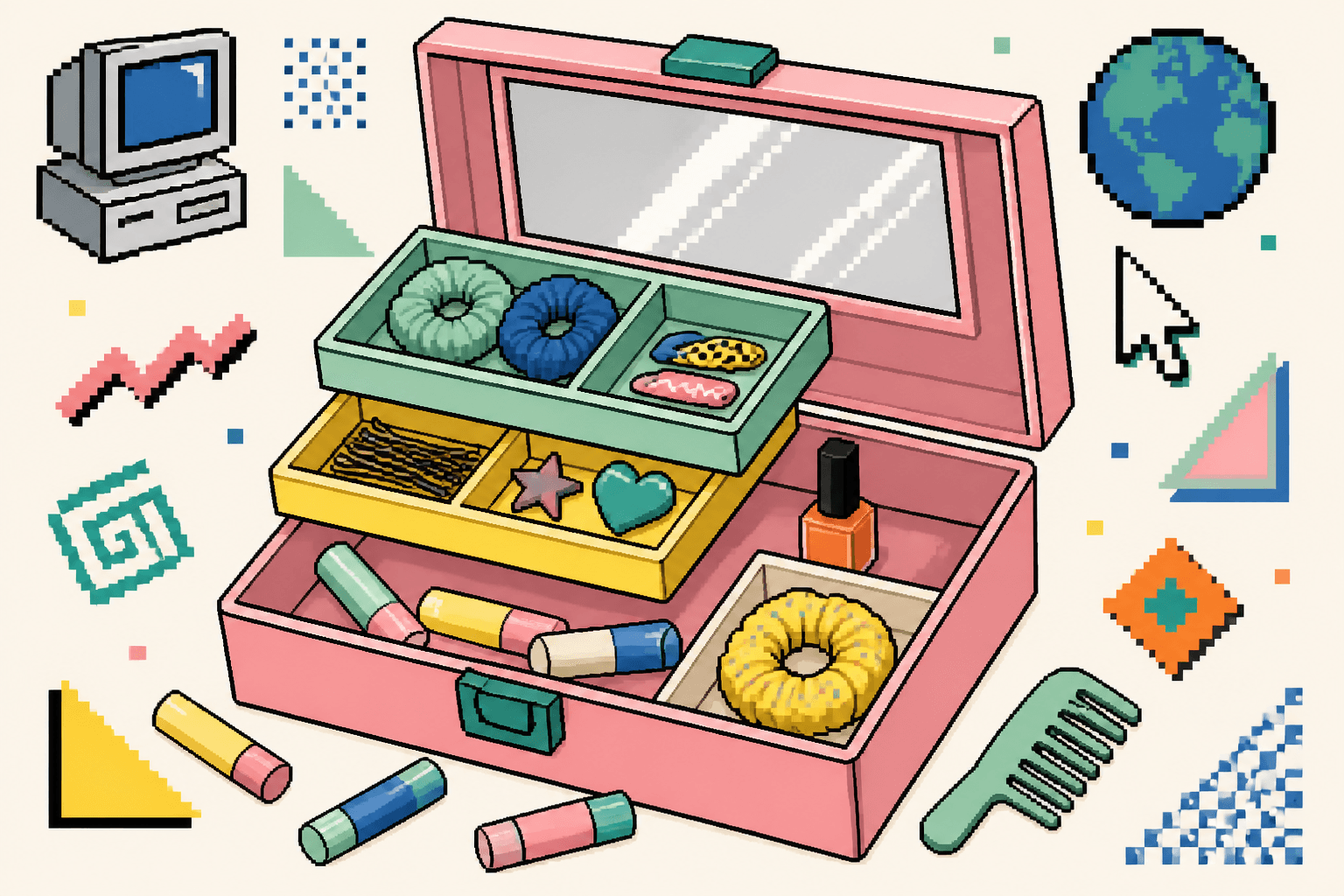
The box lived on the floor of your closet, or on top of your dresser, or on the back of the toilet in a bathroom that was shared with a brother who treated it like a hazard. It was pink, mostly. Sometimes teal. It had a plastic handle and a lid that latched with a dry click, and when you popped the latch the lid swung up on two cheap hinges and revealed a mirror on the inside, a flip-up tray with little pockets, and a main compartment the size of a shoebox, divided by removable walls into bays you did not need yet.
You had three Lip Smackers. The case had eleven slots.
The Case
The Caboodles case was a tackle box for femininity. Not a joke - a literal tackle box. The company that made them, Plano Molding, was a fishing-tackle manufacturer in Illinois, and in the mid-80s somebody there got the idea to pink the mold and sell it to girls. The engineering was identical. The compartments were sized for lures. The lid was engineered to not warp when you dropped it on the kitchen floor, which you did, and it didn't.
Mine was pink with a teal handle and teal latches, and the hinges made a specific squeak that I would still recognize in a crowd.
The whole thing was about four pounds, empty, and about four pounds and six ounces, full. Which was the problem.
The Compartments
Here is the inventory the case was built to hold.
The flip-up tray in the lid: eight small square pockets, each about an inch and a half square. These were, in the Caboodles catalog imagination, for eye shadow pots and small compacts. You did not have eye shadow pots. You put a dime in one, a hair tie in another, a Pog you were saving in a third, and a tooth in the fourth, which was the one from last Tuesday, which was for the Tooth Fairy, which you had forgotten to put under your pillow.
The main compartment, with the removable walls: it was divided, by default, into three bays and a long slot. The long slot was for brushes and liners. You did not have brushes. You had one small comb, from a Barbie, that had lost half its teeth to a dog. The three bays were for jars, bottles, and sprays. You did not have jars. You had three Lip Smackers (Dr Pepper, Strawberry, Watermelon), a Bonne Bell Lip Smacker-adjacent gloss that was more of a tube, and a tiny bottle of pearlescent nail polish from the drugstore that your mom bought you when she was feeling guilty about something.
The lid. The lid had a mirror. The mirror was not glass. The mirror was polished plastic, and even on day one it was already a little warped, so your reflection in it was wider at the forehead than at the chin, and after about three months the mirror had a scratch across it from where the latch had scraped it one time when you shut the lid wrong.
The latches: two of them, on the front, with little grey plastic tabs you pressed up with your thumbs. They clicked when they opened. They snapped when they closed. Nobody could sneak up on you if you were opening your Caboodles.
The case was built for a woman you were not. It was priced for a girl you were. The compartments were empty because the woman was years away, and the girl had three Lip Smackers.
Try It
Click the latches. Click a compartment. The compartments know what they were built for. You know what you actually put in them. These are not the same.
The Lip Smacker Collection
I need to explain Lip Smackers.
Lip Smackers were a lip balm, made by Bonne Bell, that came in a plastic tube about the size of a fat crayon, with a twist bottom that pushed the balm up a quarter inch at a time. The flavors were sweet - cherry, strawberry, Dr Pepper (yes, officially, with the Dr Pepper logo on it, under license, in 1973 going forward) - and the balm itself was waxy and slightly gritty and smelled a lot more than it tasted. You were not supposed to eat it. You ate it.
The Lip Smacker collection was the primary tenant of the Caboodles case. You collected them. Not deliberately. You acquired them. One in your stocking at Christmas. One from a party favor bag. One from the drugstore when you had leftover birthday money. By the end of fourth grade you had eight. Four of them were worn down to the plastic tube. Two of them had been in the car in July and were now sort of lopsided and sweating. One of them was Dr Pepper and nobody was ever going to use it, including you, but you kept it anyway, because Dr Pepper lip balm was a social fact you did not want to lose.
The Caboodles had a bay for them. The bay was in the main compartment, and if you stood the Lip Smackers up on their flat ends, like little pink and brown and red soldiers, the bay held sixteen of them. You had eight. You stood them up anyway, with gaps, like a mouth missing teeth.
- The eye shadow tray - catalog: eight shimmery palettes. you: a dime, a hair tie, a Pog, a baby tooth, a Lisa Frank sticker that was no longer sticky, two bobby pins, and a Chuck E. Cheese token.
- The brush slot - catalog: three professional-grade brushes with wooden handles. you: one Barbie comb missing teeth, one eraser shaped like a strawberry.
- The jar bay - catalog: night cream, day cream, serum. you: a jar of Vaseline you took from the bathroom and have not put back.
- The nail polish rack - catalog: twelve bottles, one for every outfit. you: two bottles, one of which is pearlescent white, and one of which is dried shut.
- The spray slot - catalog: perfume, setting spray, hairspray. you: a half-empty bottle of body splash from the Bath and Body Works outlet, in Cucumber Melon.
- The lid mirror - catalog: a crisp, high-fidelity surface for application. you: polished plastic with a scratch and your forehead oil on it.
The Caboodles Opened Like An Office
The thing I keep remembering is the ritual.
You did not just open the case. You set up. You sat on the carpet in your bedroom. You put the case in front of you. You popped the latches, one at a time, with your thumbs, pressing up until each one went click. You lifted the lid. You caught sight of yourself in the warped plastic mirror. You adjusted a hair that was not out of place.
Then you lifted the flip-up tray out and set it to one side.
Then you looked at the main compartment.
Then you took everything out, one item at a time, and put it on the carpet.
Then you put everything back in, in a slightly different arrangement, because the arrangement was the point. The Lip Smackers went in by flavor family (fruits together, soda flavors together, mint on its own). The scrunchies went in by color. The bobby pins went in the little pocket at the back where they were going to immediately fall through the divider wall and show up in the main compartment three weeks later. The one bottle of pearlescent nail polish went in the middle, like it was in a museum.
Then you closed the case. Then you opened it again, half an hour later, to look at the arrangement.
Nothing was happening. You were nine. You were setting up a workbench for a job that had not been offered to you yet.
The arrangement was the point. Nothing was happening. You were setting up a workbench for a job that had not been offered to you yet.
The Handle Was A Lie
The case had a handle on top. The handle was engineered, flat-looped, with little stabilizing ribs on the inside where your fingers went. The handle said: this is portable. The handle said: take me somewhere.
You never took it anywhere.
You took it to a sleepover, exactly once, when you were ten, and halfway through the three-block walk the handle started biting into your fingers and the case started feeling like it was full of bricks, which it was, if you considered Lip Smackers and nail polish and a Barbie comb and a Pog and a dime and the small jar of Vaseline you took from the bathroom to be bricks, cumulatively, which collectively they were. By the time you got to Melissa's house you had switched hands four times and your fingers had grooves in them from the plastic handle. You put the case down in Melissa's living room and never picked it up again. Melissa's mom drove it home for you the next day.
The case was portable the way a dumbbell is portable. Technically, yes. Practically, no. The handle was a lie that the catalog photo had told you, and you had believed it, because at nine you believed a lot of things that were on the covers of catalogs.
The Thing We Weren't Supposed To Notice
Here is the counter-argument.
The counter-argument is that the Caboodles was a toy. Not literally - it was marketed as organization - but functionally, it was a toy. It was a prop in a role-play about being older. The role-play was grown woman at her vanity. You did not have a vanity. You did not have grown-woman things. You had a pink plastic tackle box with a mirror in the lid, and you spent an afternoon arranging Lip Smackers in it, and this was fun. Not fun because you were being tricked. Fun because arranging small objects into labeled compartments is an inherently satisfying activity, and the box gave you an excuse to do it.
I agree with most of this. The case was not predatory. The case was a plastic shell around a very old human instinct, which is: put the small things in the small places. People have been doing this with cigar boxes and sewing kits and tool chests for a very long time. The Caboodles just made one for a child who had opinions about pink.
What I keep catching, though, is the aspiration of the compartments. The case was engineered for a life you were going to have in six years, maybe eight. The eye shadow bay was waiting for you. The brush slot was reserved. The three jar bays had names tagged on them, in your head, that you did not yet have the chemistry to fill. You could not have articulated this at nine. But the case, by having the compartments, told you something about the shape of the room you were headed for. You will have eight eye shadows. You will have three brushes. You will have a day cream and a night cream and a serum. You will have perfume. You will have a routine.
Some of this came true. Some of it didn't. The parts that came true, I am not sure I would have gotten to as fast if a pink tackle box had not been drawing me a map at nine. The parts that didn't - the lid mirror, specifically, with its warped plastic making your forehead wider than your chin - I think the parts that didn't come true were the parts the mirror was quietly lying about on purpose, so a nine-year-old would look in it and see more than she had, and then grow into it.
The compartments were a map. The map was pointing at a room you weren't in yet. Some of the rooms were real. Some of the rooms were drawn for a girl who wasn't going to live there.
What Was Actually In Mine
If I open the case now - and the case is, somewhere, in a plastic bin in my parents' basement, I would bet money on it - I know exactly what I will find.
I will find three Lip Smackers, all expired, two of them cracked. I will find a crumpled friendship bracelet that I meant to give to somebody and did not. I will find a note on binder paper, folded into a triangle, that I never opened because I was told who it was from and I was not sure yet how I felt about it. I will find a dime. I will find a quarter. I will find a jar of Vaseline, half full, that at some point was definitely going to be used for something, and the something never came. I will find a Chuck E. Cheese token. I will find the one bottle of pearlescent nail polish, dried shut, with a brush that is fused to the inside of the lid.
I will not find the eye shadow. I will not find the serum. I will not find the three professional-grade brushes with wooden handles. The compartments for those will be empty, which is how they started, and which is how they stayed. The compartments are not the problem. The compartments were doing their job. The compartments were holding a space, patient and plastic, for a life that was arriving at its own pace.
The latches still click. The hinges still squeak. The mirror in the lid is still a little warped, so if you look at yourself in it today, at thirty-whatever, you still look like your forehead is wider than your chin, and you still look, a little bit, like a nine-year-old on the carpet of her bedroom, arranging Lip Smackers by flavor family and talking to herself about a day that was coming.