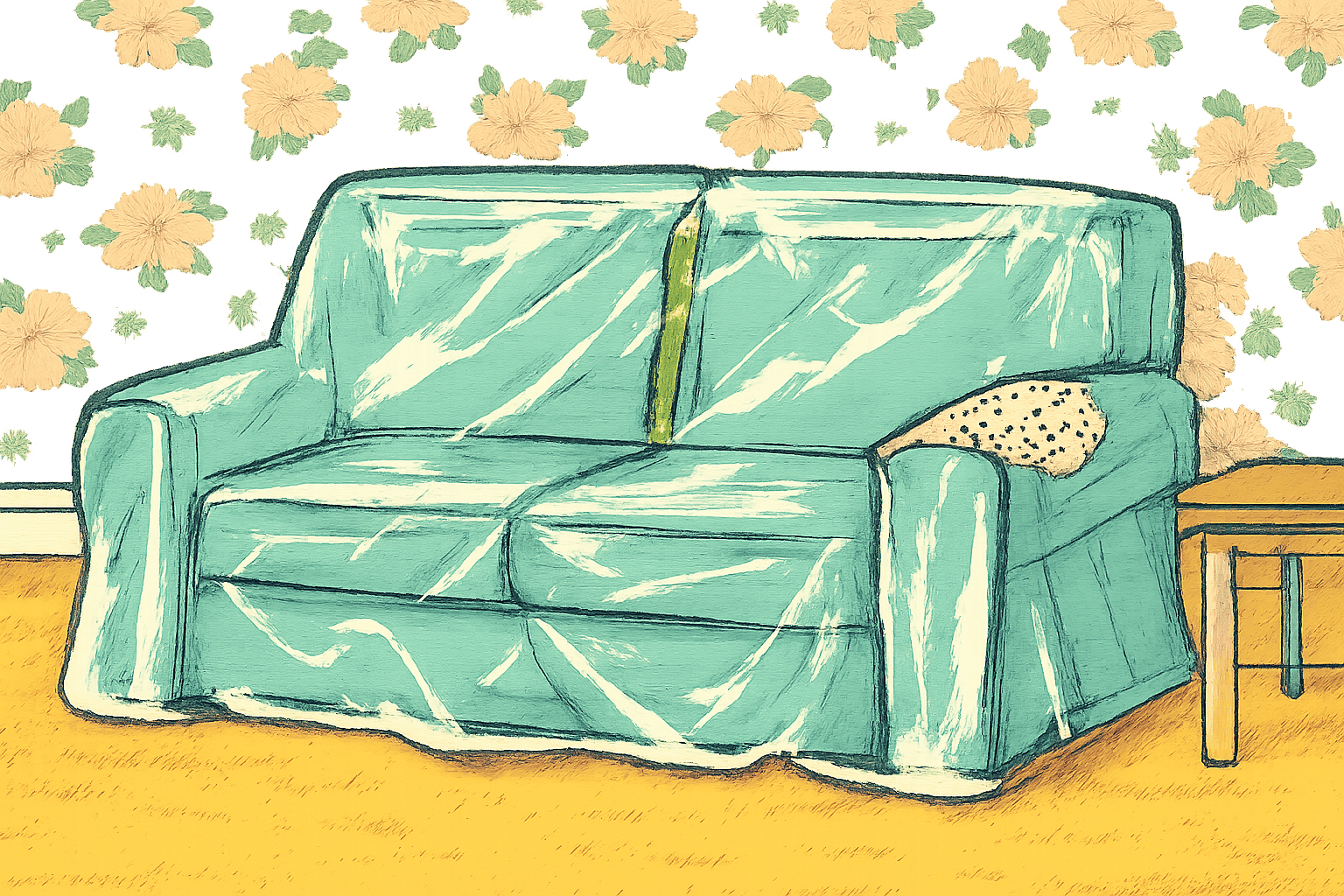
The first thing you heard when you sat down at your grandma's house wasn't hello. It was the couch. A long, slow crinkle - like someone carefully unwrapping a piece of hard candy during a church service - that announced your presence to every room in the house. You didn't sit on that couch so much as you made a pact with it. You pressed down, it pressed back, and somewhere between your body and the floral upholstery beneath was a quarter inch of clear vinyl that neither of you had agreed to.
The plastic was always there. Not on all the furniture. Just the good furniture. The couch in the living room - not the den, never the den, the den had a corduroy sectional that smelled like your grandfather's pipe and that was fine. But the living room couch, the one facing the china cabinet with the commemorative plates, that couch was sealed like evidence at a crime scene.
The Logic Was Airtight
The couch was too nice to sit on, so it was covered in something terrible to sit on, so that someday someone could sit on it nicely. That someone never came.
Your grandmother's reasoning, if she ever explained it, went something like this: the couch was expensive. The couch was beautiful. The couch had a pattern - usually floral, sometimes geometric, always in a color palette that could only be described as aggressive mauve - and that pattern needed to be preserved. For whom? For what occasion? These were not questions you were supposed to ask. You were supposed to sit down, crinkle, and accept.
The plastic was protecting the fabric from the very people who lived in the house. Which meant the couch existed in a permanent state of being saved for later. It was furniture as theory. A sitting surface you could see but never truly experience. Like a museum exhibit you happened to live near.
The Summer Equation
In winter, the plastic was merely uncomfortable. Cool to the touch, a little stiff, vaguely clinical - like sitting in a waiting room for an appointment that was your entire childhood. You could wear pants and survive. You could put a throw pillow behind your back and negotiate a truce with the vinyl.
But summer changed everything.
In summer, with bare legs, the plastic became a device. You'd sit down and feel it grip - not stick, grip - like the couch had been waiting for exposed skin and finally got its chance. The backs of your thighs would make contact and immediately begin a process that was part adhesion, part suction, part something science hasn't fully named. You were bonded to that couch at a molecular level.
- The Initial Sit - A deep, full-body crinkle, like stepping on a bag of chips in slow motion
- The Shift - A squeaky protest when you tried to get comfortable
- The Lean - A long, drawn-out vinyl groan as you reached for the remote
- The Summer Peel - The unmistakable sound of bare skin separating from plastic, like pulling tape off a gift
- The Stand-Up - A rapid-fire crackle, your body departing in stages
Standing up was the real event. You'd peel yourself off the couch one body part at a time, and each separation produced a sound that carried. Your grandmother in the kitchen could hear you stand up. The neighbors could probably hear you stand up. It was the sound of skin releasing from a surface that had no business touching skin, and it happened every single time, and nobody ever said maybe we should remove the plastic.
The Preservation Paradox
Here's what got me, even as a kid. The plastic was there to keep the couch pristine. But the plastic itself was never pristine. It yellowed. It cracked at the seams where people sat most often. It developed a particular kind of wrinkle - not fabric wrinkles, but stiff vinyl creases that would never smooth out, like the couch was aging in its own parallel way underneath the thing meant to stop it from aging.
The plastic aged faster than the thing it was protecting. It was a shield that took the damage and showed every scar.
And the edges. The plastic was always tucked under the cushions in a way that suggested someone had installed it with great care and moderate fury. You'd reach between the cushions for a dropped quarter and find the border where the vinyl ended and the real couch began - a strip of the original fabric that felt impossibly soft compared to what you'd been sitting on. A glimpse of the couch's true self, hidden like a secret.
Sometimes, on very special occasions - and I mean occasions that involved someone from outside the family entering the house, someone who needed to be impressed - your grandmother would remove the plastic. Just temporarily. And the couch would sit there, naked and perfect, the floral pattern undimmed, the cushions uncrinkled, looking exactly like the day it was bought. You'd sit on it and feel fabric against your legs and think this is what rich people must feel all the time.
Then the guests would leave and the plastic would go right back on.
It Wasn't Just Your Grandma
The thing is, it was everywhere. Your friend's abuela had it. Your neighbor's nonna had it. The specific grandmothers varied, but the impulse was universal - a generation of women who had grown up with less deciding that certain objects would be protected from the entropy of daily use, even if that protection made daily use actively unpleasant.
There was something almost religious about it. The couch was sacred. The plastic was the barrier between the sacred and the profane, which in this case meant your cousin who spilled Kool-Aid on everything and your uncle who fell asleep with his shoes on. The plastic existed because the world could not be trusted with the couch, and honestly, looking at your uncle, your grandmother had a point.
The Couch Is Probably Still Perfect
She's gone now, or she's moved to a smaller place, or the couch finally went to Goodwill after thirty-two years of immaculate imprisonment. But wherever that couch is, I promise you the fabric is flawless. Not a stain. Not a fade mark. Not a single thread out of place. The plastic did its job. The couch was saved.
Nobody's sure what it was saved for. But it was saved.
And if you close your eyes, you can still hear it. That crinkle. That slow vinyl exhale as you lowered yourself onto a couch that was beautiful and untouchable and yours to visit but never to know. Your grandmother handing you a glass of ginger ale with a coaster - a coaster, on a table that also had a protective pad - and telling you to be careful. You were always careful. Everyone was always careful. The couch demanded it. The plastic made sure.